
Key Takeaway for B2B Buyers
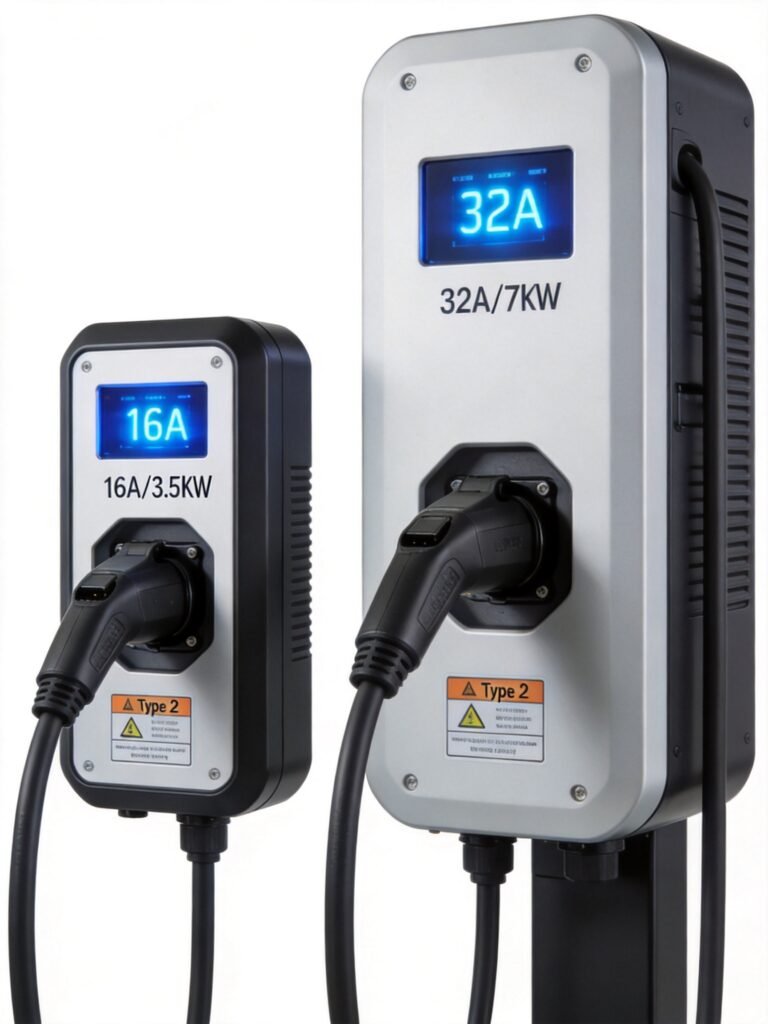
In 2026, 32A (7.4kW) portable chargers account for 65% of European B2B sales, driven by newer BEVs with larger batteries and 7.4kW onboard chargers. However, 16A (3.7kW) remains essential for Southern/Eastern European markets with older grid infrastructure.
16A vs 32A Portable EV Charger: How to Choose the Right Power Level for Your European Market in 2026
Portable EV chargers have become an essential product category for European charging equipment distributors, automotive aftermarket retailers, and fleet operators. Among the most common procurement questions we receive is: should you stock 16A or 32A models — or both? This selection guide breaks down the technical specifications, use-case requirements, and market demand factors that determine which power level fits each customer segment.
European Market Fast Read
Battery-electric vehicle registrations across 13 reporting EU Member States reached 238,897 units in June 2026, a 41.5% year-on-year increase, with BEVs capturing 25.3% of new passenger-car registrations. Publicly accessible recharging infrastructure reached 1,170,493 points across Europe. For B2B buyers, this means surging demand for portable EV charging equipment that bridges the gap between public fast chargers and home charging needs.
Technical Specifications: 16A vs 32A at a Glance
Both 16A and 32A portable EV chargers operate under the IEC 61851-1 standard for electric vehicle conductive charging systems. The key differences lie in power output, circuit requirements, and charging speed:
| Specification | 16A Portable Charger | 32A Portable Charger |
|---|---|---|
| Power Output | 3.5 kW (230V × 16A) | 7.4 kW (230V × 32A) |
| Circuit Requirement | Standard 20A household circuit | Dedicated 40A circuit required |
| Cable Cross-Section | 3 × 2.5 mm² | 3 × 6 mm² |
| Weight (5m cable) | ~3.0–3.5 kg | ~4.5–5.5 kg |
| Charging Speed (60 kWh battery) | ~17 hours (0–100%) | ~8 hours (0–100%) |
| Typical Charging Mode | Mode 2 (IC-CPD) | Mode 2 or Mode 3 |
| Connector Standard | Type 2 (IEC 62196-2) | Type 2 (IEC 62196-2) |
| CE/UKCA Certification | Required | Required |
The 16A model draws power from a standard European household socket (Schuko or UK 3-pin), making it truly plug-and-play. The 32A model requires a dedicated higher-amperage circuit — typically installed by a certified electrician — but delivers double the charging speed.
Use-Case Analysis: Which Power Level Fits Each Customer?
16A Portable Charger — Ideal For:
- Emergency/top-up charging: Drivers who need a lightweight, always-in-the-trunk backup solution for unexpected situations
- Overnight trickle charging: PHEV owners (battery 10–20 kWh) who can fully recharge in 3–6 hours at 3.5 kW
- Rental and car-sharing fleets: Portable units included with vehicle handover for customers without dedicated home charging
- Workplace supplementary charging: Offices with standard socket infrastructure that cannot support high-amperage circuits
- Multi-market distribution: Standard household compatibility across all European countries without electrical modifications
32A Portable Charger — Ideal For:
- Daily BEV charging at home: Full-size EV owners (battery 50–80 kWh) who need overnight charging completion within 8–10 hours
- Commercial fleet operations: Delivery vans and service vehicles that require faster turnaround between shifts
- Aftermarket upgrade segment: Customers who started with a 16A unit and want faster charging without installing a wallbox
- Semi-permanent installation: Users who mount the unit in a garage with a dedicated 40A circuit, combining portable flexibility with wallbox-level performance
- Premium retail positioning: Higher-margin product for specialist EV accessory retailers
Electrical Infrastructure Considerations for B2B Buyers
When advising end-users or specifying products for your catalog, the installation requirements differ significantly between the two power levels:
16A models can connect to any standard European household outlet rated at 16A or above. In most EU countries, residential circuits are rated at 16A or 20A, making these units universally compatible. No electrician visit is needed. The EAFO July 2026 data shows that with over 1.17 million public charging points across Europe, many BEV owners still rely on home charging for daily use — and not all residences have dedicated EV circuits.
32A models require a dedicated circuit with minimum 6 mm² cable cross-section and a 40A MCB (Miniature Circuit Breaker). For Mode 3 installations, the EVSE must communicate with the vehicle via the Control Pilot (CP) PWM signal per IEC 61851-1. This means your technical support team should be prepared to guide customers through electrical requirements — or partner with local electrician networks.
A practical recommendation: many OEM/ODM customization programs now offer adjustable-current models that can switch between 10A/13A/16A/32A via a dial or app control. These adjustable units reduce SKU complexity for distributors while serving multiple customer segments.
Market Demand Signals: What European Buyers Are Ordering
Based on our export order data and industry analysis, European B2B procurement patterns for portable EV chargers show clear segmentation:
- Automotive aftermarket retailers tend to order 60% 16A + 40% 32A, reflecting the broad consumer base
- EV specialist retailers shift toward 50/50 or even 40% 16A + 60% 32A, as their customers are committed BEV owners
- Fleet operators overwhelmingly prefer 32A for daily-use vehicles, with 16A reserved for PHEVs and emergency kits
- Supermarket and retail chain buyers favor 16A models for impulse-purchase price points and universal compatibility
- Car rental and car-sharing companies order 16A units almost exclusively, paired with each vehicle
The smart charging trend also influences product selection. A pilot project in the Dutch province of Gelderland, involving 12,000 public charging points, is now testing financial incentives for grid-friendly charging times — a model that could extend to home charging equipment. Portable chargers with adjustable current and smart scheduling capabilities are positioned to benefit from this trend, as they can reduce charging power during peak grid hours.
5-Point Procurement Checklist for B2B Buyers
- Certification compliance: Verify CE/UKCA marking, IEC 61851-1 and IEC 62196-2 conformity, RoHS and REACH material compliance. For the UK market, UKCA certification is mandatory. Confirm your supplier holds IATF 16949 automotive-grade quality management.
- Adjustable current capability: Models with 10A/13A/16A/32A switchable output serve wider customer segments and reduce inventory complexity.
- Cable specification: Ensure 32A models use 3 × 6 mm² cables with H07BQ-F or equivalent TPU/TCPSHE jacket for outdoor temperature resistance (-30°C to +50°C).
- Protection features: Both power levels must include over-current protection, RCD (Type A + 6mA DC residual current), over-temperature shutdown, and surge protection. Verify terminal temperature rise stays below 50K at rated current.
- OEM customization: Confirm the supplier can customize branding, cable length (3m/5m/7.5m/10m options), connector type (Type 2 for EU, Type 1 for legacy markets), and packaging to your specifications.
With Europe’s BEV market now exceeding 25% of new car registrations and charging infrastructure continuing to expand, portable EV chargers remain a high-growth product category. Whether you choose 16A, 32A, or both, partnering with a certified manufacturer that offers flexible OEM/ODM services and 7–15 day delivery ensures you can respond quickly to market demand.
Get in Touch with ChuangRui
Chat on WhatsApp — +86 13757774567 — Quick questions? Our team replies within 2 hours.
https://wa.me/8613757774567
Request our certification package
Contact us to receive CE, UKCA, UL, IATF 16949 and ISO 9001 documentation
Request a quote — 24h response
Submit your specifications and receive a competitive quotation within 24 hours
Visit our product catalog or learn more about our factory at About ChuangRui.
#EVCharger #PortableEVCharger #16A32A #OEM #B2B #EVChargingEquipment #ChargingGun #EuropeanMarket
📚 References
Frequently Asked Questions
❓ What is the current market split between 16A and 32A chargers in Europe?
In 2026, 32A portable chargers account for approximately 65% of B2B sales in Western/Northern Europe, while 16A models remain dominant (55–60%) in Southern and Eastern European markets where older electrical infrastructure limits available amperage.
❓ Why is the market shifting toward 32A chargers?
New BEV models have larger batteries (60–80kWh) and support 7.4kW onboard charging, making 16A chargers too slow for daily use. Additionally, European home electrical upgrades increasingly support 32A circuits, removing the infrastructure barrier.
❓ Can a single charger model serve both 16A and 32A markets?
Yes — dual-mode chargers with automatic current detection (switching between 16A and 32A) are the optimal solution. These simplify distributor inventory while covering both market segments. Look for models with DIP switch or auto-detection capability.
❓ What is the price premium for 32A over 16A portable chargers?
Typically 15–25% higher unit cost for 32A models, due to heavier cables (6mm² vs 2.5mm²), higher-rated components, and enhanced thermal management. The retail price premium is usually 20–30%, offering healthy margin uplift.
❓ Which regions should prioritize 16A chargers in 2026?
Southern Europe (Italy, Spain, Portugal, Greece) and Eastern Europe (Poland, Romania, Bulgaria) still have significant populations of homes with only 16A circuits. For these markets, 16A chargers remain the volume product, while 32A is the premium upsell.

About the CREVCC Engineering Team
Our engineering team brings 12+ years of experience in EV charging system design, from PCB layout and power electronics to international certification compliance. We design and manufacture portable EV chargers, charging guns, and V2L discharge equipment for B2B partners across Europe, North America, and Southeast Asia.


