
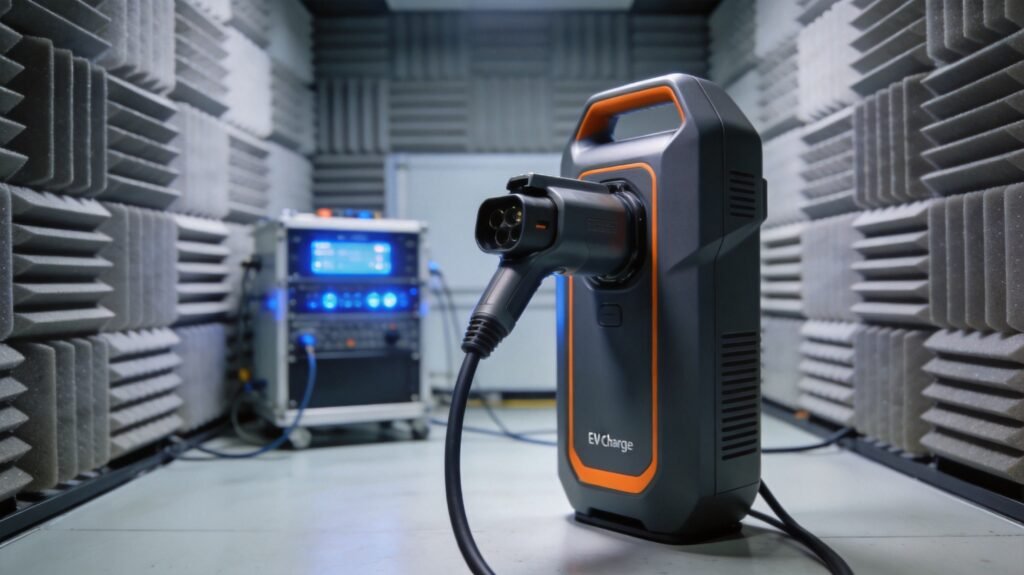
EMC Compliance for EV Charging Equipment in 2026: What European Buyers Must Verify Before Q4
Key Takeaway for B2B Buyers
Starting Q4 2026, IEC 61000-6-3:2026 and EN 61000-6-4:2026 tighten emission limits for EV charging equipment. B2B buyers must verify EMC test reports from accredited labs — not self-declarations — before placing bulk orders.
European Market Update: The IEC released IEC 61000-6-3:2026 in April, replacing the 2020 version, while CEN/CENELEC published EN 61000-6-4:2026 in July. Both standards tighten electromagnetic compatibility (EMC) requirements for electrical equipment, including portable EV chargers. Industry sources report that EU importers must complete product reassessment and technical file updates by October 1, 2026.
For distributors and procurement managers sourcing portable EV chargers, charging guns, and discharge equipment for the European market, EMC compliance has moved from a back-of-spec-sheet checkbox to a front-line procurement risk. The standards landscape is shifting quickly, and products that cleared CE marking six months ago may not meet the latest harmonised standards referenced under the EMC Directive 2014/30/EU.
This article explains what is changing, why it matters for portable EV charging equipment, and how to verify that your supplier’s products remain compliant through Q4 2026 and beyond.
Why EMC Matters for Portable EV Chargers
Electromagnetic compatibility is not an abstract engineering concern. A portable EV charger that fails EMC testing can emit radio-frequency interference that disrupts nearby electronics — from residential Wi-Fi routers to medical equipment in apartment buildings. Conversely, a charger with poor immunity may reset or malfunction when exposed to electromagnetic noise in industrial environments or at public charging locations.
For European buyers, EMC compliance is a legal requirement under the EMC Directive 2014/30/EU. Any apparatus placed on the EU market must satisfy two fundamental conditions:
- Emission control: The equipment must not generate electromagnetic disturbance exceeding levels that allow radio and telecommunications equipment or other apparatus to operate as intended.
- Immunity: The equipment must be expected to operate as intended without degradation in the presence of electromagnetic disturbance to which it is liable to be exposed during normal use.
Portable EV chargers are particularly affected because they combine high-current power switching (often using high-frequency semiconductor devices) with compact form factors and residential use cases. Unlike fixed wallboxes installed by qualified electricians, portable chargers are plugged into standard sockets by end users, making EMC performance in home environments a critical safety and reliability factor. For more details, explore our guide on EV charging connector standards. To learn more about this topic, see our article on CE marking for EV chargers.
What Changed in 2026: Key Standard Updates
IEC 61000-6-3:2026 — Emission Standard for Residential Environments
On April 7, 2026, the International Electrotechnical Commission (IEC) officially released IEC 61000-6-3:2026, fully replacing the 2020 version. This is the core generic emission standard for electrical and electronic equipment in residential, commercial, and light-industrial environments — exactly the environments where portable EV chargers are most commonly used.
The 2026 revision introduces several changes that directly affect EV charging equipment:
- Expanded low-frequency conducted emission test bands: The previous version focused on 150 kHz to 30 MHz. The 2026 standard extends testing coverage at lower frequencies, where high-frequency switching power supplies in modern chargers generate harmonic content.
- Stricter magnetic field emission requirements: New magnetic emission testing from 9 kHz to 30 MHz addresses leakage from inductive components and charging coils — relevant for chargers with high-current transformers and coils.
- Updated measurement methods: The revision aligns testing procedures with the latest CISPR practices and addresses the challenges posed by wide-bandgap semiconductor technologies (SiC and GaN) that switch at much higher frequencies than traditional silicon devices.
EN 61000-6-4:2026 — Industrial Emission Standard
On July 7, 2026, CEN/CENELEC released EN 61000-6-4:2026, adding high-frequency harmonic emission limits and new test layout requirements for power semiconductor modules, including those based on SiC and GaN technologies. This standard applies to equipment used in industrial environments — relevant for distributors supplying fleet depots, logistics centres, and commercial charging installations.
The mandatory application date for industrial-grade and automotive-grade power modules is October 1, 2026. While portable EV chargers primarily fall under the residential standard (EN 61000-6-3), chargers marketed for commercial or industrial use may need to demonstrate compliance with both standards depending on their intended application.
IEC 61851-21-2: The Product-Specific EMC Standard for EV Charging
Beyond the generic standards, EV charging equipment has its own dedicated EMC requirement: IEC 61851-21-2:2018, which defines EMC requirements for off-board electric vehicle charging systems. This standard covers conductive power transfer equipment with rated input voltage up to 1,000 V AC or 1,500 V DC — encompassing the entire category of portable AC EV chargers.
IEC 61851-21-2 specifies both emission limits and immunity requirements tailored to the unique characteristics of EV charging systems, including:
- Conducted and radiated emission limits for charging modes 2 and 3
- Immunity to electrostatic discharge (ESD), electrical fast transients (EFT), surge, and voltage dips
- Specific test configurations that account for the vehicle-charger connection
For CE marking purposes, compliance with the product-specific standard (IEC 61851-21-2) takes precedence over generic standards, but the generic standards (IEC 61000-6-3, IEC 61000-6-4) still apply for aspects not covered by the product standard. The IEC 61000-4-20 TEM waveguide testing methodology is one of the referenced test methods used for radiated emission and immunity measurements.
How the New Standards Affect Your Supply Chain
The 2026 standard revisions create three concrete risks for European distributors:
1. Existing CE Declarations May Need Updating. When harmonised standards are revised, manufacturers and importers must assess whether existing test reports and Declarations of Conformity still cover the new requirements. If a charger was tested against IEC 61000-6-3:2020, the 2026 version may introduce test clauses that were not previously evaluated. The EU approach is that CE marking attests compliance at the time of placement on the market — but once a new harmonised standard is cited in the Official Journal, relying on the superseded version becomes increasingly difficult to defend during market surveillance.
2. Test Laboratory Lead Times Are Extending. Accredited EMC laboratories across Europe and Asia are reporting increased demand as manufacturers rush to retest products against the new standards. For importers, this means that scheduling retesting in Q3 2026 is essential — waiting until Q4 could result in delayed shipments or products held at customs while awaiting updated documentation.
3. Wide-Bandgap Semiconductor Scrutiny Is Increasing. The growing use of SiC and GaN power devices in next-generation chargers offers higher efficiency and smaller form factors, but these components switch at much higher frequencies and generate different EMI profiles than traditional silicon. The 2026 standard updates explicitly address this technology shift. Buyers should confirm whether their supplier’s chargers use SiC or GaN components and whether EMC testing covers the higher-frequency emissions these devices produce.
EMC Compliance Checklist for EV Charger Buyers
When evaluating a portable EV charger supplier for the European market, request and verify the following EMC documentation:
- EC Declaration of Conformity (DoC): Must explicitly reference the EMC Directive 2014/30/EU and list the harmonised standards applied. Check that the standard versions are current — a DoC citing only the 2007 or 2020 version may not reflect the latest requirements.
- EMC Test Report: Request the full test report from an accredited laboratory (ISO/IEC 17025 certified). Verify that the report covers both emissions and immunity testing, and that the product model tested matches the product you intend to purchase — including cable length, enclosure material, and any optional accessories.
- IEC 61851-21-2 Compliance: Confirm that the charger has been tested to the product-specific EMC standard for EV charging systems, not just the generic residential standard.
- Residual Current Device (RCD) Performance: While not strictly an EMC requirement, Type B residual current protection (AC 30 mA and DC 6 mA) is required under European installation standards and interacts with EMC performance. Ensure the charger RCD does not nuisance-trip due to electromagnetic interference.
- Technical File Retention: The manufacturer must maintain the technical file supporting the CE Declaration for at least 10 years after the last product is placed on the market. Confirm that your supplier can provide this documentation on request from EU market surveillance authorities.
- Cable and Connector EMC: The charging cable itself can act as an antenna for both emissions and immunity. Verify that EMC testing was conducted with the actual cable configuration supplied with the product, including maximum cable length.
What ChuangRui Does Differently
At ChuangRui, EMC compliance is engineered into our portable EV chargers from the design stage, not added as a final testing checkpoint. Our full product range — including Type 2 portable chargers, V2L discharge guns, and dual-head charging solutions — is tested to IEC 61851-21-2 and the latest applicable EMC standards by accredited third-party laboratories.
We maintain complete technical files for every product variant, including detailed EMC test reports that specify cable configurations, enclosure materials, and component selections. Our engineering team continuously monitors updates to harmonised standards and proactively schedules retesting when standards are revised — so our distribution partners do not face compliance gaps during regulatory transitions.
Explore our full product range on the products page, or learn how we support custom branding and specification through our OEM/ODM services. For a complete overview of our certification portfolio, visit our certifications page.
Key Takeaways for Q4 2026
The EMC standard landscape for EV charging equipment is tightening, and European buyers who proactively verify supplier compliance will avoid shipment delays, customs issues, and potential product recalls. Here is what to do now:
- Audit your current supplier EMC documentation against the latest standard versions before placing Q4 orders.
- Confirm that IEC 61851-21-2 testing covers your exact product configuration, including cable length and accessory options.
- Ask about SiC/GaN component use and whether EMC testing addresses higher-frequency emissions from wide-bandgap devices.
- Verify technical file availability for market surveillance response — your supplier should be able to produce documentation within days, not weeks.
EMC compliance is not just a regulatory burden — it is a quality signal. Chargers that pass rigorous EMC testing are more reliable in the field, generate fewer warranty returns, and protect your brand reputation in a competitive European market.
Talk to Us
Chat on WhatsApp — +86 13757774567 — Quick questions? Our team replies within 2 hours.
Request our certification package — Full CE, UKCA, UL, RoHS, REACH, and IATF 16949 documentation for your review.
Request a quote — 24h response. Factory-direct pricing with OEM/ODM customization available.
Learn more about ChuangRui and our manufacturing capabilities.
#EVCharger #EMCCompliance #CECertification #EVCharging #OEM #B2B #PortableEVCharger
📚 References
Frequently Asked Questions
❓ What is EMC compliance and why does it matter for EV chargers?
EMC (Electromagnetic Compatibility) ensures your EV charger neither emits excessive electromagnetic interference nor is susceptible to external interference. Non-compliant chargers can disrupt nearby electronics and fail customs inspection in the EU.
❓ What changed in the 2026 EMC standards for EV charging equipment?
IEC 61000-6-3:2026 and EN 61000-6-4:2026 tighten conducted and radiated emission limits, particularly in the 150kHz–30MHz range. Chargers with switch-mode power supplies must now meet stricter harmonic current limits.
❓ How can B2B buyers verify EMC compliance before ordering?
Request test reports from ISO 17025-accredited labs (TÜV, SGS, Intertek, or Chinese labs with CNAS accreditation recognized by ILAC mutual recognition). Self-declarations or in-house test reports are not accepted by EU notified bodies.
❓ What happens if imported EV chargers fail EMC testing at the border?
Market surveillance authorities can seize the shipment, issue fines, and require recall. The importer (not the manufacturer) bears legal liability under the EU EMC Directive 2014/30/EU.
❓ Do EV chargers need both conducted and radiated EMC testing?
Yes. Conducted emissions (150kHz–30MHz via power cord) and radiated emissions (30MHz–1GHz via air) are both tested. For chargers with wireless modules (WiFi, Bluetooth, 4G), additional band-specific testing applies under the RED Directive.

About the CREVCC Engineering Team
Our engineering team brings 12+ years of experience in EV charging system design, from PCB layout and power electronics to international certification compliance. We design and manufacture portable EV chargers, charging guns, and V2L discharge equipment for B2B partners across Europe, North America, and Southeast Asia. Every article reflects hands-on engineering knowledge — not marketing copy.


