
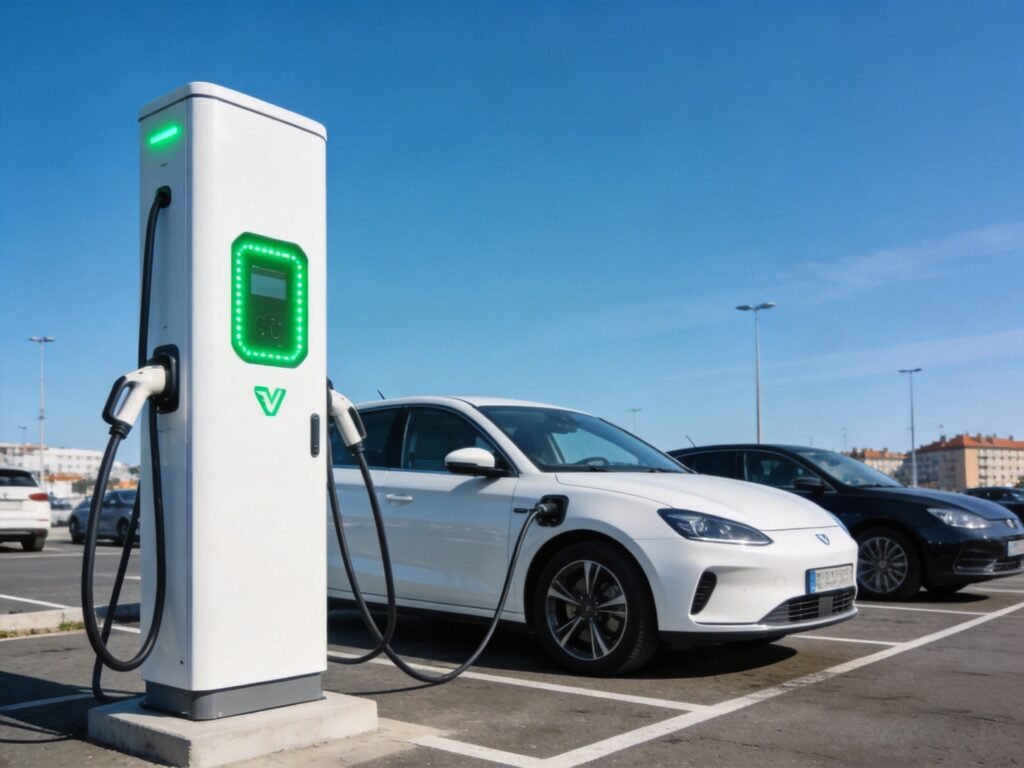
The European Union is on the verge of significantly simplifying how charging stations get approved and built. In early July 2026, the European Parliament’s Industry and Energy Committee voted overwhelmingly (57 votes in favour, 3 against, 8 abstentions) to support a set of measures under the EU Grid Package that could dramatically cut red tape for EV charging infrastructure deployment across the continent.
For charge point operators (CPOs), investors, and fleet managers planning to expand across European markets, these proposed regulatory changes represent one of the most important developments in years. Here’s what you need to know.
What Is the EU Grid Package?
The EU Grid Package is a broad legislative initiative first proposed by the European Commission in December 2025. Its core objective is to accelerate the approval and construction of electricity grids, renewable energy projects, energy storage facilities, and EV charging stations across all 27 member states.
The context is clear: Europe’s electricity grids span over 11 million kilometres, yet they suffer from ageing infrastructure, insufficient capacity, and permitting procedures that can stretch up to a decade for transmission networks and up to nine years for renewable projects depending on the country and technology. These delays directly slow down the deployment of public charging infrastructure, which the EU desperately needs to meet its climate targets.
Under the Alternative Fuels Infrastructure Regulation (AFIR), the EU has set a binding target of 3.5 million public charging points by 2030. As of early 2026, Europe has approximately 800,000 publicly accessible chargers — meaning the continent needs to add roughly 2.7 million more in the next four years. The current permitting bottlenecks make that target nearly impossible without regulatory intervention.
Key Proposed Changes for Charging Stations
The European Parliament’s committee has put forward several specific proposals that would directly affect how EV charging infrastructure is permitted and built:
- Higher permit threshold: The capacity threshold triggering mandatory permit requirements would rise from 100 kW to 200 kW for small solar installations, energy storage systems, and charging stations. This means many mid-range charging installations that previously required full administrative approval would now be exempt.
- No permit for stations up to 1 MW on artificial structures: Perhaps the most impactful proposal, charging stations with a total installed capacity of up to 1 megawatt built on “artificial structures” — a term the Greens interpret to include motorway service areas, highway rest stops, and already-sealed or built-up areas — would no longer require any administrative permit at all.
- Strict approval deadlines: Grid connection and permit procedures would be limited to a maximum of three months for charging stations up to 1 MW and six months for larger installations. If authorities fail to issue a decision within the deadline, the project would be automatically approved (a concept known as tacit approval).
- Single digital portal: Every member state would be required to establish a unified national digital portal covering all permitting steps, eliminating the current fragmented process where applicants must navigate multiple agencies and paper-based systems.
Why Permitting reform is critical
Industry data paints a stark picture of the challenge. According to market analysis, roughly 30 to 40 percent of planned high-power charging projects in the EU currently face grid connection delays of 18 to 36 months, particularly in suburban and highway-adjacent zones where transformer capacity is already exhausted. These delays push up total project costs and create significant financing uncertainty.
The problem is especially acute for heavy-duty transport corridors. Electric trucks require high-power chargers (often 350 kW or more per unit), predictable site availability, and fast approval processes. When permitting takes years rather than months, it becomes a major brake on the entire electrification of commercial road transport.
For charging hardware manufacturers and their B2B customers, permitting delays translate directly into longer sales cycles, delayed revenue, and higher project risk. Streamlined approvals would allow operators to deploy equipment faster and scale their networks more efficiently.
What Happens Next: Trilogue Negotiations
While the Parliament’s position is ambitious, nothing is final yet. The EU’s legislative process requires agreement between three institutions: the Parliament, the Commission, and the Council (representing member states).
The Council has already adopted its own position, which is notably less ambitious than the Parliament’s. Member states are advocating for longer review periods, more national flexibility, and opposing the automatic approval mechanism. Green Party MEP Michael Bloss, the lead negotiator on the file, has publicly criticised the Council for “watering down” the acceleration approach.
Trilogue negotiations are expected to begin under the Irish Presidency of the Council. The final text will likely reflect a compromise between the Parliament’s ambitious timeline and the Council’s more cautious approach. Even a watered-down version, however, would still represent a meaningful improvement over the current system.
How Charging Operators and Investors Should Prepare
Even before the final legislation is passed, forward-looking operators and investors should take action:
- Pipeline planning: Identify sites along the TEN-T network and motorway corridors where charging deployment could be accelerated once permitting thresholds change. Early movers will secure prime locations before competition intensifies.
- Equipment selection: Ensure your charging hardware is OCPP 2.0.1 compliant, MID-certified for revenue-grade metering, and ready for CE marking under current EU technical standards (IEC 61851, IEC 15118). With faster deployment timelines, having pre-certified equipment is a decisive advantage.
- Grid connection readiness: Begin early dialogue with local distribution system operators (DSOs) about grid capacity at target sites. Transformer lead times of 12-18 months for 250-630 kVA units remain a bottleneck regardless of permitting reform.
- V2G readiness: By 2027, an estimated 40-50 percent of high-power charger tenders in the EU are expected to require V2G-capable hardware. Investing in bidirectional charging-ready equipment now positions you for upcoming procurement requirements.
The Bigger Picture: EU’s Charging Infrastructure Ambitions
The permit reform is one piece of a larger puzzle. The EU’s charging infrastructure buildout is entering what market analysts call a “deployment super-cycle,” driven by AFIR mandates, national zero-emission vehicle targets, and corporate fleet decarbonisation requirements. Ultra-fast DC charging (150 kW and above) now accounts for roughly 35-40 percent of all new public charging investments.
At the same time, over half of all DC charger modules and power conversion units sold in Europe are sourced from outside the EU, primarily from China. This creates both opportunity and supply chain risk for operators. Choosing a reliable manufacturing partner with proven EU certification experience is more important than ever.
Conclusion: A Window of Opportunity for the EV Charging Industry
The EU Grid Package represents a genuine opportunity to remove one of the most persistent barriers to charging infrastructure deployment. If the final legislation retains even a portion of the Parliament’s proposed reforms, we could see a meaningful acceleration of charging station construction across Europe by late 2026 or early 2027.
For charging operators, investors, and fleet managers, the message is clear: the regulatory landscape is changing fast, and those who prepare now — with compliant equipment, strategic site selection, and proactive grid planning — will be best positioned to capitalise on Europe’s charging infrastructure boom.
ChuangRui is a professional manufacturer of EV charging equipment with full EU certification, including CE marking, OCPP 2.0.1 compliance, and MID-certified metering. Our product range spans AC wallboxes, DC fast chargers, and ultra-high-power charging solutions designed for the European market. Contact us today to discuss how we can support your charging infrastructure deployment across Europe.
📚 References
Frequently Asked Questions
❓ What does the Grid Package reform?
Streamlines administrative approval for charging stations, cutting permit times from 3-7 years to 6-12 months.
❓ How will it affect equipment demand?
Removes biggest bottleneck (permitting), triggering construction wave. Equipment demand surge 40-60% in 2027-2028.
❓ Which equipment will see most demand?
DC fast chargers (50-350kW) for corridors, AC 22kW for workplace/destination, grid connection equipment.
❓ When does it take effect?
Proposed 2026, key provisions effective mid-2027, full implementation 2028. Prepare now.
❓ How should buyers prepare?
Secure supply agreements with certified manufacturers, ensure certifications current, build operator relationships.

About the CREVCC Engineering Team
Our engineering team brings 12+ years of experience in EV charging system design, from PCB layout and power electronics to international certification compliance.


