The European electric vehicle charging market is accelerating faster than ever. In July 2026 alone, the EU Parliament voted to exempt charging stations under 1 MW from construction permits on highway service areas, and new ISO 15118 standards are now mandatory for all publicly accessible AC chargers installed after January 2026. Europe crossed 1 million public charging points by the end of 2025, and the demand for compliant, high-quality charging accessories has never been higher.
For B2B buyers — distributors, fleet operators, and automotive aftermarket purchasers — finding a portable EV charger manufacturer that ticks every compliance box while offering competitive pricing and customization is a strategic decision, not just a purchasing one. This guide walks you through exactly what to look for.
Why Certification Is Non-Negotiable When Sourcing a Portable EV Charger Manufacturer
Before you compare specs or negotiate pricing, there is one question that should eliminate half the suppliers on your list: Do their products carry the certifications your market requires?
In Europe, the answer is straightforward — your portable EV chargers and Type 2 charging cables must comply with at minimum:
- CE marking — Mandatory for all electrical equipment sold in the EU/EEA. Covers Low Voltage Directive (LVD) and EMC Directive compliance.
- UKCA marking — Required for the UK market post-Brexit. Separate testing, separate certificate, but often bundled with CE by competent manufacturers.
- UL listing — Essential if you’re also targeting the North American market or supplying to multinational fleet operators.
- RoHS & REACH — Environmental compliance for chemical substances. Not optional — EU customs actively enforce these.
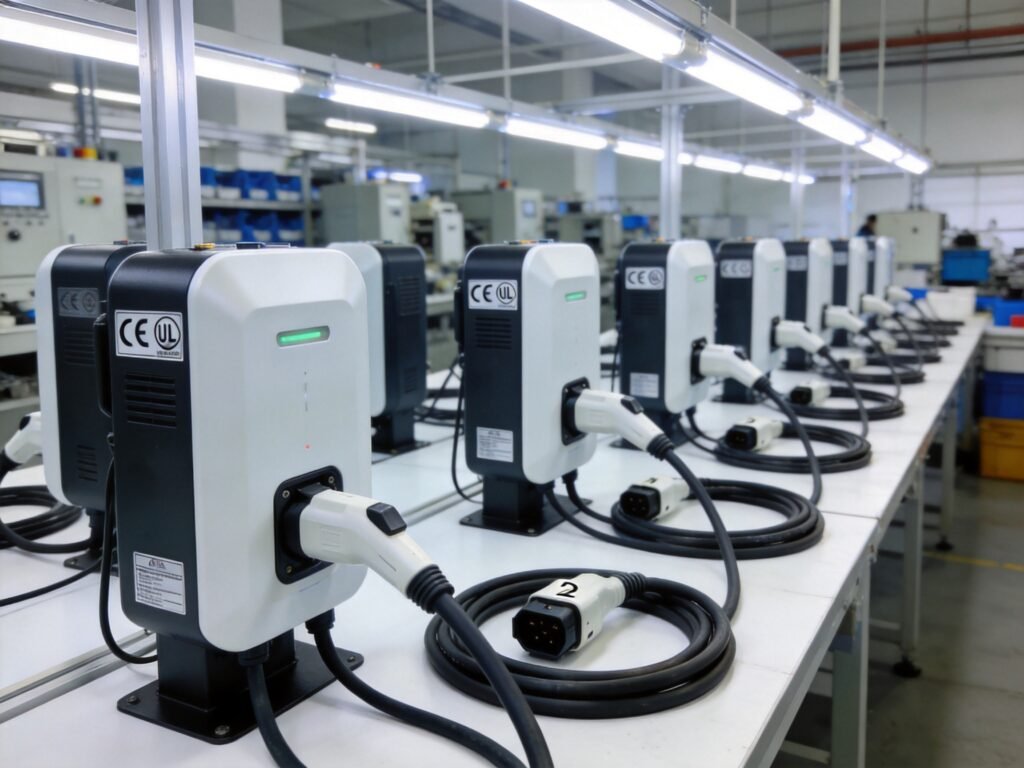
A CE certified EV charger manufacturer should be able to provide you with test reports from accredited laboratories (TÜV, SGS, Intertek), not just self-declarations. Always ask for the original test report, not a photocopy.
Pro tip: Visit our certifications page to see how a fully compliant product documentation package looks in practice.
Key Technical Standards Your Portable EV Charger Manufacturer Must Meet
Beyond safety certifications, the technical standards landscape in Europe is tightening. As of January 2026, all newly installed public AC charging points must support ISO 15118-2 for plug-and-charge communication. By January 2027, the extended ISO 15118-20 standard will add bidirectional charging and multi-contract handling capabilities.
For a portable EV charger or Type 2 charging cable, this means your Type 2 charging cable OEM supplier should ensure:
- IEC 62752 compliance — The international standard for In-Cable Control and Protection Devices (IC-CPD) used in Mode 2 portable chargers.
- IEC 62196-2 — Type 2 connector specification. Verify that the manufacturer produces connectors that meet dimensional and thermal requirements.
- EN 61851-1 — The foundational standard for EV charging systems in Europe.
- IP rating — Portable chargers should be at minimum IP54 for outdoor use; IP66 is preferred for harsh European winter conditions.
A reliable manufacturer will already have these standards baked into their product design — you should not have to request compliance as an afterthought.
How to Evaluate a Portable EV Charger Manufacturer’s Production Capability
Certifications tell you the product is compliant. Production capability tells you whether the manufacturer can actually deliver at scale and on time. Here is what to assess:
1. Factory-Direct vs. Trading Company
This is the single biggest factor in your unit cost. A factory-direct portable EV charger manufacturer eliminates the middleman markup — typically 15-30% — and gives you direct control over customization, quality control, and lead times.
Ask for a factory audit video or schedule a live video call to tour the production line. If the supplier hesitates, that is your answer.
2. Production Capacity and Lead Time
A mid-sized EV charger factory should be capable of producing 5,000-10,000 units per month for portable chargers. Standard lead time for a first order (including custom packaging) is typically 15-25 days. Repeat orders with existing tooling can drop to 7-15 days.
Be wary of any manufacturer quoting less than 7 days for a first order with custom branding — corners are being cut somewhere.
3. OEM/ODM Flexibility
European B2B buyers increasingly need products tailored to their market. Look for a manufacturer that offers full OEM/ODM customization:
- Silk-screen printing of your logo and branding on the charger body
- Custom plug types — Type 2 for Europe, Type 1 for North America, BS 1363 for UK
- Cable length options — 3m, 5m, 7.5m, or custom lengths
- Packaging design — Custom retail boxes, user manuals in your language, QR codes linking to digital support
Want to see how the full OEM process works from drawing to delivery? Check our OEM/ODM customization services page for the complete workflow.
Red Flags to Watch When Choosing a Portable EV Charger Manufacturer
After working with hundreds of B2B buyers, here are the most common mistakes we see:
- “CE marked” but no test report — Self-declared CE is not sufficient for serious buyers. Insist on third-party test reports from TÜV, SGS, or equivalent.
- MOQ that doesn’t match your business — A good manufacturer should accommodate trial orders (50-100 units) before committing to larger volumes. If MOQ is 1,000+ units for a first order, walk away.
- No after-sales support — Portable EV chargers are safety-critical devices. Your manufacturer should offer warranty support, replacement policies, and technical documentation in English.
- Unusually low pricing — If a quote is 30-40% below market average, the manufacturer is likely cutting corners on internal copper wiring, thermal protection components, or using uncertified connectors.
- Slow communication — If it takes days to get a response before the sale, imagine what after-sales support will look like.
Your Portable EV Charger Manufacturer Checklist for 2026
To make your sourcing process efficient, here is a quick-reference checklist:
| Criteria | Minimum Requirement | Preferred |
|---|---|---|
| CE Certification | Mandatory | TÜV/SGS test report |
| UKCA Certification | Required for UK market | Combined CE+UKCA package |
| UL Listing | Required for North America | UL + cUL (US + Canada) |
| IEC 62752 / IEC 62196-2 | Mandatory | Third-party verified |
| MOQ (trial order) | ≤ 100 units | ≤ 50 units |
| Lead time (standard) | ≤ 25 days | 15-20 days |
| OEM customization | Logo + packaging | Full: plug, cable, packaging, manual |
| Warranty | 12 months | 24 months |
| Factory audit access | Virtual tour available | In-person audit welcome |
Why European Distributors Are Shifting to Direct Factory Sourcing
The traditional model — sourcing through trading companies or regional agents — is being disrupted. With EU regulations tightening (the new EU Grid Package aims to reduce charging infrastructure approval times from years to months), the volume of charging accessories entering Europe is set to surge.
Smart distributors are moving to factory-direct sourcing for three reasons:
- Cost control — Eliminating 1-2 layers of intermediaries saves 15-30% per unit, which directly improves margin or competitive pricing.
- Speed to market — Direct communication with the factory means faster iteration on custom designs, quicker response to regulatory changes, and shorter reorder cycles.
- Quality ownership — When you work directly with the manufacturer, you control the specification, the testing protocol, and the quality inspection process.
Spain’s recent €105 million investment in charging infrastructure and Germany’s 17% year-on-year growth in public charging points (reaching ~200,000 by April 2026) are clear signals: the market is scaling, and buyers who build direct factory relationships now will have a structural advantage.
Final Thoughts: Choosing the Right Manufacturing Partner
Finding the right portable EV charger manufacturer is not just about finding the lowest price. It is about building a partnership with a supplier who understands European compliance requirements, can deliver consistent quality at scale, and supports your customization needs from silk-screen printing to full ODM development.
The manufacturers who will thrive in the next wave of European EV adoption are those who treat certifications not as a cost, but as a competitive advantage — and who make it easy for B2B buyers to verify every claim.
Ready to Source with Confidence?
ChuangRui is a CE/UKCA/UL/RoHS/REACH certified portable EV charger and Type 2 charging cable manufacturer with full OEM/ODM capability. We support custom branding, plug types, cable lengths, and packaging — with a minimum trial order of just 50 units and standard lead times of 15-20 days.
Take the next step:
- 💬 Chat on WhatsApp — +86 13757774567 — Quick questions? Our team replies within 2 hours.
- 📄 Request our certification package — CE, UKCA, UL test reports and compliance documents
- 📋 Request a quote — Get a competitive price within 24 hours
Get in touch today — our B2B team responds within 24 hours.