
Key Takeaway for B2B Buyers
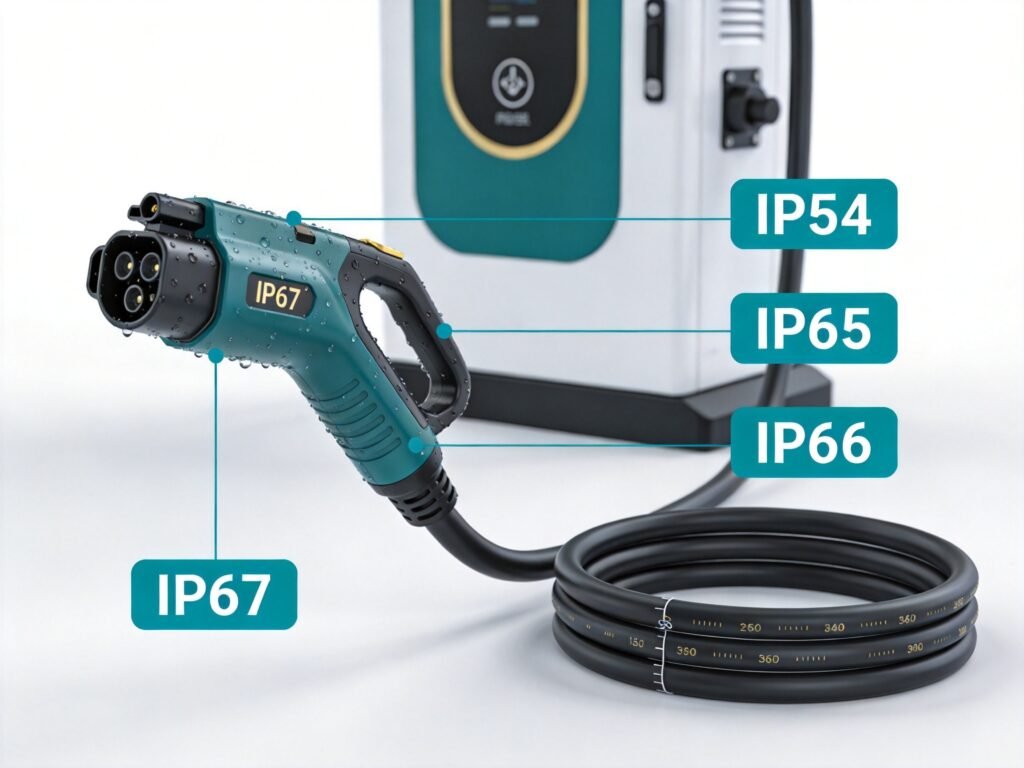
For European portable EV chargers: IP66 minimum for the control box, IP54 for the connector. Cable length: 5m is standard for residential; 7.5m for commercial/fleet. Never compromise IP rating for cost — warranty claims will erase any savings.
IP Rating & Cable Length Guide for Portable EV Chargers: A B2B Buyer’s Specification Framework for European Markets in 2026
When procurement teams evaluate portable EV charging equipment for European distribution, two specifications consistently generate the most questions and the most costly mistakes: IP (Ingress Protection) ratings and cable length selection. These are not optional comfort features — they determine whether your product survives real-world deployment, passes CE compliance audits, and avoids field failure claims from end users.
With Europe’s public charging network surpassing 1.1 million points and portable EV chargers becoming a mainstream aftermarket product across the continent, getting these specifications right is essential for every B2B buyer sourcing charging equipment in 2026.
European Market Snapshot: The EU’s AFIR regulation now requires 1.3 kW of public charging power per battery-electric vehicle across the bloc. As of mid-2026, 26 of 27 EU member states exceed their 2027 infrastructure targets 18 months early, driving rapid growth in portable charging equipment demand for residential, fleet, and supplementary charging applications.
Understanding IP Ratings: The IEC 60529 Standard Every Buyer Must Know
The IP Code is defined by IEC 60529 — the international standard classifying degrees of protection provided by electrical equipment enclosures. In the European market, this standard is adopted as EN IEC 60529, and it forms the foundation for CE marking compliance under the Low Voltage Directive (2014/35/EU).
The IP Code consists of two digits:
- First digit (0–6): Protection against solid objects and dust. IP6X means complete dust-tight protection — critical for portable chargers used in construction sites, parking garages, and rural environments.
- Second digit (0–9K): Protection against water ingress. IPX4 resists splashing water from any direction; IPX5 withstands low-pressure water jets; IPX6 handles powerful jets; IPX7 allows temporary submersion (1m depth, 30 minutes).
For portable EV charging equipment sold in Europe, EN IEC 61851-1 (the harmonised standard for conductive EV charging systems) mandates the following minimum IP requirements:
- Indoor use: At least IP41 (protected against solid objects ≥1mm and vertical dripping)
- Outdoor use: At least IP44 (protected against solid objects ≥1mm and splashing water from all directions)
In practice, leading manufacturers produce portable charging guns rated to IP66 or IP67, far exceeding the minimum requirements. This extra margin is what separates equipment that survives a Nordic winter or a Mediterranean storm from equipment that triggers warranty claims.
IP Rating Selection Matrix: Match the Rating to the Deployment Environment
Not every deployment scenario requires IP67. Over-specifying increases unit cost unnecessarily; under-specifying generates field failures and reputational damage. Here is a practical decision matrix for B2B buyers:
IP54 — Controlled Outdoor (Covered Parking, Gas Stations)
Protects against limited dust ingress and water splashing. Suitable for covered car parks, fuel station forecourts with canopy protection, and warehouse loading bays. Lowest cost tier. Acceptable for markets with mild climates and sheltered installation points.
IP65 — Exposed Outdoor (Residential Driveways, Commercial Lots)
Complete dust-tight protection plus low-pressure water jets from any direction. This is the minimum rating recommended for any portable EV charger marketed as “all-weather” in Northern or Western Europe. Ideal for residential driveway charging, open-air commercial parking, and fleet depot installations where equipment remains exposed.
IP66 — Harsh Environment (Coastal, Industrial, High-Rainfall Regions)
Dust-tight with protection against powerful water jets (100 L/min at 100 kPa from 3m distance). Required for coastal installations where salt spray accelerates corrosion, industrial zones with airborne particulates, and regions with heavy seasonal rainfall (UK, Ireland, Scandinavia, Benelux). This is the sweet spot for most European B2B distribution programmes.
IP67 — Extreme Environment (Temporary Submersion, Flood-Prone Areas)
Dust-tight with protection against temporary immersion (1m depth for 30 minutes). Specified for flood-prone deployment zones, ground-level installations in low-lying areas, and applications where equipment may contact standing water. This rating commands a premium but eliminates the highest-severity warranty scenarios.
Cable Length Selection: The Hidden Variable That Drives End-User Satisfaction
Cable length is the single most impactful specification for end-user satisfaction with portable EV chargers, yet it is frequently selected without adequate analysis. A cable that is too short frustrates users; a cable that is too long creates handling problems and increases resistive losses.
The IEC 62196 connector standards (Type 2 for Europe) support cable assemblies in standard lengths of 3m, 5m, 7.5m, and 10m. Custom lengths up to 15m are available through OEM/ODM services, but each increment carries trade-offs:
Electrical Resistance & Power Loss: Longer cables have higher resistance, which translates to voltage drop and energy wasted as heat. For a 16A single-phase charger (3.7 kW), a 5m cable with 3×2.5mm² conductors typically shows <2% voltage drop — well within acceptable limits. At 10m, the same conductor cross-section reaches approximately 3.5–4% drop, still acceptable but approaching the threshold where thicker conductors (3×4mm²) become advisable.
Weight & Handling: A 10m charging cable assembly adds approximately 2.5–3.5 kg compared to a 5m version. For portable equipment that end users store in vehicle trunks, this weight differential matters. Fleet operators consistently report higher satisfaction with 5–7m cables for daily use, while 10m cables are preferred for residential installations where the parking position varies.
Recommended Cable Length by Use Case:
- Retail/Aftermarket Distribution: 5m (best balance of portability and reach for most EV owners)
- Residential Installation: 7.5m (accommodates varied parking positions in driveways and garages)
- Fleet & Commercial: 5m or 7.5m depending on depot layout (standardise across fleet for spare parts compatibility)
- Emergency/Roadside Kit: 3m (minimal weight, maximum portability for trunk storage)
The Combined IP + Cable Decision Framework for B2B Procurement
Smart procurement teams do not evaluate IP rating and cable length in isolation. These two variables interact with your target market, distribution channel, and pricing strategy. Here is a framework for building your product portfolio:
Tier 1 — Entry-Level (Mass Market Retail): IP54 + 5m cable. Positioned at the lowest price point for indoor or sheltered use. Ideal for online marketplaces and retail chains targeting budget-conscious EV owners in Southern Europe (Spain, Italy, Portugal) where outdoor weather exposure is moderate.
Tier 2 — Mid-Range (Core B2B Programme): IP65 + 5m or 7.5m cable. The volume seller for European distributors. Covers the majority of use cases from residential to light commercial. Compatible with the full portable charging gun product range including Type 2 single-phase and three-phase variants. This tier typically represents 50–60% of a distributor’s portable charger sales mix. For more details, explore our guide on CE marking for EV chargers. To learn more about this topic, see our article on EV charging connector standards.
Tier 3 — Premium (Northern Europe & Harsh Climates): IP66 + 7.5m cable. Engineered for the UK, Ireland, Scandinavia, Benelux, and Alpine regions. The higher IP rating justifies a 15–25% price premium. Recommended for distributors serving utility companies, fleet operators, and commercial property managers who specify minimum IP66 in their procurement tenders.
Tier 4 — Specialist (Infrastructure & Public Realm): IP67 + 10m cable. For deployment in public charging zones, flood-prone areas, and temporary event installations. Lower volume but higher margins. Often paired with OEM-branded packaging and custom cable colours for infrastructure operators.
Verification Checklist: What to Demand from Your Supplier
Before placing a bulk order, verify the following with your portable EV charger supplier:
- IP Test Report: Demand a test certificate from an accredited laboratory referencing EN IEC 60529 as the method standard. The report must specify the exact product configuration tested (including cable entry seals and connector mating).
- Conductor Cross-Section: Confirm the cable conductor size matches the rated current. For 16A: minimum 3×2.5mm²; for 32A: minimum 3×6mm² (or 3×10mm² for cable runs exceeding 7.5m).
- Temperature Rating: The cable must be rated for the deployment climate. Standard TPU cables operate from -30°C to +50°C. For Nordic markets, verify low-temperature flexibility testing per IEC 60811-501.
- Connector Mating IP: EN IEC 61851-1 requires the vehicle connector when mated to meet at least IPXXD (protected against 1.0mm wire access). Verify the complete assembly — control box, cable, and connector — achieves the claimed IP rating when connected.
- Certification Stack: The complete product must carry CE/UKCA marking, with test reports referencing IEC/EN 61851-1, IEC/EN 62196-2, IEC/EN 60529, and applicable RoHS/REACH requirements. IATF 16949 certification from the manufacturer provides additional assurance of automotive-grade quality management.
ChuangRui’s portable charging equipment portfolio covers the full IP54–IP67 range with cable lengths from 3m to 15m, all manufactured under IATF 16949-certified quality management and tested to full CE/UKCA/UL/RoHS/REACH compliance. Our OEM/ODM services support custom IP ratings, cable configurations, connector types, and branded packaging for European distributors and fleet operators. Visit our certifications page to review our complete compliance documentation, or learn more about our manufacturing capabilities.
Request a Consultation
Chat on WhatsApp — +86 13757774567 — Quick questions? Our team replies within 2 hours.
Start a conversation now
Request our certification package
Get CE, UKCA, UL & IEC test reports
Request a quote — 24h response
Submit your specifications
#EVCharger #PortableEVCharger #IPRating #CableLength #EVChargingEquipment #OEM #B2B #ChargingGun
📚 References
Frequently Asked Questions
❓ What IP rating does a portable EV charger need?
Minimum IP66 for the control box (IC-CPD module) and IP54 for the charging connector. IP66 protects against powerful water jets; IP54 protects against splashing water. For harsh environments (coastal, industrial): specify IP67 for the control box.
❓ What is the standard cable length for portable EV chargers?
5 meters is the European standard for residential portable chargers. 7.5 meters is preferred for commercial and fleet applications. Custom lengths of 3m (travel) or 10m (large parking areas) are available from most OEM factories.
❓ How does cable length affect charger performance?
Longer cables increase voltage drop and resistance. A 10m cable at 32A may lose 2–3% of power compared to a 5m cable. For cables over 7.5m at 32A, specify 6mm² conductor cross-section (vs 2.5mm² for 5m cables) to minimize loss.
❓ What happens if the IP rating is lower than required?
Insufficient IP rating leads to water ingress, PCB corrosion, and field failures. In Northern European markets with heavy rain/snow, IP65 or below results in 3–5× higher warranty claims. This is the #1 cause of portable charger field failure.
❓ How should B2B buyers specify IP and cable length in RFQs?
Specify: (1) IP rating for control box (recommend IP66), (2) IP rating for connector (recommend IP54), (3) cable type (H07RN-F or equivalent), (4) cable length (5m standard), (5) conductor cross-section (2.5mm² for ≤5m, 6mm² for >5m at 32A).

About the CREVCC Engineering Team
Our engineering team brings 12+ years of experience in EV charging system design, from PCB layout and power electronics to international certification compliance.


