Key Takeaway for B2B Buyers
EU EV charging equipment procurement in 2026 requires CE + UKCA + AFIR compliance + EMC certification + cybersecurity readiness (EU Cyber Resilience Act). Use this 10-point checklist to verify every requirement before signing a purchase order.
EV Charging Equipment Procurement in the EU: A Compliance Checklist for 2026
European buyers of portable EV chargers, charging guns, and discharge cables are facing a more complex compliance landscape in 2026. A low factory price is no longer enough: distributors, retailers, and fleet operators must confirm CE marking, connector standards, electrical safety, electromagnetic compatibility, and producer responsibility obligations before goods arrive at the border.
This procurement guide explains the documents, specifications, and supplier checks that should be part of every B2B order for portable EV charging equipment. It is written for European charging distributors, automotive aftermarket buyers, retail sourcing teams, and fleet operators purchasing from China-based manufacturers such as ChuangRui.
1. Why Compliance Is Now a Procurement Risk, Not Just a Technical Detail
Portable EV chargers sit at the intersection of three heavily regulated areas: electrical safety, electromagnetic compatibility, and environmental product responsibility. When sold in the EU, they must comply with the Low Voltage Directive, EMC Directive, RoHS restrictions, and, where wireless communication is included, the Radio Equipment Directive.
According to the European Commission’s CE marking guidance, CE marking is required for products covered by specific EU harmonisation rules, and the manufacturer or its authorised representative must keep the EU Declaration of Conformity and technical documentation available for at least ten years. For importers, that means a supplier that cannot produce a complete technical file is transferring legal risk directly to your business. For more details, explore our guide on CE marking for EV chargers. To learn more about this topic, see our article on EV charging connector standards.
The risk is not theoretical. Non-compliant electrical products can be stopped at customs, removed from online marketplaces, recalled, or destroyed. For a distributor building a seasonal stock plan, even a two-week customs hold can miss a sales window and damage customer relationships.
2. Certification Documents to Require Before You Place an Order
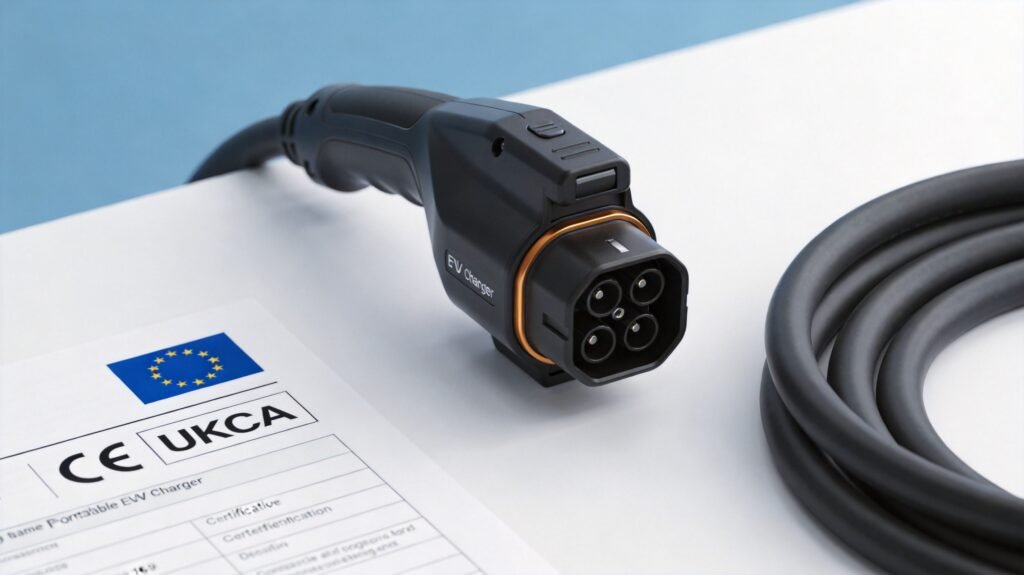
Before approving a purchase order, request documentation in the name of the actual manufacturer or product model—not generic certificates for a similar product. For a portable Type 2 charger or EV charging gun, the core file should include:
- EU Declaration of Conformity: clearly listing the applicable directives and harmonised standards.
- CE/UKCA test reports: issued by an accredited laboratory, with the exact model number, plug type, current rating, and cable specification.
- EN IEC 61851-1 compliance: the core standard for conductive charging system safety.
- EN IEC 62196 connector compliance: covering plugs, socket-outlets, vehicle connectors, and vehicle inlets. The IEC’s IEC 62196-1 publication details confirm that the standard addresses general requirements for EV charging accessories, including contact materials, temperature rise testing, mechanical wear, and thermal stress.
- RoHS and REACH support: material declarations showing restricted substances are controlled.
- User manual and safety markings: in the official language of each destination market where required.
If you are also selling into the UK, request UKCA documentation separately. CE and UKCA marking may look similar, but they follow separate conformity frameworks and require separate market-surveillance readiness.
3. EPR, WEEE, and Packaging Compliance Cannot Be an Afterthought
Extended Producer Responsibility has become one of the most common causes of marketplace account warnings for electrical goods sellers. EPR is not a single Europe-wide certificate: it is organised by waste stream and by member state. For EV charging equipment, the main obligations relate to electrical and electronic equipment (WEEE), batteries where applicable, and packaging.
The European Parliament’s overview of resource efficiency and the circular economy notes that EU waste rules cover electrical and electronic equipment and are implemented through national producer responsibility systems. In practice, if you sell into Germany, France, Spain, Italy, or other EU markets, you may need separate registration numbers, periodic reporting, and recycling fee payments in each country.
For procurement teams, the key question is simple: who holds the EPR registration? If you are the importer or place products on the market under your own brand, you may be the “producer” under national law. Ask your manufacturer to provide product weight, packaging materials, battery information, and country-specific labelling support so your compliance team can register correctly.
4. Product Specifications That Should Be Locked Before Mass Production
Compliance paperwork is only useful if the shipped product matches the tested unit. For portable charging equipment, confirm the following specifications in writing and compare them with the test report:
- Rated current and power: common portable AC configurations include 16A (approximately 3.7kW single-phase) and 32A (approximately 7.4kW single-phase or higher on three-phase units).
- Plug and connector type: Type 2 is the mainstream AC connector in Europe; CCS2 is used for DC fast charging and should not be confused with portable AC products.
- Voltage range: verify compatibility with destination-market grid voltage and phase configuration.
- Residual current protection: look for Type A RCD with DC leakage protection or equivalent safety architecture as required by the applicable standard and local installation rules.
- IP and IK ratings: choose ratings appropriate to the intended use environment, especially for outdoor, fleet, or roadside recovery applications.
- Cable length and material: confirm conductor size, jacket material, temperature rating, and durability for repeated use.
- Display, adjustment, and smart features: if Wi-Fi, Bluetooth, app control, or scheduling functions are included, RED and cybersecurity requirements may apply.
These details should appear on the product label, packaging, commercial invoice, and test report. Mismatched model numbers or ratings are a red flag during market surveillance inspections.
5. Supplier Due Diligence: What to Verify Beyond the Quotation
A professional EV charging equipment manufacturer should be able to demonstrate factory quality systems and consistent production control. ChuangRui, for example, publishes its certifications and provides OEM/ODM services for buyers that need private-label charging guns, portable chargers, or discharge equipment.
When evaluating suppliers, use the following checklist:
- Check certificate authenticity: verify certificate numbers with the issuing laboratory or certification body where possible.
- Match the factory to the certificate holder: ensure the production site, brand, and certificate holder are consistent or properly linked through OEM authorisation.
- Review quality systems: ISO 9001, IATF 16949, ISO 14001, and ISO 45001 indicate structured quality, environmental, and occupational safety management.
- Ask about production capacity and lead time: a supplier that can offer 7–15 day production windows for standard orders is better positioned to support repeat purchases and seasonal demand.
- Confirm customisation scope: logo printing, packaging design, plug types, cable length, current settings, and instruction manuals should be agreed before production begins.
- Evaluate after-sales support: ask for warranty terms, spare-part availability, defective-unit handling, and technical support response time.
- Review the full product range: a supplier with both charging and discharge capability can help you serve EV owners, fleets, outdoor workers, and emergency power users from one catalogue. Explore ChuangRui’s products for portable chargers, discharge guns, and dual-head charging solutions.
6. Seven-Point Pre-Shipment Checklist
Use this checklist before the final balance payment and before booking freight:
- EU Declaration of Conformity and test reports match the shipped model number.
- CE marking, UKCA marking, warning symbols, and manufacturer/importer information are correctly labelled.
- Connector, current rating, voltage, cable specification, and IP rating match the purchase order.
- User manuals and safety instructions are supplied in the required languages.
- RoHS, REACH, packaging, and EPR/WEEE information is available to the importer.
- Commercial invoice, packing list, and product certifications use consistent model names.
- Pre-shipment photos or inspection records confirm the carton markings, plug type, and accessories.
If any item is missing, resolve it before the container leaves the factory. Correcting a labelling or document issue at origin costs far less than resolving it after customs detention or a product recall.
Build a Supply Chain That Survives Market Surveillance
The European EV charging market is growing, but growth is attracting stricter enforcement. The strongest distributors are not simply buying the cheapest unit; they are selecting manufacturers that can provide consistent certification support, accurate technical files, flexible OEM/ODM production, and reliable delivery.
If you are sourcing portable EV chargers, charging guns, V2L discharge adapters, or dual-head charging cables for Europe, ChuangRui can support your procurement process with certified products and factory-direct customisation. Contact us to discuss your product requirements.
Talk to ChuangRui
Chat on WhatsApp
+86 13757774567 — Quick questions? Our team replies within 2 hours.
Request our certification package
Receive CE, UKCA, RoHS, REACH, and quality system documentation for your review.
Request a quote
Share your plug type, current rating, cable length, packaging, and destination market. 24h response.
#EVCharger #EVCharging #PortableEVCharger #CECertification #B2BProcurement #OEM #EVSupplyChain #EuropeEV
📚 References
Frequently Asked Questions
❓ What certifications are mandatory for selling EV charging equipment in the EU?
Minimum: CE marking (LVD + EMC + RoHS directives). For smart chargers: RED Directive for wireless modules. For grid-connected chargers: AFIR compliance. From September 2026: Cyber Resilience Act requirements apply.
❓ What is the EU Cyber Resilience Act and does it affect EV chargers?
The CRA (effective September 2026) requires all products with digital elements — including smart EV chargers with connectivity features — to meet cybersecurity requirements: secure default configuration, vulnerability handling, and software update capability.
❓ How does AFIR affect procurement specifications?
AFIR mandates that new charging points support smart charging, payment terminal interoperability, and real-time data availability. B2B buyers should ensure chargers support OCPP 1.6J or 2.0.1 and have open communication interfaces.
❓ What documentation should I request from a Chinese EV charger supplier?
CE Declaration of Conformity, test reports from accredited labs (LVD, EMC, RoHS), IATF 16949 or ISO 9001 certificate, technical file (circuit diagrams, BOM, user manual), and for smart chargers: cybersecurity self-assessment documentation.
❓ Can I use a CE-certified product in the UK market?
No. The UK requires UKCA marking (replacing CE in Great Britain from 2025). Products need separate testing and certification for UKCA. Northern Ireland still accepts CE marking under the Windsor Framework.

About the CREVCC Engineering Team
Our engineering team brings 12+ years of experience in EV charging system design, from PCB layout and power electronics to international certification compliance. We design and manufacture portable EV chargers, charging guns, and V2L discharge equipment for B2B partners across Europe, North America, and Southeast Asia. Every article reflects hands-on engineering knowledge — not marketing copy.


