Key Takeaway for B2B Buyers
Three connector standards dominate globally: Type 2/CCS2 (Europe), J1772/CCS1 (North America), and GB/T (China). For multi-market B2B distributors, stock adapters between these standards to maximize SKU coverage.
EV Charging Connector Standards Explained: IEC 62196, SAE J1772 & Global Compatibility for B2B Buyers
If you source, distribute, or specify portable EV charging equipment, connector compatibility is the single most important technical decision you will make. A charging gun that ships with the wrong connector type for its target market is not just unsellable — it is a liability. Yet the landscape of EV charging connector standards remains fragmented across regions, with overlapping IEC, SAE, and national specifications that can confuse even experienced procurement teams.
This guide breaks down every major connector standard, explains which markets require which types, and shows you what to verify before placing a bulk order for portable charging equipment.
European Market Flash (July 2026): Battery-electric vehicle registrations in the EU reached 1,220,890 units in the first half of 2026, a 40.5% year-on-year increase, with BEVs now capturing 20.7% of all new car sales. Europe’s public charging network has surpassed 1.1 million points, with Type 2 and CCS2 connectors dominating the infrastructure. The demand for compatible, certified portable charging equipment has never been higher.
The IEC 62196 Family: The International Framework for EV Connectors
The International Electrotechnical Commission (IEC) 62196 series is the foundational international standard that defines the mechanical, electrical, and performance requirements for plugs, socket-outlets, vehicle connectors, and vehicle inlets used in conductive EV charging. Maintained by IEC Technical Committee 69 (TC 69), this standard family is the reference point for virtually every regional connector regulation worldwide. For more details, explore our guide on EV charging connector standards. To learn more about this topic, see our article on EV charging connector standards.
The series is divided into key parts:
- IEC 62196-2 — Covers AC charging connectors: Type 1 (J1772), Type 2 (Mennekes), and related configurations for single-phase and three-phase charging up to 250 V / 63 A.
- IEC 62196-3 — Covers DC fast charging connectors: CCS Combo 1, CCS Combo 2, and CHAdeMO configurations for high-power DC charging up to 500 V / 500 A.
Working alongside IEC 62196, the IEC 61851 series defines the overall conductive charging system — including charging modes (Mode 1 through Mode 4), control pilot signaling, safety protections, and EMC requirements. Together, these two standard families form the technical backbone of EV charging equipment certification for most global markets.
For B2B buyers, understanding which IEC standard applies to your target market is the first step in ensuring product-market fit. ChuangRui’s entire product lineup is manufactured in compliance with IEC 62196 and IEC 61851 requirements, and our full certification portfolio covers CE, UKCA, UL, and RoHS/REACH compliance for every major market.
Connector Types at a Glance: Specifications & Regional Coverage
Here is a practical breakdown of every connector type you need to know for portable EV charging equipment procurement:
Type 1 (SAE J1772) — North America & Japan
The SAE J1772 connector, commonly called Type 1, is the standard AC charging plug for North America and Japan. It features 5 pins, supports single-phase AC power up to 7.2 kW at Level 2, and uses a 120V/240V supply. While it has been the cornerstone of North American EV infrastructure since 2010, its adoption is now being supplemented by NACS (SAE J3400) for newer vehicles. For more details, explore our guide on EV charging connector standards.
Type 2 (IEC 62196-2, Mennekes) — Europe & Global
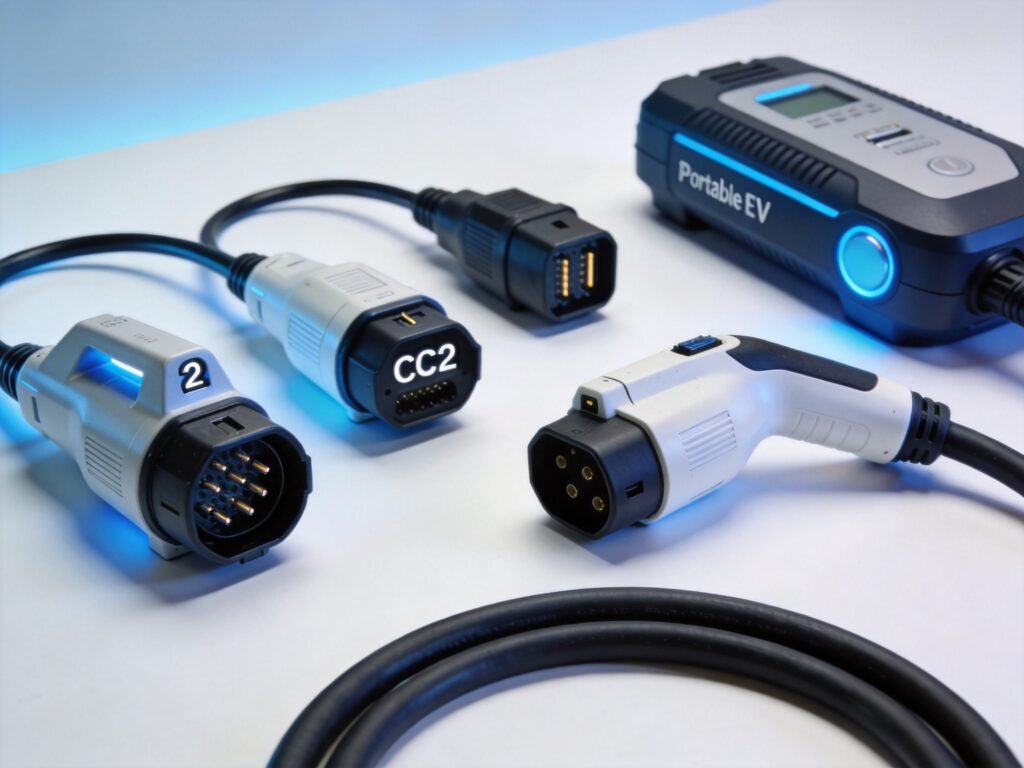
The IEC 62196 Type 2 connector is the mandatory AC charging standard across Europe, mandated by the EU’s Alternative Fuels Infrastructure Directive. With 7 pins, it supports both single-phase (up to 7.4 kW) and three-phase power (up to 22 kW), making it significantly more versatile than Type 1. Over 65% of Europe’s 1.1 million public charging points support Type 2 connectors. For B2B buyers targeting Europe, Type 2 is non-negotiable.
CCS Combo 2 (IEC 62196-3) — Europe DC Fast Charging
CCS Combo 2 combines the Type 2 AC inlet with two additional DC power pins, enabling both AC and DC charging through a single connector. Supporting up to 350 kW, CCS2 is the dominant DC fast charging standard in Europe, with over 80% adoption in fast-charging stations. Portable charging equipment manufacturers must offer CCS2-compatible products to serve the European commercial market. To learn more about this topic, see our article on EV charging connector standards.
NACS (SAE J3400) — North America’s Emerging Standard
Originally developed by Tesla and standardized as SAE J3400, NACS integrates AC and DC charging in a compact, single-connector design capable of up to 1,000 kW. Major automakers including Ford, GM, Rivian, and Volvo have committed to NACS adoption. For manufacturers exporting to North America, NACS compatibility is becoming a competitive requirement.
CHAdeMO — Japan Legacy Standard
Developed by a Japanese consortium, CHAdeMO was the world’s first DC fast charging standard. While its influence has declined in Western markets, it remains relevant for exports to Japan and for servicing existing CHAdeMO-equipped vehicles. Most new vehicle platforms have transitioned to CCS2 or NACS.
What B2B Buyers Must Verify Before Placing a Bulk Order
Connector type compatibility is just the starting point. When procuring portable EV charging equipment for resale or fleet deployment, B2B buyers should verify the following technical and compliance requirements:
- Connector certification: Confirm that the charging gun connector is tested and certified to IEC 62196-2 (AC) or IEC 62196-3 (DC) as applicable. Request test reports from accredited laboratories.
- Regional compliance marks: CE marking for Europe, UKCA for the United Kingdom, UL listing for North America. Each market has its own mandatory certification pathway.
- IP rating: Portable charging equipment must be rated at minimum IP55 for outdoor durability. IP67-rated connectors offer superior protection against dust and water ingress for harsh environments.
- Current rating matching: Ensure the connector’s rated current (16A, 32A, or 63A) matches the target market’s grid infrastructure and vehicle onboard charger specifications.
- Cable specification: Verify conductor gauge, insulation material (TPU or XLPO), and bend radius meet IEC 62893 requirements for flexible charging cables.
- Temperature monitoring: For connectors rated above 32A, integrated NTC temperature sensors are essential for thermal protection during extended charging sessions.
At ChuangRui, every portable charging gun undergoes 100% factory testing including insertion/extraction cycle testing (10,000+ cycles), IP rating verification, and high-voltage withstand testing before shipment. Our product range covers Type 2, CCS2, and NACS connectors across 16A and 32A configurations, with full OEM/ODM customization available for market-specific requirements.
The Market Opportunity: Why Connector Compatibility Drives B2B Revenue
The European EV market is growing at an unprecedented pace. According to ACEA data published by electrive, 270,557 new battery-electric passenger cars were registered in the EU in June 2026 alone — a 60.7% year-on-year increase. France recorded a 93.5% increase, Germany 78.2%, and Italy 86.6%. This explosive growth means that demand for certified, connector-compatible portable charging equipment is accelerating across every European market.
The business case for procurement teams is clear:
- Europe (Type 2 / CCS2): The largest and fastest-growing market for portable EV charging equipment, driven by 1.1 million+ public charging points and mandatory Type 2 infrastructure under AFIR regulations.
- North America (Type 1 / NACS): A transitioning market where both J1772 and NACS connectors are in demand, creating opportunities for dual-standard product lines.
- Middle East & Asia-Pacific: Emerging markets where Type 2 adoption is increasing alongside EV infrastructure investment, particularly in the UAE, Australia, and Southeast Asia.
Distributors who stock the correct connector types for their target markets — backed by proper certifications — capture repeat B2B orders and build long-term supply relationships. Those who ship the wrong standard face returns, warranty claims, and lost contracts.
For procurement teams evaluating suppliers, ChuangRui offers full OEM/ODM services including custom connector configurations, branded packaging, and market-specific certification support. With a 7–15 day delivery window for standard products and IATF 16949-certified manufacturing processes, we help B2B buyers move from order to market faster.
Looking Ahead: Emerging Standards & What They Mean for Procurement
The connector standards landscape continues to evolve. Two developments deserve attention from B2B buyers planning their 2026–2027 procurement strategy:
Megawatt Charging System (MCS): The IEC published IEC TS 63379 in February 2026, establishing the first global technical specification for megawatt-level DC charging connectors. Rated up to 1,500 V DC and 3,000 A, MCS targets heavy-duty vehicles and will create a new product category for charging equipment manufacturers. While portable MCS equipment is not yet commercially viable, B2B buyers should monitor this standard for future product line expansion.
NACS global expansion: SAE J3400 is increasingly being discussed for adoption beyond North America. Several non-Tesla automakers have announced NACS-compatible vehicles for 2026–2027 model years. Manufacturers who invest in NACS tooling now will be positioned to capture early-mover advantage as the standard gains international traction.
The key takeaway for B2B buyers: stay aligned with the IEC standards framework, verify connector certifications before ordering, and choose a manufacturing partner who can adapt to evolving standards across multiple markets. Learn more about ChuangRui’s capabilities and how we support global distributors with certified, market-ready portable EV charging equipment.
Chat on WhatsApp — +86 13757774567 — Quick questions? Our team replies within 2 hours.
Start a conversation on WhatsApp
Request our certification package — Need CE, UKCA, UL, or IEC test reports for your market?
Contact us to receive our full certification documentation
Request a quote — 24h response
Get pricing for Type 2, CCS2, and NACS charging equipment
#EVCharging #ConnectorStandards #IEC62196 #Type2 #CCS2 #OEM #B2B #PortableEVCharger
📚 References
Frequently Asked Questions
❓ What are the main EV charging connector standards worldwide?
Three dominant standards: Type 2 / CCS2 (Europe, mandated by EU regulation), J1772 / CCS1 (North America, SAE standard), and GB/T (China, national standard). Japan uses CHAdeMO for DC fast charging, but CCS2 is increasingly replacing it.
❓ What is the difference between Type 2 and CCS2?
Type 2 is the AC-only connector (up to 43kW AC). CCS2 adds two DC pins below the Type 2 connector, enabling DC fast charging (up to 350kW). CCS2 is the European standard for both AC and DC charging.
❓ Can a Type 2 charger work with CCS2 vehicles?
Yes — CCS2 vehicles have a Type 2 AC inlet. A Type 2 AC charger will work for AC charging at up to 22kW. CCS2 DC charging requires the full CCS2 connector with DC pins.
❓ What adapter solutions are available for multi-market distributors?
Key adapters: CCS2-to-J1772 (Europe charger → US vehicle), CCS2-to-GB/T (Europe charger → Chinese vehicle), and J1772-to-Type 2 (US charger → European vehicle). For DC: CCS1-to-CCS2 adapters are available but expensive ($500–$2,000).
❓ Which connector standard should B2B buyers prioritize?
For the European market: CCS2 (mandatory). For global distributors: stock Type 2/CCS2 as the primary product, with adapter lines for J1772 and GB/T markets. The adapter market is growing faster than dedicated connector sales as cross-border EV usage increases.

About the CREVCC Engineering Team
Our engineering team brings 12+ years of experience in EV charging system design, from PCB layout and power electronics to international certification compliance.


