
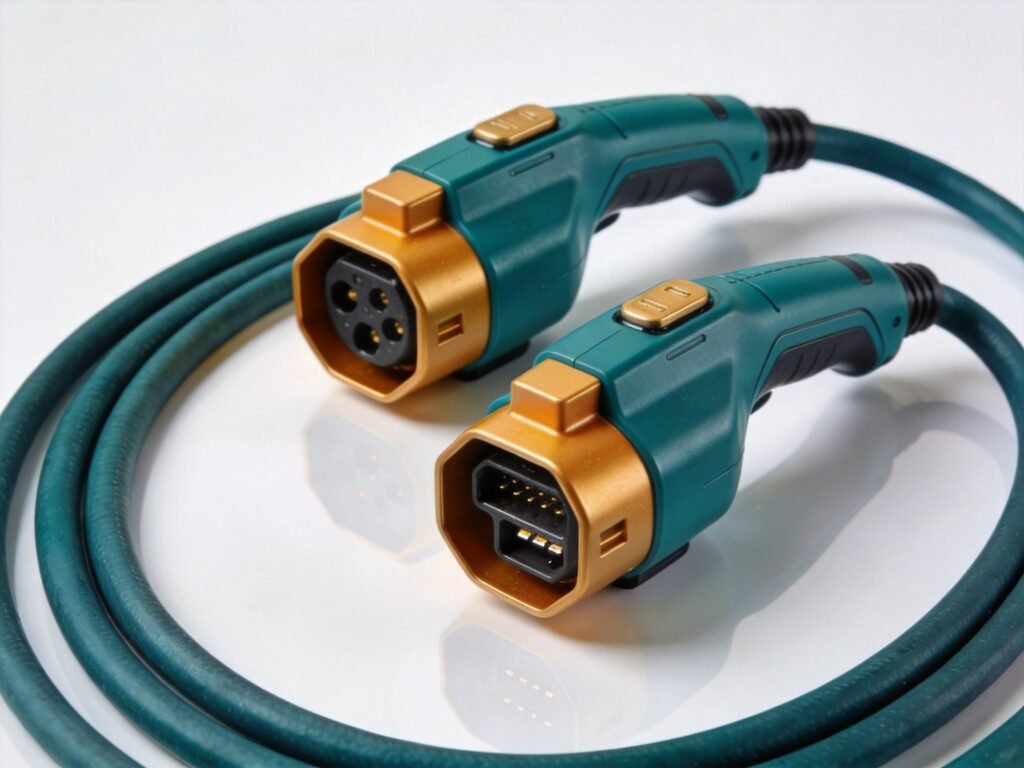
Key Takeaway for B2B Buyers
Dual-head EV charging guns allow one charging unit to serve two vehicles simultaneously, switching power dynamically. Ideal for fleet depots, parking operators, and workplace charging — but overkill for residential aftermarket distributors.
Dual-Head EV Charging Gun: When and Why Your Business Needs One in 2026
Europe’s public charging network has surpassed 1.3 million points, yet fleet operators, parking facility managers, and charging service providers face a persistent bottleneck: not enough charging slots for the rapidly growing number of electric vehicles on the road. A dual-head EV charging gun — one unit with two independent connectors — solves this by doubling vehicle throughput from a single installation point. This guide explains what dual-head charging guns are, which business scenarios demand them, and how B2B buyers should evaluate technical specifications before placing a bulk order.
European Market Flash
With BEV registrations hitting 1.22 million units in H1 2026 (+40.5% YoY) and over 1.3 million public chargers now deployed across the EU, the demand for high-utilization charging hardware is accelerating faster than infrastructure can keep up. Dual-connector configurations are rapidly becoming standard specification for commercial sites that need to maximize parking efficiency while minimizing per-connector installation costs. According to the European Alternative Fuels Observatory, the ratio of vehicles to public chargers continues to tighten in high-growth markets like Germany, France, and Italy.
What Is a Dual-Head EV Charging Gun?
A dual-head (or dual-connector) EV charging gun integrates two independent charging connectors into a single charging unit. In the European market, the most common configuration pairs two IEC 62196-2 Type 2 connectors for AC charging, though DC variants with dual CCS2 outputs are gaining significant traction in fleet depots and highway service areas where faster turnaround times are required.
Unlike a simple splitter or shared-power adapter, a properly engineered dual-head charging gun features:
- Independent power channels — each connector operates on its own dedicated circuit, allowing simultaneous charging of two vehicles without mutual interference or power throttling.
- Dynamic load balancing — the unit’s internal controller distributes available power between the two outputs based on each vehicle’s real-time demand and the site’s total electrical capacity.
- Separate communication protocols — each connector runs its own Control Pilot (CP) and Proximity Pilot (PP) signaling circuits, ensuring full IEC 61851-1 compliance on both channels completely independently.
- Individual metering — each output has its own MID-certified energy meter for accurate billing when operating in commercial or pay-per-use environments.
Five Scenarios Where Dual-Head Charging Guns Are Essential
1. Commercial Fleet Depots
Delivery vans, service vehicles, and corporate fleets typically return to a central depot for overnight charging. A dual-head unit covers two vehicles per parking bay, effectively halving the total number of installations needed. For a 50-vehicle fleet, this means 25 charging points instead of 50 — reducing civil works, cabling, and grid connection costs by up to 40%. Fleet managers also benefit from simplified management: monitoring and maintaining 25 units instead of 50 significantly cuts ongoing operational overhead.
2. Public Parking Facilities
Shopping centers, airports, and municipal car parks need to serve as many EV drivers as possible within limited physical space. Dual-head units double the charging capacity per footprint without requiring additional parking bays or expensive lot expansions. With the EU’s AFIR regulation mandating increasing charging density along TEN-T corridors, operators who deploy dual-connector hardware from day one are effectively future-proofing their infrastructure investment against rapidly growing demand.
3. Workplace Charging Programs
Corporate offices installing employee EV charging benefits face a common constraint: electrical panel capacity. A dual-head 22 kW unit (11 kW per connector on three-phase) serves two employees from a single 16A three-phase circuit. This is far more efficient than installing two separate single-head units, each requiring its own circuit breaker and cabling run. HR departments also find that shared dual-head units encourage collegial scheduling among employees, reducing conflicts over charging access. For more details, explore our guide on EV charging connector standards.
4. Hotel and Hospitality Sector
Hotels offering EV charging as a guest amenity need to handle turnover during peak evening hours when most guests arrive. Dual-head units in the car park ensure two guests can charge simultaneously overnight, improving satisfaction scores without doubling hardware spend. For boutique hotels with limited parking, a single dual-head unit may be the difference between offering a competitive amenity and losing EV-driving guests to competitors.
5. Charging Service Providers and CPOs
Charge Point Operators deploying infrastructure for revenue generation benefit enormously from dual-head configurations at every site. Two connectors per station double the potential billing sessions per day, improving return on investment and reducing the payback period on each installation location. For CPOs managing hundreds of sites, this efficiency gain compounds into significant revenue uplift across the entire network.
Key Specifications B2B Buyers Must Verify
| Parameter | What to Check | Why It Matters |
|---|---|---|
| Connector Standard | Type 2 (IEC 62196-2) for EU markets | Ensures compatibility with all European EVs on the road |
| Power Distribution Mode | Independent vs. shared output | Independent channels prevent one vehicle from throttling the other |
| Max Output per Connector | 16A (3.5 kW) or 32A (7.4 kW) per head | Must match your target vehicle fleet’s onboard charger capacity |
| Load Balancing | Dynamic vs. static power split | Dynamic allocation optimizes usage when only one vehicle is connected |
| IP Rating | IP54 minimum for indoor; IP65+ for outdoor | Critical for long-term reliability in varying weather conditions |
| Communication Protocol | OCPP 1.6J / OCPP 2.0.1 support | Enables remote monitoring, billing integration, and fleet management |
| Certification Stack | CE, UKCA, RoHS, REACH at minimum | Legal requirement for EU/UK market deployment and resale |
| Mating Cycles | 10,000+ insertion cycles rated | Dual-head units see double the wear — durability is paramount |
Dual-Head vs. Two Single-Head Units: Total Cost of Ownership
For B2B buyers, the decision ultimately comes down to total cost of ownership over the equipment’s operational lifetime. Here is a simplified comparison for a typical commercial installation scenario:
| Factor | Dual-Head Unit | Two Single-Head Units |
|---|---|---|
| Hardware cost | 1 unit (lower per-connector cost) | 2 units (higher aggregate cost) |
| Installation | 1 mounting point, 1 grid connection | 2 mounting points, 2 separate grid connections |
| Cabling | Shared input cable, reduced copper usage | Separate input cables for each individual unit |
| Space footprint | Compact — one enclosure serves two vehicles | Wider — two separate enclosures needed |
| Maintenance | Single unit to service, one warranty to manage | Two units, double the service points and warranty paperwork |
| Scalability | Add more dual-head units as demand grows | Each unit is independent but costs more per connector added |
For installations requiring 10 or more connectors, dual-head units typically deliver 20–35% savings on total installed cost compared to deploying an equivalent number of single-head units. The savings are even more pronounced when grid connection fees, trenching costs, and permit applications are included in the calculation.
OEM and ODM Options for Dual-Head Charging Guns
For distributors and charging network operators seeking branded solutions, OEM and ODM manufacturing of dual-head charging guns offers significant competitive advantages. A qualified manufacturer can customize connector configurations (Type 2 + Type 2, or CCS2 + CCS2 for DC fast-charging applications), cable lengths (3m, 5m, 7.5m, 10m options), housing design and color, branding elements, and firmware — including OCPP integration, load balancing algorithms, and payment system compatibility.
When evaluating a manufacturing partner for dual-head charging gun production, prioritize suppliers with:
- Multi-market certification capability (CE/UKCA/UL/RoHS/REACH) to support your expansion across regions
- IATF 16949 quality management certification for automotive-grade production consistency
- Proven OEM/ODM track record supplying European distributors and CPOs
- 7–15 day delivery windows for standard configurations to keep your projects on schedule
- In-house testing laboratory for pre-shipment validation of every unit
ChuangRui specializes in OEM and ODM production of certified EV charging equipment including dual-head charging guns engineered for European B2B buyers. Our OEM/ODM services cover custom connector configurations, private-label branding, and firmware development tailored to your market requirements. All products carry full certification stacks for EU, UK, and international markets, backed by our IATF 16949 and ISO 9001 quality systems. To learn more about this topic, see our article on EV charging connector standards.
Ready to Explore Dual-Head Charging Solutions?
Chat on WhatsApp — +86 13757774567 — Quick questions? Our team replies within 2 hours.
https://wa.me/8613757774567
Request our certification package
Contact us to receive CE, UKCA, UL, and IATF 16949 documentation
Request a quote — 24h response
Get pricing for dual-head charging guns with your specifications
Learn more about our manufacturing capabilities at About ChuangRui.
#DualHeadEVCharger #EVChargingGun #Type2Charger #FleetCharging #OCPP #EVChargerOEM #B2BEVCharging #ChuangRui
📚 References
Frequently Asked Questions
❓ What is a dual-head EV charging gun?
A dual-head charging gun integrates two charging connectors into a single charging unit, allowing one charger to serve two vehicles simultaneously. The power is dynamically distributed between the two outlets based on vehicle demand and available capacity.
❓ What are the main use cases for dual-head chargers?
Three primary scenarios: (1) Fleet depots where multiple vehicles need overnight charging from a single electrical connection, (2) Workplace parking with limited electrical capacity, (3) Public charging operators who want to maximize charger utilization per parking bay.
❓ How does power distribution work in a dual-head system?
Most dual-head systems use load balancing: if one vehicle is nearly full, excess power shifts to the other. Common configurations: 22kW total split 11+11kW, or 22kW total with dynamic allocation (22+0, 16+6, 11+11).
❓ Is a dual-head charging gun more expensive than two single chargers?
A dual-head unit is typically 30–40% cheaper than two equivalent single-head units, plus it requires only one electrical connection — saving on installation costs. However, the unit cost is 60–80% higher than a single-head equivalent.
❓ Should distributors stock dual-head charging guns?
Dual-head chargers are best suited for B2B customers: fleet operators, parking management companies, and workplace charging installers. Residential aftermarket distributors will see limited demand. Recommended as a specialized product line, not a core SKU.

About the CREVCC Engineering Team
Our engineering team brings 12+ years of experience in EV charging system design, from PCB layout and power electronics to international certification compliance. We design and manufacture portable EV chargers, charging guns, and V2L discharge equipment for B2B partners across Europe, North America, and Southeast Asia.


