Key Takeaway for B2B Buyers
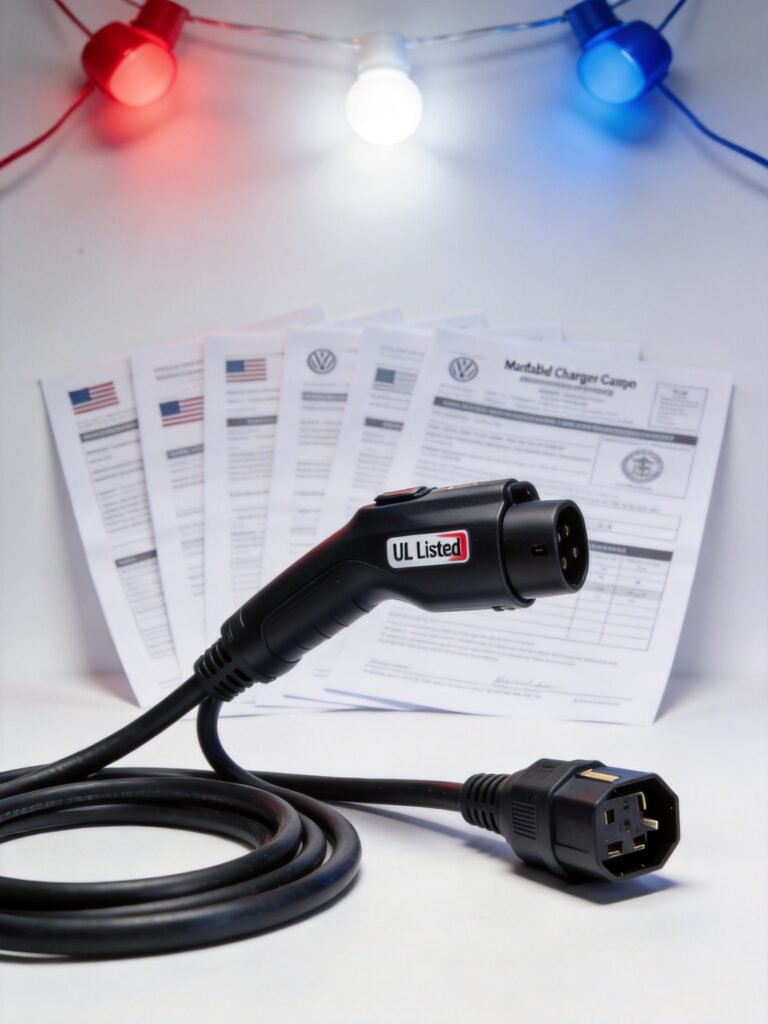
For North American market entry: UL 2202 (EV charging system equipment) and UL 2231 (personnel protection) are mandatory. Without UL listing, your product cannot be legally sold or installed in the US and Canada.
UL Certification for EV Charging Equipment: A Complete Guide for B2B Buyers in the North American Market
If you manufacture or distribute portable EV charging equipment and plan to sell into the United States or Canada, there is one certification that defines whether your product can legally enter the market: UL certification.
As a factory-direct supplier of portable charging guns, discharge guns, and dual-head connectors with full OEM/ODM capabilities and 7–15 day delivery, ChuangRui helps B2B buyers navigate both European and North American compliance requirements. Here is everything you need to know about UL standards for EV charging equipment in 2026.
Why UL Certification Is a De Facto Requirement in North America
Technically, UL (Underwriters Laboratories) certification is a “voluntary” standard. In practice, it functions as a mandatory requirement for the following reasons:
- NEC (National Electrical Code) mandate: NEC Article 625 — adopted by all 50 U.S. states — requires EV charging equipment to be “listed” (certified) by a Nationally Recognized Testing Laboratory (NRTL). UL standards are the recognized benchmarks.
- Insurance requirements: Most commercial property insurers require UL-listed EV charging equipment. Without it, claims may be denied in case of fire or electrical incidents.
- Building permits and inspections: AHJs (Authorities Having Jurisdiction) will not approve commercial EV charging installations without UL-listed equipment. The NEC 2026 edition adds even stricter installation requirements, including mandatory emergency disconnects for commercial EVSE.
- Utility interconnection: Utility companies often require UL certification before granting interconnection permission for commercial EV charging installations.
Simply put: without UL certification, your EV charging equipment cannot legally be installed or sold in most North American markets.
The Core UL Standards for Portable EV Charging Equipment
For portable EV charging guns and related accessories, four UL standards form the compliance stack:
UL 2594 — Electric Vehicle Supply Equipment (EVSE)
This is the primary standard for all EV charging stations, including portable Level 1 and Level 2 chargers. UL 2594 (harmonized as UL 2594 / CSA C22.2 No. 280 / NMX-J-677-ANCE across the U.S., Canada, and Mexico) covers:
- Thermal management under continuous high-current operation
- Enclosure integrity and environmental resistance
- Electrical input/output safety testing
- Performance under sustained 240V power delivery
Key test requirements include thermal stress testing (verifying internal components do not overheat during hours of continuous maximum-amp charging), physical durability testing (impact resistance, environmental degradation from UV and moisture), and input/output evaluation (ensuring the structural design handles steady power delivery without degrading electrical connections).
The latest edition (UL 2594 Ed. 4) also addresses EV power management systems — aligning with NEC 2026 Article 625.42(A) which now formally recognizes Power Control Systems for managing simultaneous charging loads.
UL 2231 — Personnel Protection Systems
While UL 2594 covers the equipment itself, UL 2231 protects the human operator. Split into two parts:
- UL 2231-1: General requirements for user protection systems in EV supply circuits
- UL 2231-2: Specific testing criteria for protective devices including GFCI (Ground Fault Circuit Interrupters) and CCID (Charge Circuit Interrupting Devices)
Critical requirement: GFCI protection must detect ground fault leakage and interrupt power within milliseconds — preventing potentially lethal electric shock. For portable chargers used outdoors in wet conditions (driveways, carports, open parking areas), this protection is non-negotiable.
NEC 2026 further expands GFCI requirements. All cord-and-plug connected EVSE rated 150V to ground or less and 50A or less must have GFCI protection per Section 625.54. The 2026 edition also requires more sensitive ground-fault protection thresholds across all installation types.
UL 2251 — Plugs, Receptacles, and Couplers
This standard covers the physical connectors — the vehicle plug (J1772 or NACS for North America), the equipment receptacle, and the coupler. UL 2251 requires:
- Endurance testing through 10,000+ mating cycles
- Crush resistance (connector must not expose live parts if run over)
- Dielectric voltage-withstand testing for insulation integrity
- Temperature rise limits under continuous rated current
ChuangRui’s connectors are manufactured with copper alloy contacts rated for 10,000 insertion cycles and PA66 housing with UL 94 V-0 flame retardancy — meeting or exceeding these requirements.
UL 817 — Cord Sets and Power Supply Cords
The cable assembly connecting the charging equipment to the vehicle is governed by UL 817. This standard ensures:
- Appropriate conductor sizing for the rated current
- Flexibility at temperature extremes (tested from -40°F to +176°F / -40°C to +80°C)
- Resistance to stretching, pulling, and abrasion
- Flame resistance of jacket and insulation materials
ChuangRui offers TPU-jacketed cables in multiple cross-sections (3×2.5mm², 3×6mm² configurations) with lengths from 3m to 15m, all meeting or exceeding UL 817 requirements while maintaining flexibility in sub-zero temperatures.
UL vs. CE Marking: Key Differences B2B Buyers Must Understand
Manufacturers serving both European and North American markets often ask: “If I already have CE marking, do I need separate UL certification?” The answer is yes. Here is why:
| Aspect | CE Marking (Europe) | UL Certification (North America) |
|---|---|---|
| Governing standards | IEC 61851-1, IEC 62196, EN standards | UL 2594, UL 2231, UL 2251, UL 817 |
| Connector type | Type 2 / CCS2 | J1772 / NACS (J3400) |
| Voltage system | 230V single-phase / 400V three-phase | 120V (L1) / 240V (L2) |
| Certification model | Self-declaration + Notified Body for some directives | Third-party listing by OSHA-recognized NRTL |
| Factory inspections | Varies by directive | Mandatory FUS (Follow-Up Service) ≥4× per year |
| GFCI/RCD standard | IEC 62423 (Type B RCD, 30mA) | UL 2231-2 (GFCI, 5mA trip threshold) |
| NEC/Installation code | IEC 60364 national adaptations | NEC Article 625 (NFPA 70) |
Key difference: While IEC-based test reports can sometimes be used to support UL applications (through the CB Scheme), UL certification requires the product to be specifically tested and listed to UL standards, with the listing bound to the specific manufacturing factory. This means you cannot simply “convert” a CE certificate into a UL listing — you need dedicated UL testing and certification.
However, manufacturers like ChuangRui who already design products to IEC 61851-1 and IEC 62196 standards have a significant advantage: the underlying electrical safety design, thermal management systems, and material specifications are largely shared. The main differences lie in connector types (J1772 vs Type 2), voltage ranges (120/240V vs 230/400V), and specific GFCI/RCD thresholds.
The North American Market Opportunity in 2026
The timing for North American market entry has never been better for certified EV charging equipment suppliers:
- NEC 2026 edition (finalized 2025) introduces stricter installation requirements, creating demand for higher-quality, properly listed equipment. Multiple states including Colorado, Massachusetts, Oregon, and Washington have already adopted the 2026 edition.
- IRA tax incentives: The 30C Alternative Fuel Vehicle Refueling Property Credit provides 30% of installation costs (up to $100,000 for commercial properties) for EV charging installations — but only with qualified (UL-listed) equipment.
- U.S. public charging infrastructure: Exceeded 200,000 points and growing rapidly, with federal and state funding accelerating deployment.
- Canada’s Zero Emission Vehicle Infrastructure Program: CAD 530 million committed through 2027 for charging infrastructure, requiring certified equipment.
For B2B buyers in automotive aftermarket, fleet operations, commercial real estate, and charging service providers, sourcing from a manufacturer with full UL compliance eliminates the risk of customs rejection, installation code violations, and insurance claim denials.
7-Point UL Compliance Verification Checklist for B2B Procurement
Before placing a bulk order for the North American market, verify these 7 points with your supplier:
- UL Listing (not just “UL Recognized Component”): The complete EVSE product must carry a UL Listed mark (not just individual components). Verify the listing at UL Solutions’ EV charging services page.
- All four standards covered: Confirm UL 2594, UL 2231, UL 2251, AND UL 817 compliance — not just one or two. Each standard covers a different safety domain.
- Correct connector for your market: J1772 (SAE J1772) for standard North American non-Tesla EVs; NACS (SAE J3400) for Tesla-compatible applications. Ensure connectors are UL 2251 listed.
- GFCI protection integrated: Portable chargers must include GFCI protection meeting UL 2231-2 requirements (5mA trip threshold within specified time). This is critical for passing NEC 625.54 inspections.
- Cable compliance: Verify UL 817 listing for the cord set, including correct AWG sizing (typically 8 AWG for 32A, 6 AWG for 40A+) and temperature rating.
- Proper marking and labeling: Equipment must display voltage, current, phase, frequency, manufacturer identification, and UL listing mark per NEC 2026 Section 625.54 requirements.
- Factory Follow-Up Service (FUS): Legitimate UL certification requires ongoing factory inspections. Ask the manufacturer how many FUS inspections they undergo annually — it should be ≥4.
ChuangRui: Your Compliance-Ready Manufacturing Partner
ChuangRui manufactures portable EV charging guns, discharge guns, and dual-head connectors with a complete multi-market certification stack:
- European compliance: CE, UKCA, RoHS, REACH, IEC 61851-1, IEC 62196
- North American readiness: UL certification program for portable EVSE products
- Quality management: IATF 16949 (automotive-grade), ISO 9001, ISO 14001, ISO 45001
- Production capacity: 300,000+ units annually, 7–15 day delivery
- OEM/ODM: Custom connector configurations, cable lengths, housing designs, firmware, and branding
Our engineering team supports B2B buyers through the entire certification and market entry process — from product specification alignment to documentation packages required for UL listing applications.
Whether you are a European distributor expanding into North America, a North American fleet operator sourcing certified equipment, or an automotive aftermarket company adding EV charging products to your catalog — ChuangRui provides the product quality, certification support, and manufacturing flexibility you need.
Browse our complete product range or explore our OEM/ODM customization services to start your North American market entry.
Contact ChuangRui — Get Your North American Compliance Package
Chat on WhatsApp — +86 13757774567 — Quick questions? Our team replies within 2 hours.
https://wa.me/8613757774567
Request our certification package
Contact us to receive full UL compliance documentation and product specifications
Request a quote — 24h response
Submit your requirements for a detailed quotation
European EV Market Briefing: Europe’s public charging network has surpassed 1.3 million charging points (August 2026), with H1 2026 BEV registrations reaching 1.22 million units (+40.5% YoY). Meanwhile, the NEC 2026 edition introduces stricter installation requirements for commercial EVSE, including mandatory emergency disconnects and enhanced GFCI protection — reinforcing the importance of sourcing properly UL-listed equipment for North American installations.
#EVCharger #ULCertification #NorthAmericanMarket #OEM #B2B #PortableEVCharger #J1772 #ChuangRui
📚 References
- UL 2202 — Standard for EV Charging System Equipment
- UL 2231 — Standard for Personnel Protection Systems for EV Supply Circuits
- US National Electrical Code (NEC) Article 625 — EV charging requirements
- Natural Resources Canada — EV charging equipment regulations
- SAE J1772 — EV connector standard for North America
Frequently Asked Questions
❓ What UL standards apply to EV charging equipment?
Two primary standards: UL 2202 covers the overall EV charging system (safety, electrical, mechanical). UL 2231 covers personnel protection (GFCI, RCD, ground-fault detection). Both are required for products sold in the US.
❓ How long does UL certification take for EV chargers?
Typically 3–6 months from application to listing, depending on product complexity and the number of test iterations needed. First-time applicants from Chinese manufacturers should budget 4–8 months including factory inspection.
❓ Can a CE-marked charger also get UL listing?
CE and UL are separate certification systems. A CE-marked charger may need significant design modifications to meet UL requirements (different GFCI thresholds, enclosure materials, labeling). Budget for a dedicated UL variant.
❓ What is the cost of UL certification for portable EV chargers?
UL listing fees typically range from $15,000–$50,000 depending on product complexity, plus annual factory inspection fees ($5,000–$15,000/year). For a product line of 5–10 models, total first-year cost is typically $40,000–$80,000.
❓ Is UL certification required for Canada as well?
UL certification through UL LLC covers the US market. For Canada, you need cUL listing (UL Canada) or CSA certification. Many manufacturers pursue dual UL/cUL listing simultaneously, which adds ~20% to certification cost but saves 3–4 months vs separate applications.

About the CREVCC Engineering Team
Our engineering team brings 12+ years of experience in EV charging system design, from PCB layout and power electronics to international certification compliance. We design and manufacture portable EV chargers, charging guns, and V2L discharge equipment for B2B partners across Europe, North America, and Southeast Asia.


