
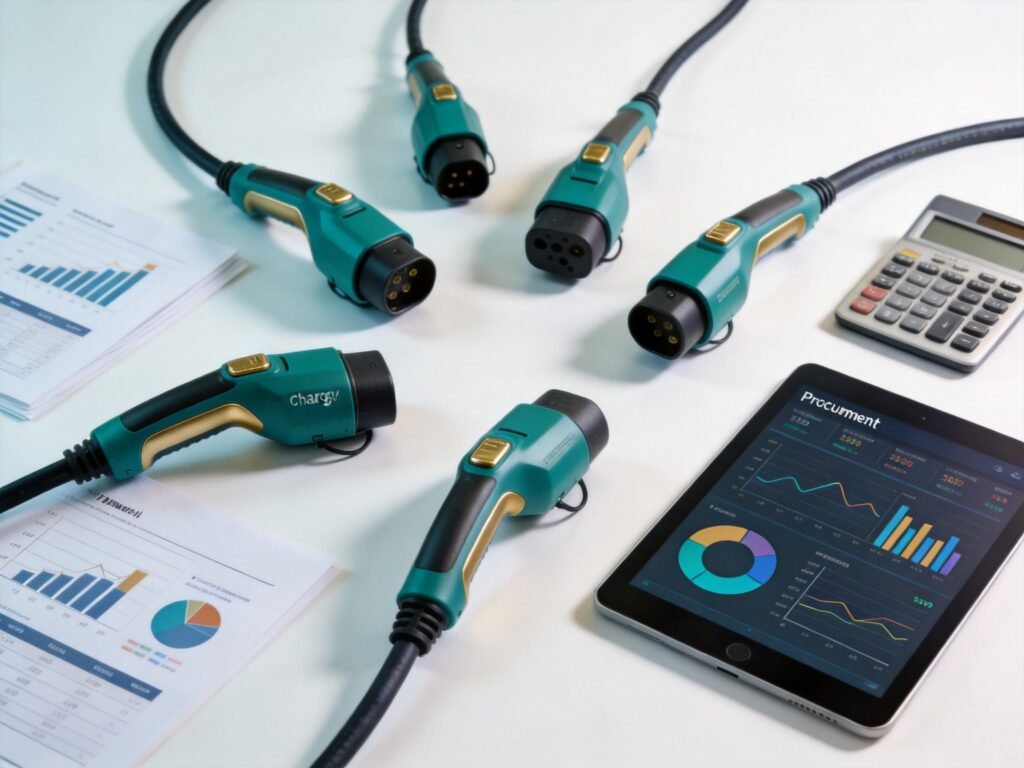
Total Cost of Ownership for Portable EV Charging Equipment: A B2B Buyer’s Framework for European Market Procurement in 2026
Key Takeaway for B2B Buyers
The cheapest portable EV charger often has 2–3× the Total Cost of Ownership of a premium unit. TCO includes: unit price + shipping + warranty claims + replacement logistics + brand reputation damage. Factor all five, and the ‘expensive’ option is usually cheaper.
When European B2B buyers evaluate portable EV charging equipment, the unit price tag often dominates the decision. But in a market where 1.1 million public charging points now serve over 14 million plug-in vehicles across the EU, procurement professionals know that the cheapest invoice rarely delivers the lowest long-term cost. The real measure of value is Total Cost of Ownership (TCO) — a framework that accounts for certification compliance, quality assurance, warranty exposure, supply chain reliability, and customization expenses over the full product lifecycle.
This guide breaks down every cost component that European distributors, fleet operators, and aftermarket buyers should include in their procurement calculations before placing a bulk order for portable charging guns, discharge guns, or dual-head connectors.
European Market Snapshot: Why TCO Matters More Than Ever in 2026
The European charging infrastructure has crossed a structural milestone. According to the latest analysis by Transport & Environment, the EU now exceeds its AFIR fleet-based charging target by 180 percent, with 26 of 27 member states meeting the mandatory 1.3 kW per BEV threshold. Eastern European markets — Poland, Romania, and the Baltic states — are recording charger deployment growth above 50 percent year-on-year, creating urgent procurement demand for certified portable charging equipment.
For B2B buyers sourcing from certified manufacturers, this growth wave translates into volume opportunity — but only if procurement decisions are built on TCO rather than unit price alone.
Cost Component 1: Certification Compliance — The Hidden Upfront Investment
Every portable EV charger sold in Europe must carry valid CE marking, UKCA certification (for the UK market), and compliance with RoHS and REACH environmental regulations. Products targeting automotive OEM supply chains additionally require IATF 16949 quality management certification from the manufacturer. To learn more about this topic, see our article on dual-head EV charging gun. You might also be interested in our guide to dual-head EV charging gun. For more details, explore our guide on dual-head EV charging gun. To learn more about this topic, see our article on dual-head EV charging gun.
The compliance cost structure has two layers:
- Type testing and certification fees: CE/UKCA certification for a single charging gun model typically costs EUR 3,000–8,000 depending on the testing laboratory and scope. UL certification for North American market crossover adds further expense. Buyers who source from manufacturers without pre-existing certifications must either absorb these costs themselves or pay a premium to certified suppliers.
- Ongoing compliance maintenance: Certification standards evolve. The EU Cyber Resilience Act (Regulation 2024/2847), now entering its enforcement phase, introduces cybersecurity requirements for connected charging equipment. Manufacturers must update firmware security, provide Software Bills of Materials (SBOM), and maintain vulnerability reporting processes. A supplier without a compliance roadmap creates future re-certification costs for the buyer.
Procurement action: Verify that your supplier holds current, verifiable certificates — not just claims. Request to review the full certification portfolio including test reports before committing to volume orders.
Cost Component 2: Quality Assurance — Preventing the 10x Rule
Industry data consistently shows that the cost of a quality failure in the field is approximately 10 times the cost of preventing it at the factory stage. For portable EV charging equipment, quality failures manifest as connector contact resistance exceeding the 5 mΩ threshold, insulation degradation under IP66/IP67 conditions, or mechanical failure before the rated 10,000 insertion cycle lifespan.
A rigorous TCO model must account for:
- Incoming Quality Control (IQC) costs: Either your own inspection resources or the manufacturer’s certified IQC process. Suppliers operating under IATF 16949 automotive-grade quality management systems typically deliver incoming defect rates below 50 PPM (parts per million), while non-certified suppliers may run 500–2,000 PPM.
- Warranty claim exposure: A typical portable charging gun warranty runs 2–3 years. If field failure rates exceed 1 percent, the replacement logistics cost (shipping, customs, re-delivery) quickly erases any unit price savings from a cheaper supplier.
- Brand reputation damage: For distributors selling to B2B end-users, unreliable products damage customer relationships far beyond the cost of a single warranty replacement.
Procurement action: Review the manufacturer’s quality testing protocol and request field failure rate data. Leading manufacturers target below 0.3 percent annual failure rates — anything above 1 percent should trigger a cost-benefit recalculation.
Cost Component 3: Supply Chain Reliability — The Cost of Late Delivery
In the European EV charging market, procurement timelines are compressing. The AFIR-driven infrastructure buildout means that distributors who cannot deliver to their end customers on schedule lose contracts to competitors. A 7–15 day delivery commitment from a factory-direct manufacturer like ChuangRui represents a tangible TCO advantage over suppliers with 45–90 day lead times.
The hidden costs of unreliable supply chains include:
- Inventory carrying costs: Buyers forced to order 3–6 months ahead to buffer against delivery uncertainty tie up working capital in safety stock. For a EUR 50,000 order, carrying costs at 8 percent annual rate add EUR 2,000–4,000 per quarter of提前 ordering.
- Lost sales from stock-outs: When infrastructure projects are ready to deploy and chargers are not available, buyers lose not just the immediate sale but future contract renewals.
- Expedited shipping premiums: Emergency air freight can cost 5–8 times the standard sea freight rate, entirely negating any per-unit price advantage from a distant or unreliable supplier.
Procurement action: Build delivery reliability into your TCO model. Calculate the real cost of a 30-day delay against a supplier offering 7–15 day factory-direct delivery.
Cost Component 4: OEM/ODM Customization — Reducing Long-Term Differentiation Costs
European distributors increasingly require branded products with custom specifications — specific cable lengths, connector configurations, packaging, labeling, and firmware settings. The customization cost structure varies dramatically between suppliers:
- Mold and tooling costs: Custom housing molds for branded products typically cost EUR 5,000–15,000. Some suppliers amortize this across order volumes; others charge it upfront. Understanding the amortization structure is critical to accurate TCO.
- Minimum order quantities (MOQs): High MOQs force buyers to over-order, increasing inventory costs. Flexible manufacturers offering lower MOQs for customized products reduce the total capital commitment.
- Engineering support costs: When a manufacturer provides in-house engineering for OEM customization (cable specification, connector selection, firmware configuration), the buyer saves on external engineering consultancy fees that typically run EUR 100–200 per hour.
Procurement action: Evaluate the OEM/ODM service offering holistically — not just the per-unit customization price, but the total program cost including tooling, MOQs, engineering support, and sample iteration cycles.
Building Your TCO Comparison Framework
To make informed procurement decisions, B2B buyers should build a TCO spreadsheet that includes the following line items over a 3-year product lifecycle:
- Unit purchase price (per charging gun or connector)
- Certification compliance costs (amortized across order volume)
- Incoming inspection and quality assurance costs
- Estimated warranty claim costs (failure rate × replacement logistics)
- Inventory carrying costs (based on required safety stock levels)
- Supply chain risk premium (expedited shipping probability × cost differential)
- Customization and tooling amortization
- Engineering and technical support costs
- End-of-life disposal or recycling compliance costs (per EU Battery Regulation)
When all components are quantified, the unit price typically represents only 40–55 percent of the total 3-year TCO. The remaining 45–60 percent comes from compliance, quality, logistics, and customization costs — areas where certified, factory-direct manufacturers with proven track records deliver decisive advantages.
For European B2B buyers evaluating portable EV charging equipment suppliers in 2026, the message is clear: look beyond the invoice. The lowest unit price often carries the highest total cost. Explore ChuangRui’s certified product range and request a detailed TCO comparison to see how factory-direct sourcing from a fully certified manufacturer impacts your bottom line.
Get in Touch with Our Team
1. Chat on WhatsApp
+86 13757774567
Quick questions? Our team replies within 2 hours.
Start WhatsApp Chat
2. Request our certification package
Need CE, UKCA, UL, or IATF 16949 documentation for your procurement file?
Request Certification Package
3. Request a quote — 24h response
Tell us your specifications, volume, and timeline. We respond within one business day.
Request a Quote
#EVCharger #PortableCharger #B2BProcurement #TCO #OEM #EVChargingEquipment #EuropeanMarket #ChargingGun
📚 References
Frequently Asked Questions
❓ What is Total Cost of Ownership (TCO) for EV charging equipment?
TCO is the complete cost of purchasing, deploying, and maintaining EV chargers over their useful life (typically 5–8 years). It includes: unit price, shipping, customs/duties, installation, maintenance, warranty claims, energy consumption, and end-of-life disposal.
❓ What are the hidden costs in cheap EV chargers?
Four main hidden costs: (1) Higher warranty claim rate (3–5% vs <1% for premium), (2) Customer support burden from compatibility issues, (3) Replacement logistics (shipping defective units back to China), (4) Brand reputation damage from negative reviews.
❓ How do warranty claims affect TCO?
A 3% warranty failure rate on a 1,000-unit order means 30 units need replacement. At $25/unit for return shipping + $80/unit replacement cost, that’s $3,150 in hidden costs — erasing any 5% unit price savings. Premium chargers with <1% failure rate save $2,100+ per 1,000 units.
❓ How should B2B buyers calculate TCO?
Formula: TCO = Unit Price × Qty + Shipping + Duties + (Failure Rate × Replacement Cost × Qty) + (Support Hours × Hourly Rate) + Brand Risk Adjustment. Request supplier data on field failure rates and warranty claims to populate the formula.
❓ What TCO benchmarks should B2B buyers use?
For portable EV chargers (16A/32A): target TCO of €45–65/unit over 5 years for quality products. Below €40/unit TCO usually indicates corner-cutting on components. Above €70/unit TCO may indicate over-engineering or premium brand markup.

About the CREVCC Engineering Team
Our engineering team brings 12+ years of experience in EV charging system design, from PCB layout and power electronics to international certification compliance.


