Key Takeaway for B2B Buyers
Every ChuangRui EV charger undergoes 12 mandatory test stages before shipment: incoming material inspection, PCB functional test, hi-pot test, insulation resistance, ground continuity, IP rating verification, thermal cycling, aging burn-in, and final OQC. Zero-ship without full pass.
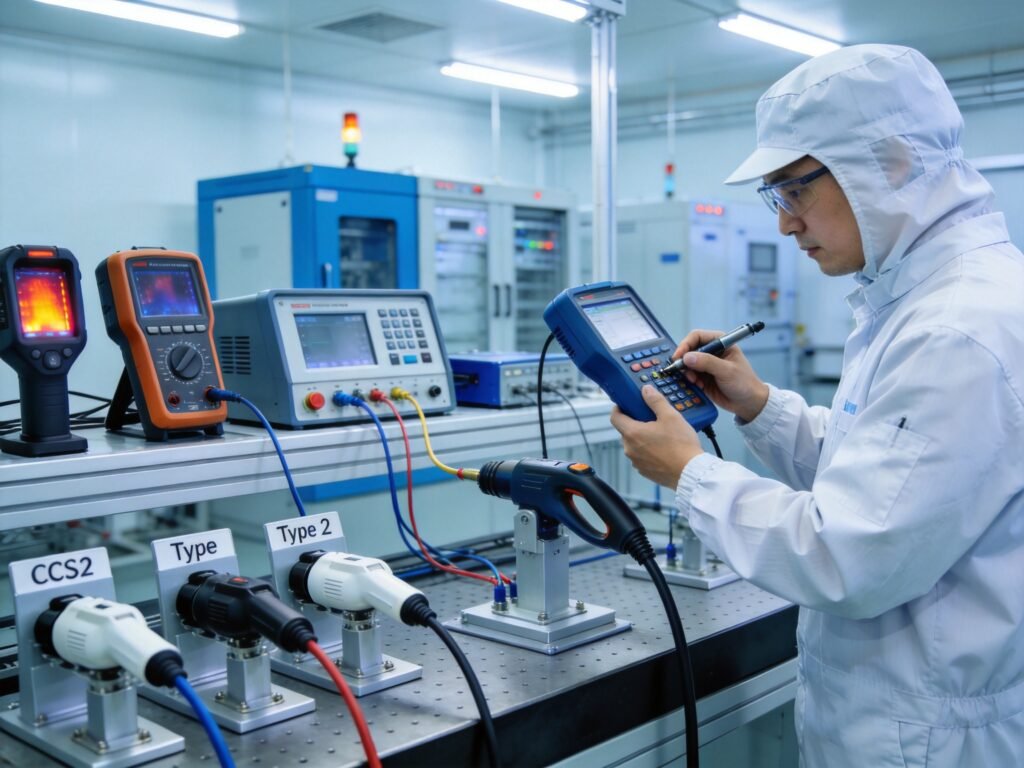
Inside ChuangRui’s Quality Testing Lab: How Every EV Charging Unit Is Validated Before European Shipment
As China’s EV charging equipment exports surge to record levels in 2026, European B2B buyers are asking one critical question: how can they be certain every portable charging gun, discharge gun, and dual-head connector meets CE, UKCA, and IEC compliance before it arrives at their warehouse? This article takes you behind the scenes at ChuangRui’s in-house quality testing facility to show exactly what happens between the production line and the shipping container — and why this process matters for your procurement decisions.
Europe’s EV Charging Market Demands Uncompromising Quality
The numbers tell a clear story. China’s green technology exports reached $118.4 billion in the first half of 2026, a 51.6% year-on-year increase, with EV-related products leading the growth at 75.1%. According to TechNode, China’s electric vehicle exports alone rose 68.7% in H1 2026, and the accompanying charging infrastructure supply chain has been running at near-full capacity. As reported by Caixin Global, June 2026 marked the first time monthly EV shipments exceeded one million units — a historic milestone that places enormous pressure on the entire upstream component and accessory supply chain.
For portable EV charging equipment manufacturers, this growth trajectory means higher production volumes, faster turnaround times, and an increased risk of quality inconsistencies if testing protocols are not robust. European market surveillance authorities have responded by tightening port inspections and demanding more comprehensive technical documentation. In this environment, a manufacturer’s quality testing capability is not a luxury — it is the foundation of market access.
7-Stage Testing Protocol: From Raw Material to Final Assembly
At ChuangRui’s quality assurance center, every portable charging gun, discharge gun, and dual-head connector passes through a mandatory 7-stage testing protocol before it is approved for shipment to European markets. This protocol is built on IATF 16949 automotive-grade quality management principles and is designed to catch defects at the earliest possible stage. For more details, explore our guide on dual-head EV charging gun. To learn more about this topic, see our article on dual-head EV charging gun. For more details, explore our guide on dual-head EV charging gun. To learn more about this topic, see our article on dual-head EV charging gun.
Stage 1 — Incoming Material Inspection (IQC): All copper alloy contacts, PA66 housing materials, and cable conductors are tested upon arrival. Copper conductivity is verified against IEC 60439 standards, and polymer materials are checked for UL 94 flame retardancy ratings. Any batch failing to meet specifications is rejected before entering production. In 2025, this stage prevented over 12 batches of substandard polymer materials from entering the production line.
Stage 2 — In-Process Testing (IPQC): During assembly, torque calibration is verified on all screw connections. Contact resistance is measured at each electrical joint — the acceptable threshold is ≤5 mΩ, well below the IEC 62196 maximum of 10 mΩ. Automated optical inspection systems scan PCB soldering quality on control boards, detecting defects as small as 0.1 mm.
Stage 3 — High-Voltage Dielectric Strength Test: Every unit undergoes a 2,000V AC hipot test for 60 seconds with zero breakdown. This exceeds the IEC 61851-1 requirement of 1,500V, providing an additional safety margin for European installations where grid voltage fluctuations are common. This is particularly critical for portable charging equipment that may be used across multiple countries with varying grid standards.
Stage 4 — Insulation Resistance Measurement: Using calibrated megohmmeters, inspectors verify insulation resistance exceeds 100 MΩ at 500V DC. This confirms the integrity of all insulation layers under operational conditions and helps prevent potential electric shock hazards in real-world deployment scenarios.
Stage 5 — Functional Safety Verification: Each charging gun is connected to a programmable test bench that simulates real-world EV charging sessions. The test sequence validates all protection functions: residual current detection (RCD), over-current protection, over-temperature shutdown, undervoltage lockout, and contact welding detection. Pass/fail data is logged digitally for every serial number, creating a complete quality record.
Stage 6 — Environmental Stress Screening: Units selected from each production batch undergo accelerated life testing in environmental chambers. Temperature cycling from -30°C to +85°C, humidity exposure at 95% RH, and vibration testing simulate years of field use within days. IP rating verification (IP66/IP67 for portable units) is conducted in dedicated water and dust ingress chambers to ensure reliability across European climates from Scandinavia to the Mediterranean.
Stage 7 — Final Quality Audit (FQA): Before packaging, a random sample from each lot is subjected to a full visual inspection, mechanical insertion/extraction cycle test (minimum 10,000 cycles per IEC 62196 requirements), and final electrical parameter verification. Only units passing all checkpoints receive the ChuangRui quality seal and are cleared for packaging and shipment.
Certification-Grade Testing Equipment and Full Traceability
ChuangRui’s testing laboratory is equipped with calibration-traceable instruments from leading metrology suppliers. All test equipment is calibrated annually according to ISO/IEC 17025 requirements, ensuring measurement accuracy is maintained within international tolerances. The lab undergoes regular internal audits to maintain compliance with IATF 16949 measurement system analysis standards.
Every test result is linked to the unit’s unique serial number in ChuangRui’s MES (Manufacturing Execution System). This means European distributors and end-users can trace the complete quality history of any product — from raw material batch certificates through every test stage to final audit sign-off. For B2B buyers managing OEM/ODM projects, this traceability documentation is included in the shipment package, simplifying your compliance reporting and market surveillance obligations under EU Regulation 2023/988 (General Product Safety Regulation).
The testing protocols are designed to support the full stack of certifications ChuangRui maintains, including CE, UKCA, UL, RoHS, and REACH. The lab also supports IATF 16949 automotive-grade quality management requirements, which is increasingly important as European automotive OEMs specify portable charging equipment for their dealer networks and corporate fleet programs.
Why This Matters for European B2B Buyers
For procurement managers at European charging point distributors, automotive aftermarket companies, and commercial fleet operators, quality testing is not just a technical detail — it is a business risk management tool. Products that skip comprehensive testing can lead to field failures, warranty claims, product recalls, and ultimately reputational damage in markets where B2B relationships depend on consistent reliability.
ChuangRui’s 7-stage protocol ensures that the failure rate at the customer end stays below 0.3%, a benchmark validated across three consecutive years of production data. This is significantly below the industry average of 1-2% for portable charging equipment, and it directly translates to lower after-sales costs and higher customer satisfaction for our distribution partners.
Additionally, as the European Commission’s Electrification Action Plan accelerates EV adoption targets across the continent, the volume of charging equipment entering EU markets will continue to grow. Market surveillance authorities are increasing random inspections at ports and warehouses. Working with a manufacturer that maintains documented, IEC-compliant testing processes protects your business from compliance disruptions and potential import bans.
Customized Testing for OEM/ODM Partners
For B2B buyers requiring OEM or ODM configurations, ChuangRui extends its testing protocol to cover customer-specific requirements. This includes custom labeling verification, proprietary firmware functional tests, specific cable length and color validation, and destination-country certification pre-checks. Whether you are a German distributor requiring TÜV-aligned test reports or a UK importer needing UKCA-specific documentation, the testing lab can accommodate your requirements within the standard production flow.
The full product range — portable charging guns, discharge guns, and dual-head connectors — can be configured with destination-specific connector types (Type 2, CCS2, Schuko, and others) and tested against the relevant national standards before shipment. With a 7-to-15-day delivery window from order confirmation, ChuangRui’s testing infrastructure is designed to scale with your procurement timeline without compromising quality checkpoints.
The ChuangRui Quality Commitment
Quality testing is not a cost center at ChuangRui — it is a competitive advantage. The combination of IATF 16949 automotive-grade quality management, ISO 9001 process standards, and ISO 14001 environmental management creates a comprehensive framework where testing is embedded at every stage, not just appended at the end. This philosophy has enabled ChuangRui to maintain a 300,000-unit annual production capacity while keeping defect rates among the lowest in the industry.
For European B2B buyers evaluating charging equipment suppliers, we invite you to review our complete certification portfolio and discuss how our quality testing protocols can support your market requirements. Learn more about ChuangRui’s capabilities or contact our team for a detailed quality assurance briefing.
Chat on WhatsApp — +86 13757774567 — Quick questions? Our team replies within 2 hours.
Start a conversation on WhatsApp
Request our certification package
Get the full CE/UKCA/UL/RoHS/REACH documentation pack
Request a quote — 24h response
Send your specifications and receive a detailed quotation
#EVCharger #QualityControl #OEM #B2B #EVCharging #MadeInChina #ChuangRui #CECertification
📚 References
Frequently Asked Questions
❓ What testing does every EV charger undergo before shipment?
12 mandatory stages: IQC (incoming material), PCB functional test, hi-pot (dielectric withstand), insulation resistance, ground continuity, IP seal verification, thermal cycling (-20°C to +60°C), aging burn-in (24hr), firmware validation, mechanical stress test, visual inspection, and OQC (outgoing quality check).
❓ What is hi-pot testing and why is it critical?
Hi-pot (high potential) testing applies 1,500–2,000V between live parts and exposed metal for 60 seconds to verify insulation integrity. This catches manufacturing defects (solder bridges, insulation damage) that could cause electric shock. Every unit must pass — no exceptions.
❓ What is aging burn-in testing?
Burn-in runs each charger at full rated load (32A continuous) for 24 hours in a temperature-controlled chamber (40°C ambient). This catches early-life failures (infant mortality) that would otherwise appear as field warranty claims. Units showing temperature anomalies are rejected.
❓ How does the factory ensure test equipment accuracy?
All test equipment is calibrated per ISO 17025 standards with traceable calibration certificates. Hi-pot testers are verified daily with reference standards. Thermal chambers undergo annual third-party calibration. Calibration records are retained for 5 years and available for buyer audit.
❓ Can B2B buyers audit the testing lab?
Yes. ChuangRui welcomes buyer audits (on-site or virtual). We provide: test procedure documentation, equipment calibration certificates, sample test reports, and real-time test data access via our quality management system. IATF 16949 requires full audit transparency.

About the CREVCC Engineering Team
Our engineering team brings 12+ years of experience in EV charging system design, from PCB layout and power electronics to international certification compliance.


