Key Takeaway for B2B Buyers
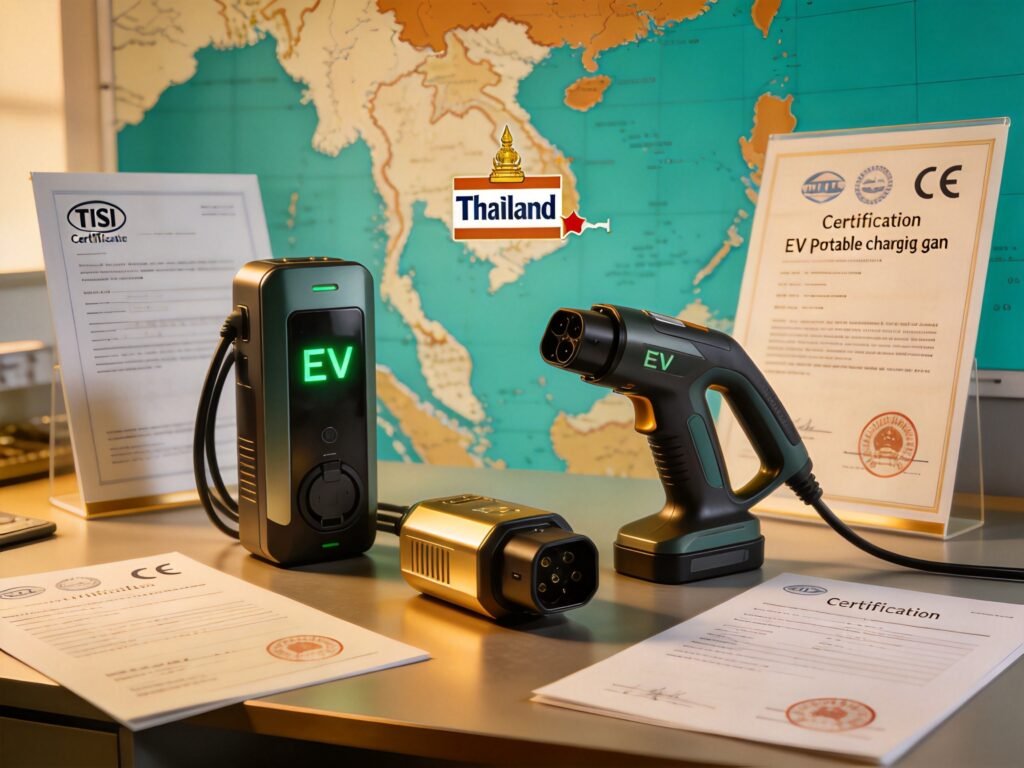
Thailand now mandates TISI certification for all EV chargers sold domestically (TISI 2863 for AC chargers). B2B buyers sourcing from China must verify the factory has TISI listing — without it, goods will be seized at customs.
Thailand TISI Mandates EV Charger Certification: What B2B Buyers in Southeast Asia Must Know in 2026
On July 21, 2026, the Thai Industrial Standards Committee approved five new mandatory EV-related standards — including the first-ever compulsory certification requirement for portable EV charging cables, AC chargers, and DC fast chargers entering the Thai market. For B2B buyers sourcing EV charging equipment from international suppliers, this signals a significant shift in Southeast Asia’s regulatory landscape that demands immediate attention.
Here is what the new TISI mandate means for your procurement strategy — and how to prepare.
Thailand’s EV Market Is Booming — and Regulation Is Catching Up
Thailand has positioned itself as Southeast Asia’s leading EV manufacturing hub. According to the Thailand Board of Investment (BOI), approved investment in the country’s electrified mobility sector reached THB 137 billion (approximately US$4.1 billion across 198 projects as of May 2026, spanning vehicle manufacturing, battery production, and charging infrastructure.
Key market indicators from the Thai market include:
- Over 22,900 EV chargers installed nationwide, including more than 10,000 DC fast chargers
- THB 9.788 billion committed across 42 dedicated charging infrastructure projects
- BEV sales grew over 80% year-on-year in 2025, with Bangkok core-area electrification penetration exceeding 30%
- Major global OEMs — including BYD, Mercedes-Benz, BMW, SAIC, and Great Wall Motor — now manufacture EVs locally
This explosive growth has exposed a critical gap: Thailand previously had no mandatory certification requirement for EV charging equipment. Products could be imported and sold without meeting any standardized safety or performance benchmark. The new TISI approval closes that gap entirely.
What the New TISI Standards Cover for EV Chargers
The Thai Industrial Standards Committee’s July 21 decision adds five EV-related standards to the mandatory controlled products list. For EV charging equipment specifically, three product categories are now subject to compulsory TISI certification:
| Product Category | Standard Reference | Enforcement Timeline |
|---|---|---|
| Portable EV charging cables | TIS 61851-1-2567 (aligned with IEC 61851) | June 2027 |
| AC home charging stations | TIS 61851-1-2567 | June 2027 |
| DC fast chargers | TIS 61851-1-2567 | Early 2028 |
Additionally, two vehicle safety standards were added — side-impact and frontal-impact occupant protection requirements — bringing Thailand’s total EV-related standards to 214, with 11 now under mandatory control.
The series classification rules for EV chargers are rigorous, requiring separate certification for each combination of: importer, factory, indoor/outdoor installation type, rated input voltage, rated output voltage, rated output current, enclosure type, electrical system (single-phase/three-phase), electric shock protection class, and IP rating.
Why This Matters for European and Global B2B Buyers
If your procurement scope extends beyond Europe — whether you are a distributor serving Southeast Asian markets, a fleet operator with regional operations, or a trading company supplying multiple geographies — Thailand’s new TISI requirement introduces a new certification layer that cannot be overlooked.
Here is why this development has broader implications:
1. The ASEAN Certification Fragmentation Is Accelerating
Thailand’s move follows a pattern we have seen across global markets: as EV adoption matures, regulators tighten product entry requirements. Vietnam has already implemented updated TCVN energy efficiency labeling standards for electrical products. The Philippines, Indonesia, and Malaysia are each developing their own national EV standards frameworks. B2B buyers who assumed a single CE or UL certification would unlock all export markets will find that assumption increasingly untenable.
2. TISI Standards Are IEC-Aligned but Not Identical
TIS 61851-1-2567 is based on the IEC 61851 series — the same international standard that underpins the European EN 61851 testing for CE marking. However, TISI applies its own series classification rules, testing protocols, and documentation requirements. A product carrying CE marking is not automatically compliant with TISI. Separate testing and certification through a TISI-accredited laboratory is required. For more details, explore our guide on CE marking for EV chargers. For more details, explore our guide on CE marking for EV chargers.
3. Non-Compliance Consequences Are Severe
Products without valid TISI certification cannot clear Thai customs. Online marketplaces (Lazada, Shopee, TikTok Shop) will delist non-compliant products and penalize seller accounts. The Thai government has explicitly stated that the new standards are designed to filter out low-quality imports and protect consumer safety.
The Broader Picture: A Global Certification Stack Is Forming
Thailand’s TISI mandate arrives at a time when the global EV charging equipment certification landscape is becoming more complex than ever. B2B buyers sourcing from international manufacturers now face a multi-layered compliance stack:
| Market | Key Certifications | Status in 2026 |
|---|---|---|
| European Union | CE (LVD + EMC + RoHS), UKCA, EN 61851, EU Cyber Resilience Act | CRA enforcement from September 2026 |
| United Kingdom | UKCA marking (post-Brexit transition ending) | Mandatory from 2025 |
| United States | UL 2231/UL 2202, FCC Part 15, Energy Star | Established requirements |
| Thailand | TISI (TIS 61851-1-2567) | New mandatory from 2027-2028 |
| China (domestic) | CCC (mandatory from August 1, 2026) | New GB/T 18487.2-2026 EMC standard |
For procurement teams, the strategic question is no longer whether your supplier can meet one certification — but whether they can navigate this multi-market certification stack efficiently and cost-effectively.
How to Evaluate Your Supplier’s Multi-Market Certification Capability
When the TISI mandate takes effect, buyers will need suppliers who can deliver certification-ready products across multiple markets. Here is a practical evaluation framework:
Certification Portfolio Depth
Ask your supplier which international certifications they currently hold. A manufacturer with existing CE, UKCA, UL, IEC 61851, and ISO 17025-accredited testing capabilities will have a significantly shorter path to TISI compliance — because the underlying technical standards (IEC 61851) are shared. Look for suppliers with IATF 16949 automotive-grade quality management, as this demonstrates systematic compliance processes.
Standard Alignment Awareness
Verify that your supplier understands the differences between IEC-aligned standards across markets. For example, TIS 61851-1-2567 and EN 61851-1 both derive from IEC 61851-1, but each national implementation has unique series classification rules, documentation formats, and testing facility accreditation requirements.
OEM/ODM Flexibility
Suppliers offering OEM/ODM customization can adapt product specifications — connector types (CCS2, Type 2, GB/T), voltage configurations, IP ratings, labeling — to meet the specific requirements of each target market. This flexibility becomes critical when a single product line must serve European, Southeast Asian, and other regional markets simultaneously.
Documentation and Technical File Readiness
TISI certification requires detailed technical documentation including mechanical drawings, pinout definitions, test reports from accredited laboratories, and series classification declarations. Suppliers who maintain comprehensive technical files for existing CE/UL certifications can typically extend these to TISI with less additional engineering effort.
Action Items for B2B Buyers
Based on the TISI timeline and the broader global certification trend, here is what procurement teams should prioritize:
- Audit your current supplier’s certification portfolio. Confirm which markets they currently serve and which certifications they hold. Identify any gaps relevant to your target export markets.
- Map your product roadmap against upcoming enforcement dates. Thailand’s portable EV charging cable and AC charger requirements take effect in June 2027 — roughly 11 months away. DC fast charger requirements follow in early 2028. Start certification conversations now.
- Prioritize suppliers with IEC-aligned testing infrastructure. Manufacturers with in-house IEC 61851/62196 testing capability, ISO/IEC 17025-accredited laboratories, and IATF 16949 quality systems are best positioned to navigate multi-market certification efficiently.
- Factor certification costs into your total cost of ownership analysis. Each new market entry requires testing, documentation, and ongoing compliance maintenance. Suppliers who absorb part of this cost through their existing certification infrastructure offer a structural advantage.
- Monitor ASEAN regulatory developments proactively. Thailand’s TISI move is part of a regional pattern. Vietnam, Indonesia, Malaysia, and the Philippines are all developing EV-specific standards. Buyers who anticipate these shifts will avoid last-minute compliance scrambles.
How ChuangRui Supports Multi-Market Certification
At ChuangRui, we manufacture portable charging guns, discharge guns, and dual-head connectors with a full international certification stack: CE, UKCA, UL, RoHS, REACH, backed by IATF 16949 automotive-grade quality management and ISO 9001/14001/45001 certifications.
Our IEC 61851 and IEC 62196-aligned product platform is designed for multi-market deployment. When new regional standards like Thailand’s TISI 61851-1-2567 come into effect, our existing technical documentation, testing infrastructure, and OEM/ODM customization capabilities allow us to extend compliance to new markets efficiently. To learn more about this topic, see our article on EV charging connector standards. To learn more about this topic, see our article on EV charging connector standards.
Our production capacity of 300,000 units annually and comprehensive product portfolio — covering Mode 2 portable chargers, Mode 3 Type 2 charging solutions, and V2L/V2G discharge equipment — means we can serve buyers targeting multiple export destinations from a single, certified product platform.
Ready to Discuss Multi-Market Certification for Your EV Charging Procurement?
Chat on WhatsApp — +86 13757774567 — Quick questions? Our team replies within 2 hours.
Start a conversation on WhatsApp
Request our certification package — Get our full CE/UKCA/UL/IATF 16949 documentation overview.
Request certification documents
Request a quote — 24h response
Get a quotation for your project
Read more about EV charging equipment certifications and procurement:
- Explore our certified EV charging products
- OEM/ODM customization services
- View our full certification portfolio
- About ChuangRui — certified EV charging equipment manufacturer
#EVChargerCertification #TISI #ThailandEV #B2BProcurement #OEMManufacturer #CEMarking #IEC61851 #SoutheastAsiaEV
📚 References
Frequently Asked Questions
❓ What is TISI certification and who requires it?
TISI (Thai Industrial Standards Institute) certification is mandatory for EV charging equipment sold in Thailand. It is the Thai equivalent of CE/UL, based on IEC 61851-1 with local amendments. The Thailand FDA/Customs will reject non-certified chargers at import.
❓ Which TISI standard applies to EV chargers?
TISI 2863 covers AC EV charging equipment for the Thai market. It is harmonized with IEC 61851-1 but includes additional requirements for tropical climate operation (higher temperature/humidity testing) and Thai-language labeling.
❓ How long does TISI certification take?
Typically 3–6 months. The process includes: application submission, document review, sample testing at a TISI-accredited lab (or recognized foreign lab), and factory inspection. First-time applicants from China should budget 4–8 months.
❓ Can CE-certified chargers also get TISI certification?
Yes — CE test reports from ILAC-accredited labs are generally accepted as the basis for TISI assessment. However, additional testing may be required for tropical climate conditions (high temperature/humidity endurance) and Thai-specific labeling requirements.
❓ What are the penalties for selling non-TISI-certified EV chargers in Thailand?
Importing or selling non-certified electrical equipment is illegal under the Thai Industrial Standards Act. Penalties include: product seizure, fines up to ฿2,000,000 (~$57,000), and imprisonment up to 2 years for repeat offenders.

About the CREVCC Engineering Team
Our engineering team brings 12+ years of experience in EV charging system design, from PCB layout and power electronics to international certification compliance.


