EV Charging Equipment Certifications Explained: What CE, UKCA & IEC Standards Mean for European Buyers
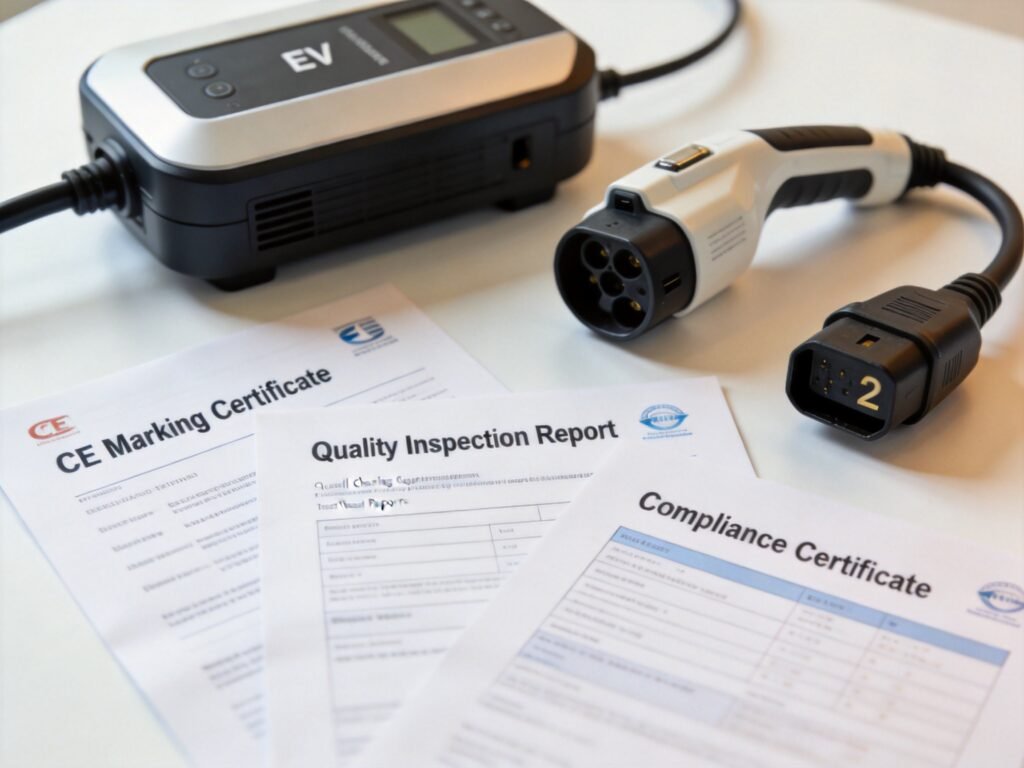
If you’re importing EV charging equipment into Europe, certifications aren’t optional — they’re your ticket to market access. Without proper CE marking, UKCA compliance, or the right IEC test reports, your products won’t clear customs, won’t pass inspections, and could expose you to significant legal liability.
At Chuangrui New Energy Technology, we’ve invested heavily in building one of the most comprehensive certification portfolios among EV charging gun manufacturers in China. This guide walks you through exactly which certifications matter, what they cover, and why they should influence your sourcing decisions.
Why Certifications Matter More Than Ever in 2026
The European regulatory landscape for EV charging equipment has gotten significantly more complex in 2026. Three major regulatory developments are reshaping compliance requirements:
- New EMC rules take effect October 1, 2026. The European Commission confirmed (Official Journal OJ L 2026/187) that EN IEC 61000-6-2/-4:2025 electromagnetic compatibility standards become mandatory from October 1, 2026. The transition period was extended to September 30, 2026 — but after that date, all products entering the EU must comply with the updated EMC framework.
- AFIR interoperability requirements are now in force. Since January 8, 2026, new or modernized public AC and DC charging points must support the ISO 15118-2 communication standard, enabling Plug & Charge functionality. By January 2027, this extends to ISO 15118-20, which enables smart charging and Vehicle-to-Grid (V2G).
- The Cyber Resilience Act (CRA) is approaching. From September 2027, all internet-connected charging hardware sold in the EU must meet security-by-design requirements, including secure firmware updates, vulnerability management, and incident reporting. Manufacturers are expected to begin preparing now.
For buyers, this means choosing a supplier with up-to-date certifications isn’t just good practice — it’s essential for regulatory survival.
The Certifications Every European EV Charging Buyer Should Know
Let’s break down the key certifications and what they actually mean for your procurement:
CE Marking (European Conformity)
The CE mark is the mandatory passport for any product sold in the European Economic Area (EEA). For EV charging equipment, CE compliance covers multiple directives:
- LVD (Low Voltage Directive 2014/35/EU) — Electrical safety for AC 50–1000V / DC 75–1500V equipment. Covers insulation resistance, grounding continuity, leakage current, temperature rise, and IP protection ratings.
- EMC (Electromagnetic Compatibility Directive 2014/30/EU) — Ensures the equipment doesn’t generate excessive electromagnetic interference and can withstand interference from other devices. This is particularly challenging for EV chargers due to high-power switching.
- RED (Radio Equipment Directive 2014/53/EU) — Required if the equipment includes wireless communication modules (4G, Wi-Fi, Bluetooth, PLC). Covers radio frequency performance and EMC for wireless devices.
- RoHS (Restriction of Hazardous Substances 2011/65/EU) — Limits six hazardous substances (lead, mercury, cadmium, hexavalent chromium, PBB, PBDE) in all materials and components.
Key standards: EN 61851-1 (general safety), EN 61851-21-1/-21-2 (EMC for charging), EN 62196-1/-2 (connectors — Type 2), EN 62368-1 (electronic equipment safety).
UKCA Marking (United Kingdom)
Post-Brexit, the UK requires its own conformity assessment. The UKCA mark replaces CE marking for products placed on the Great Britain market. While the UK has repeatedly extended acceptance of CE marking, the long-term direction is clear: UKCA compliance is essential for any manufacturer targeting the British market.
Our products carry both CE and UKCA marks, meaning our European and UK customers can source from the same product family without dual certification headaches.
IEC Standards (International Electrotechnical Commission)
The IEC standards form the technical backbone of charging equipment safety worldwide:
- IEC 61851-1 — The foundational standard for conductive charging systems. Covers portable, movable, and fixed EVSE, plus general system requirements. Currently undergoing a comprehensive revision (2025–2026).
- IEC 61851-23 — Specific to DC charging equipment. The newly released IEC 61851-23-1:2026 covers DC EV supply equipment with automated connection devices.
- IEC 62196-1/-2/-3 — Standards for plugs, socket-outlets, and vehicle connectors. Part 2 covers AC accessories (Type 1 and Type 2); Part 3 covers DC accessories (CCS1, CCS2, CHAdeMO).
- IEC 62752 — Covers portable/movable EVSE with integrated control and protection functions (Mode 2 charging). A new edition was published in March 2024.
IATF 16949 (Automotive Quality Management)
This is the gold standard for automotive supply chain quality. IATF 16949 certification demonstrates that a manufacturer’s quality management system meets the stringent requirements of the global automotive industry. It goes beyond ISO 9001, adding specific requirements for:
- Product safety and regulatory compliance
- Supplier management and traceability
- Failure mode analysis and preventive action
- Customer-specific requirements management
Not every EV charging manufacturer holds IATF 16949. For European automotive OEMs and Tier 1 suppliers sourcing charging accessories, this certification is often a non-negotiable requirement.
ISO 14001 & ISO 45001
- ISO 14001 — Environmental management system. Demonstrates the manufacturer’s commitment to reducing environmental impact through systematic environmental management.
- ISO 45001 — Occupational health and safety. Ensures safe working conditions in the manufacturing facility, reducing workplace risks and ensuring consistent production quality.
CB Scheme (Certification Bodies)
The CB scheme provides internationally recognized test reports that can be used to obtain national certifications in over 50 countries. For buyers who need to import into multiple markets beyond Europe, CB test reports significantly reduce duplication of testing and accelerate time-to-market.
Chuangrui’s Certification Portfolio
Here’s the complete certification picture for our product range:
| Certification | Scope | Status |
|---|---|---|
| CE (LVD + EMC + RED + RoHS) | EU/EEA market access | Certified |
| UKCA | United Kingdom market | Certified |
| CB | International (50+ countries) | Certified |
| CCC / CQC | China domestic market | Certified |
| RoHS / REACH | Environmental compliance | Compliant |
| IATF 16949 | Automotive quality management | Certified |
| ISO 9001 | Quality management system | Certified |
| ISO 14001 | Environmental management | Certified |
| ISO 45001 | Occupational health & safety | Certified |
This portfolio covers every major certification required for the European, UK, and international markets. When you source from Chuangrui, you receive complete documentation packages — not just product certificates, but the full test reports, Declarations of Conformity, and technical files needed for your own regulatory submissions.
How to Verify a Supplier’s Certifications
Unfortunately, not all certificates you see online are legitimate. Here’s how to verify:
- Check the issuing body. Legitimate CE certifications are self-declared (DoC) or issued by Notified Bodies (NB) such as TÜV, SGS, or Bureau Veritas. Verify the NB number on the EU NANDO database.
- Request original test reports. A real certification comes with detailed test reports (not just a certificate). Ask for LVD, EMC, and RoHS test reports from accredited laboratories.
- Verify IATF 16949 on the IATF portal. The International Automotive Task Force maintains a public database of certified companies.
- Ask for the EU Authorized Representative. Non-EU manufacturers must designate an EU Authorized Representative (EU REP) for CE compliance. Request the REP agreement and contact details.
- Cross-check product scope. Ensure the certificate covers the specific product model and specifications you’re ordering — not just a different product from the same manufacturer.
What’s Coming Next: Preparing for CRA and Updated Standards
Looking ahead to late 2026 and 2027, European buyers should be aware of several upcoming compliance shifts:
- Cyber Resilience Act (CRA) — From December 2027, all charging equipment with digital elements must meet security-by-design requirements. This includes secure boot, encrypted firmware updates, vulnerability disclosure processes, and a minimum 5-year security support period. Manufacturers who start preparing now will have a significant advantage.
- IEC 61851-1 revision — The comprehensive revision of the foundational charging standard is expected to be published soon. This will introduce clearer requirements for Mode 2 vs. Mode 3 equipment and updated safety provisions for higher-power portable chargers.
- AFIR Phase 2 — By January 2027, ISO 15118-20 support becomes mandatory for new public charging points, enabling advanced V2G functionality. Equipment manufacturers need to ensure their products are firmware-upgradeable to support this standard.
- New EMC framework — The October 1, 2026 enforcement of EN IEC 61000-6-2/-4:2025 means products certified under older EMC standards will need re-assessment.
At Chuangrui, we’re actively monitoring these developments and updating our certification portfolio accordingly. Our R&D team designs products with regulatory evolution in mind — ensuring that equipment you order today remains compliant tomorrow.
The Bottom Line for Buyers
Certifications aren’t just paperwork — they’re your assurance that the equipment you’re buying is safe, reliable, and legally marketable in your target region. When sourcing EV charging equipment from China for the European market, always verify:
- CE marking with complete LVD + EMC test reports
- Product-specific compliance (not just company-level certificates)
- IATF 16949 for automotive-grade quality management
- RoHS/REACH compliance for environmental requirements
- A designated EU Authorized Representative
Chuangrui provides all of this — plus full technical documentation support — as standard with every order. Our OEM/ODM partners receive complete certification packages tailored to their target markets.
Get in Touch
Chat on WhatsApp — +86 13757774567 — Quick questions? Our team replies within 2 hours.
Request our certification package — CE, UKCA, IATF 16949, RoHS/REACH documentation for your compliance review.
Request a quote — 24h response for standard and OEM/ODM orders.
European Market Brief: The European Commission confirmed on June 26, 2026 that new EMC standards (EN IEC 61000-6-2/-4:2025) become mandatory on October 1, 2026. Meanwhile, the EU’s Cyber Resilience Act reporting obligations begin September 2026, with full product compliance required by December 2027. Buyers should confirm their suppliers are actively preparing for these transitions.
#EVCharger #CECertification #UKCA #EVChargingCompliance #IATF16949 #IEC61851 #AFIR #ChargingGun #ChuangRui