Key Takeaway for B2B Buyers
Type 2 is the AC-only connector (up to 43kW); CCS2 adds DC fast charging capability (up to 350kW). For portable chargers: Type 2 is sufficient. For public/commercial chargers: CCS2 is mandatory. Most modern European EVs use CCS2 as the primary standard.
Type 2 vs CCS2 Charging Connectors Explained: A Complete Technical Guide for B2B Buyers in 2026
If you source EV charging equipment for the European market, the Type 2 vs CCS2 connector question comes up in almost every procurement conversation. Are they the same thing? Can a Type 2 plug handle DC fast charging? And which connector should your product lineup prioritize?
With Europe’s battery-electric vehicle fleet surpassing 950,000 new registrations in the first five months of 2026 alone — representing a 20% market share — getting the connector specification right is no longer optional. It directly affects product compliance, customer satisfaction, and your competitive position in one of the world’s fastest-growing EV markets.
This guide breaks down the technical differences between Type 2 and CCS2 charging connectors, the regulatory drivers shaping procurement decisions, and what B2B buyers should verify when ordering from manufacturers.
European EV Market Snapshot (July 2026): Europe now has over 1.2 million public charging points supporting nearly 14 million battery-electric and plug-in hybrid vehicles on the road. Under the European Alternative Fuels Observatory (EAFO), Germany’s BEV fleet alone has surpassed 2 million units. The infrastructure buildout is accelerating — and connector standardization is at its center.
1. What Is a Type 2 Charging Connector?
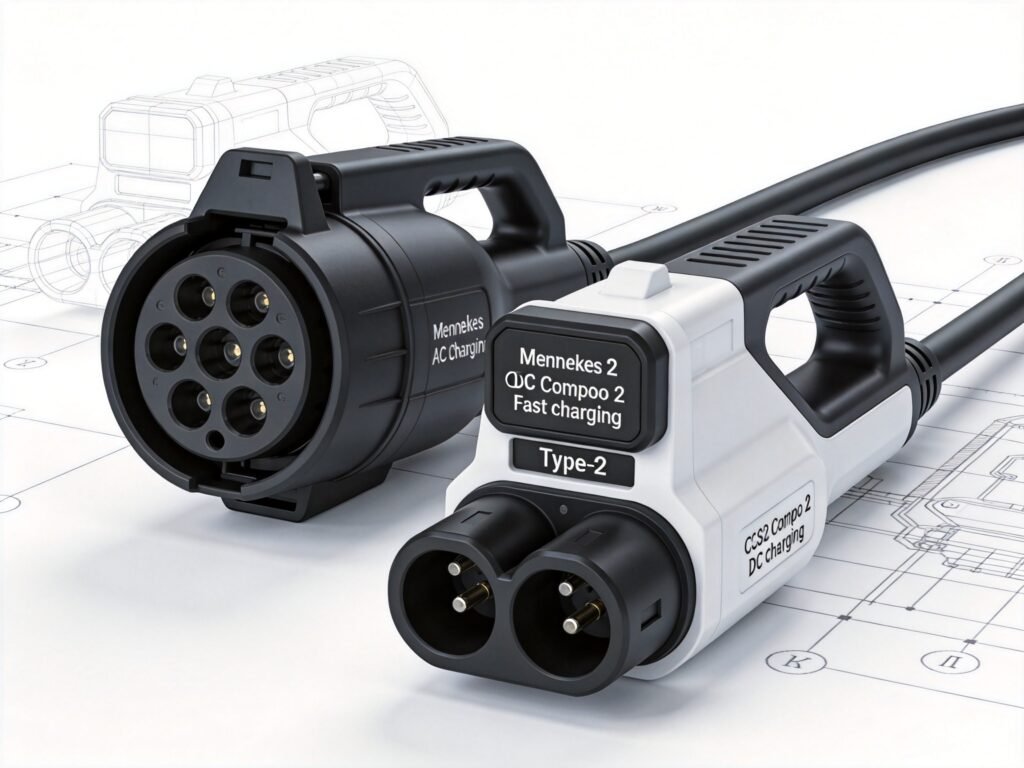
The Type 2 connector — officially defined under IEC 62196-2 — is the standard AC charging interface for the European market. Originally designed by the German manufacturer Mennekes, it features a round housing flattened on one side for proper orientation, with up to seven pins:
- 3 power pins: L1, L2, L3 (three-phase AC support)
- 1 neutral pin: N
- 1 protective earth pin: PE
- 2 signal pins: Control Pilot (CP) and Proximity Pilot (PP)
Key specifications:
- Rated voltage: up to 480V AC
- Rated current: 16A / 32A / 63A
- Maximum AC power: 7.4 kW (single-phase) to 43 kW (three-phase)
- Charging modes: IEC 61851-1 Mode 2 and Mode 3
- Communication: PWM-based control pilot signal
- Locking mechanism: electronic lock on the vehicle side
Type 2 is mandatory for all public AC charging stations across the EU under the Alternative Fuels Infrastructure Directive (2014/94/EU). It handles overnight home charging, workplace charging, and public AC infrastructure — the backbone of daily EV charging in Europe.
2. What Is a CCS2 Charging Connector?
CCS2 (Combined Charging System Combo 2) takes the Type 2 connector as its foundation and adds two large DC pins at the bottom. The result is a single vehicle inlet that supports both AC and DC charging — eliminating the need for separate charging ports.
As the CharIN (Charging Interface Initiative) explains, CCS is designed as “ONE system for ALL” — combining AC slow charging, AC fast charging, and DC ultra-fast charging into one unified connector architecture.
CCS2 extends Type 2 with:
- 2 additional DC pins: DC+ and DC− for high-power direct current
- DC charging power: 50 kW to 350 kW+ (depending on vehicle and station capability)
- Communication protocol: ISO 15118 Plug & Charge (PnC), enabling automatic authentication and billing
- V2G readiness: ISO 15118-20 support for bidirectional vehicle-to-grid charging
- Charging modes: All Type 2 modes plus IEC 61851-1 Mode 4 (DC fast charging)
In practical terms, a CCS2-equipped vehicle can charge overnight at 7.4–22 kW on AC using the same inlet it uses for 350 kW DC fast charging at highway stations. This dual capability is why CCS2 has become the dominant connector for new EVs sold in Europe.
3. Type 2 vs CCS2: Side-by-Side Technical Comparison
Understanding the differences between Type 2 and CCS2 is essential for B2B procurement decisions. Here is a direct comparison across the parameters that matter most:
| Parameter | Type 2 (AC Only) | CCS2 (AC + DC) |
|---|---|---|
| Standard | IEC 62196-2 | IEC 62196-2 (AC) + IEC 62196-3 (DC) |
| Pin Configuration | 7 pins (AC + signals) | 9 pins (7 AC + 2 DC) |
| Max AC Power | Up to 43 kW (3-phase) | Up to 43 kW (3-phase) |
| DC Fast Charging | Not supported | 50 kW – 350 kW+ |
| ISO 15118 Plug & Charge | Limited (PWM only) | Full support (mandatory under AFIR) |
| V2G Bidirectional | Not native | Supported (ISO 15118-20) |
| EU Regulatory Status | Mandatory for AC stations | Mandatory for DC stations (AFIR) |
| Typical Use Case | Home, workplace, public AC | Highway, fleet depot, rapid top-up |
| Connector Weight | ~0.5–0.7 kg (cable end) | ~0.7–0.9 kg (DC variant) |
| Vehicle Inlet | Single AC inlet | Combined AC/DC inlet (one port) |
The critical takeaway: Type 2 is the AC foundation; CCS2 is the complete AC+DC solution. For B2B buyers, the question is not “which one” but “which products do your customers need.”
4. Regulatory Drivers: Why CCS2 Is Becoming Mandatory Across Europe
Two major regulatory frameworks are accelerating the shift from standalone Type 2 to CCS2 across Europe:
1. The AFIR Regulation (Alternative Fuels Infrastructure Regulation)
The EU’s AFIR, which replaced the 2014 Directive, mandates that all new public DC charging stations must be equipped with CCS2 connectors. It also requires Plug & Charge capability (ISO 15118) on new installations, which is natively supported by CCS2 but not by standalone Type 2 hardware.
2. The EN IEC 62196-2 Latest Edition Update
The latest edition of the IEC 62196-2 standard tightens dimensional compatibility requirements for AC charging pins and contact-tube accessories. Key changes include:
- Tighter tolerances: dimensional deviations controlled within ±0.05 mm
- Mandatory cross-manufacturer interchangeability testing
- Minimum 10,000 insertion/extraction cycles with no performance degradation
- Enhanced requirements for copper alloy contact materials and surface treatment
For B2B buyers, this means that any charging gun or connector sourced from a manufacturer must comply with the latest edition. Products manufactured to older revisions may fail CE marking audits or face market surveillance actions.
5. What B2B Buyers Should Verify When Ordering Type 2 and CCS2 Products
Whether you are procuring portable charging guns, CCS2 DC cables, or complete EVSE units, here is the verification checklist that protects your investment:
Compliance & Certification:
- CE marking covering LVD (2014/35/EU), EMC (2014/30/EU), and RoHS directives
- UKCA marking for UK market access
- IEC 62196-2 (Type 2) and IEC 62196-3 (CCS2 DC portion) conformity test reports
- IATF 16949 or ISO 9001 quality management certification from the manufacturer
Material & Build Quality:
- Copper alloy contacts (not aluminum) with tin or gold plating
- PA66 (polyamide 66) housing with UL94 V-0 flame rating
- IP rating: minimum IP54 for indoor/portable use, IP65+ for outdoor deployment
- TPU or TPE cable jacket rated for 10,000+ flex cycles and -30°C to +50°C operation
Performance Verification:
- Contact resistance ≤ 5 mΩ after insertion
- Insertion force ≤ 50N, extraction force 10–80N
- Temperature rise within limits at rated current (per IEC 62196-1)
- Control pilot communication verified for ISO 15118 compatibility (CCS2 products)
For buyers exploring OEM customization options — such as branded connectors, custom cable lengths, or specialized pin configurations — our OEM/ODM services page details how we support private-label and specification-driven orders.
6. How Leading Manufacturers Are Adapting to the Type 2 + CCS2 Portfolio
The smartest EV charging equipment manufacturers maintain dual production lines for both Type 2 (AC) and CCS2 (AC+DC) products. This approach allows B2B buyers to source their entire product range from a single certified supplier — simplifying logistics, quality control, and after-sales support.
A typical product portfolio for the European market includes:
- Portable Type 2 charging guns: Mode 2 cable-integrated chargers (10A–32A) for home and emergency charging
- Type 2 charging cables: Mode 3 cordsets for public AC stations and workplace chargers
- CCS2 DC charging guns: High-power connectors for 50–350 kW DC fast charging stations
- Discharge guns (V2L/V2G): Bidirectional connectors supporting ISO 15118-20 for vehicle-to-grid and vehicle-to-load applications
- Dual-head connectors: Combined solutions for fleet and commercial applications
By sourcing from a factory with full CE/UKCA/UL/RoHS/REACH certification and IATF 16949 automotive quality management, buyers reduce the risk of compliance gaps and can respond quickly to demand across both AC and DC segments.
Explore our complete product range for certified EV charging equipment designed for the European market, or review our full certification portfolio.
Final Thoughts: Type 2 vs CCS2 Is Not Either/Or — It’s Both
For B2B buyers in 2026, the Type 2 vs CCS2 question has a straightforward answer: you need both. Type 2 remains the workhorse for AC charging across homes, workplaces, and public infrastructure. CCS2 extends that capability into the DC fast-charging domain that is essential for highway networks, fleet operations, and commercial applications.
The regulatory trajectory is clear: AFIR mandates CCS2 for DC infrastructure, ISO 15118-20 enables bidirectional charging, and the updated IEC 62196-2 standard tightens quality requirements for AC connectors. Suppliers who can deliver both connector types from a single certified production platform give buyers a significant competitive advantage.
Ready to source certified Type 2 and CCS2 charging equipment from a factory with full European compliance?
Get in Touch with ChuangRui
Chat on WhatsApp
+86 13757774567
Quick questions? Our team replies within 2 hours.
Start a WhatsApp chat →
Request our certification package
CE / UKCA / UL / RoHS / REACH / IATF 16949 test reports and compliance documents available on request.
Request certificates →
Request a quote — 24h response
Tell us your specifications (connector type, current rating, cable length, quantity). We respond within 24 hours with pricing and lead time.
Request a quote →
Learn more about ChuangRui — a certified EV charging equipment manufacturer with 300,000+ units annual capacity, serving European distributors, automotive aftermarket buyers, and fleet operators since establishment.
#EVCharger #Type2Connector #CCS2 #EVChargingEquipment #OEM #B2B #ChargingGun #ElectricVehicle
📚 References
Frequently Asked Questions
❓ What is the difference between Type 2 and CCS2 connectors?
Type 2 is the AC-only connector standardized in IEC 62196-2, supporting up to 43kW AC charging. CCS2 (Combined Charging System 2) adds two DC pins below the Type 2 AC socket, enabling DC fast charging up to 350kW. Physically, CCS2 is Type 2 + DC extension.
❓ Do I need both Type 2 and CCS2 products?
For portable chargers: Type 2 is sufficient (portable chargers are AC-only). For wallbox and commercial chargers: CCS2 is the future-proof choice as it supports both AC and DC. Most public charging stations in Europe now use CCS2 connectors.
❓ Are Type 2 chargers still relevant in 2026?
Yes — Type 2 AC chargers are essential for residential, workplace, and destination charging. The majority of charging still happens at AC speeds. However, for new public installations, CCS2 is increasingly the default specification.
❓ Can a CCS2 vehicle use a Type 2 charger?
Yes — all CCS2-equipped vehicles have a Type 2 AC inlet as part of the CCS2 socket. A Type 2 charger works perfectly for AC charging. CCS2’s DC capability is only used at DC fast charging stations.
❓ What market trends should B2B buyers watch?
CCS2 is becoming the universal European standard, with CHAdeMO being phased out. Type 2 remains relevant for AC applications. For distributors: stock Type 2 portable chargers (high volume), CCS2 wallbox chargers (growing segment), and CCS2 DC chargers (premium/high-margin).

About the CREVCC Engineering Team
Our engineering team brings 12+ years of experience in EV charging system design, from PCB layout and power electronics to international certification compliance.


