
Key Takeaway for B2B Buyers
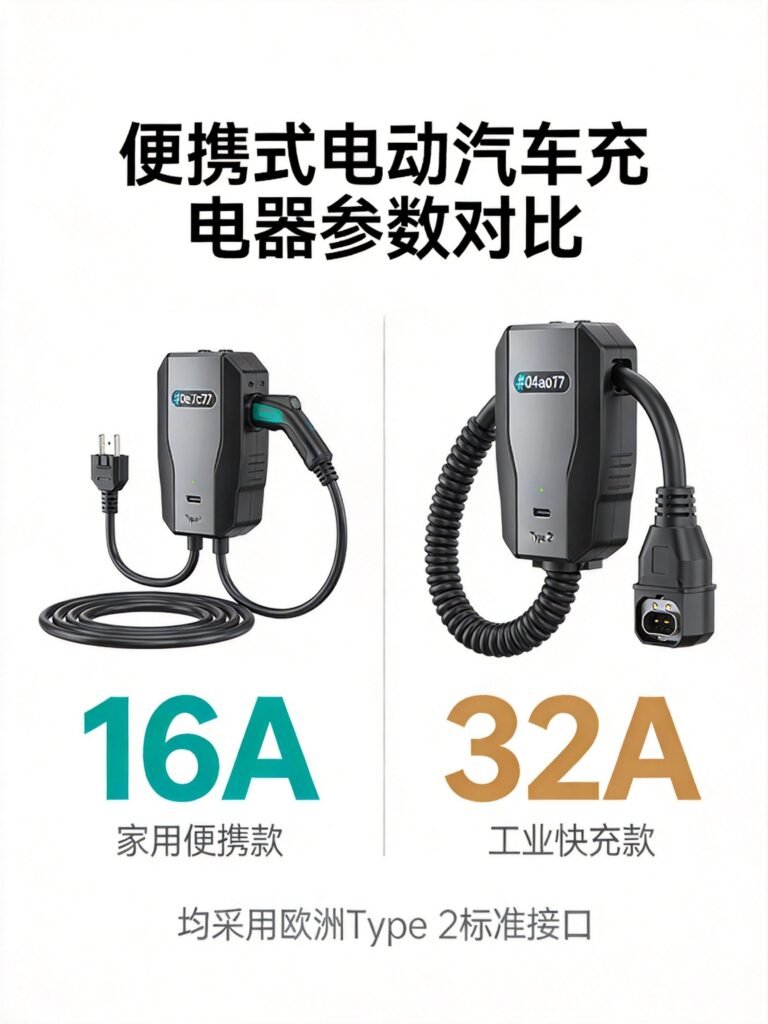
For European markets: 16A (3.7kW) targets residential with single-phase supply; 32A (7.4kW) is the standard for upgraded homes and commercial use. The optimal distributor portfolio is 55% 32A + 45% 16A to cover the full market.
16A vs 32A Portable EV Charger: How to Choose the Right Power Level for Your Market
If you are sourcing portable EV chargers for resale, fleet deployment, or aftermarket distribution in Europe, the 16A vs 32A question is one your buyers will ask constantly. Both current ratings are defined under IEC 61851-1, the international standard for conductive EV charging systems — but they serve very different use cases, customer profiles, and price points.
This guide breaks down every dimension that matters to B2B buyers: charging speed, electrical infrastructure requirements, target customer segments, and margin implications — so you can stock the right products and advise your end users with confidence.
Europe’s EV Charging Landscape: Why Amperage Selection Matters More Than Ever
The EU now has over 1.1 million public charging points, and according to Transport & Environment’s latest analysis (July 2026), public charging capacity exceeds the AFIR fleet-based requirement by 180% across the bloc. However, the fastest-growing demand segment is not public fast chargers — it is residential and workplace charging, where portable EV chargers in the 3.5 kW to 7.4 kW range dominate.
For B2B distributors and aftermarket suppliers, this means portable chargers at 16A (3.5 kW) and 32A (7.4 kW) represent the highest-volume product tier. Choosing which to stock — or whether to carry both — directly affects your market coverage and profitability.
The Technical Difference: 16A vs 32A at a Glance
Both ratings operate on single-phase 230V AC power (standard European household supply). The difference is straightforward:
| Specification | 16A Charger | 32A Charger |
|---|---|---|
| Power Output | 3.5 kW (230V × 16A) | 7.4 kW (230V × 32A) |
| Range Added Per Hour | 14–18 km/h | 28–38 km/h |
| Full Charge Time (60 kWh battery) | ~17 hours | ~8 hours |
| Required Circuit Breaker | 20A | 40A |
| Cable Cross-Section | 2.5 mm² | 6 mm² |
| Typical Connector | Type 2 / Schuko / UK 3-pin | Type 2 / CEE 32A / UK Commando |
| Weight (with 5m cable) | 2.5–3.5 kg | 4.0–5.5 kg |
The charging math is simple: power equals voltage multiplied by current. At 230V European standard, 16A delivers 3,680 watts while 32A delivers 7,360 watts — exactly double. In practical terms, a 32A charger adds roughly 30–38 km of range per hour compared to 14–18 km for a 16A unit.
Who Buys 16A Portable Chargers? Your Core Customer Segments
1. PHEV Owners and Urban Commuters
Plug-in hybrid vehicles typically have smaller batteries (8–15 kWh). A 16A charger fully replenishes these in 2–4 hours — perfect for overnight charging at home. This is your highest-volume segment in European markets.
2. Apartment Dwellers and Occasional Users
Customers without dedicated garage wiring often charge from standard household sockets. A 16A portable charger works with existing 10A or 16A outlets without electrical upgrades — a decisive advantage in markets like France, Italy, and Southern Europe where apartment living dominates. For more details, explore our guide on single-phase vs three-phase EV charging equipment.
3. Fleet Operators with Low Daily Mileage
Delivery vans, service vehicles, and shared mobility fleets that return to depot nightly and drive under 150 km per day can fully recharge with 16A units during off-peak hours. The lower unit cost makes fleet-scale deployment economically attractive.
4. Emergency and Roadside Assistance
Portable 16A chargers serve as emergency top-up devices. Their lighter weight and compact form factor make them ideal for roadside assistance vehicles and mobile service operators.
Browse our full range of portable EV charging products available in both 16A and 32A configurations.
Who Buys 32A Portable Chargers? Higher-Value Opportunities
1. BEV Owners with Dedicated Home Charging
Full battery electric vehicle owners with 60–100 kWh batteries need faster overnight charging. A 32A unit charges a 60 kWh battery from 10% to 80% in approximately 5–6 hours — fitting comfortably within an 8-hour overnight window.
2. Workplace and Destination Charging
Hotels, restaurants, retail parks, and office buildings that offer charging as a customer amenity benefit from 32A units: faster turnover means more vehicles served per socket per day. This segment is growing rapidly as AFIR drives commercial property owners to install charging.
3. Commercial Fleets with High Daily Mileage
Fleet operators running 200+ km per day need 32A charging to ensure vehicles are ready for the next shift. The higher charging speed directly translates to better fleet utilization rates.
4. Aftermarket Upgrade Buyers
Customers who initially purchased 16A chargers often upgrade to 32A after switching from a PHEV to a full BEV. This creates a reliable repeat-purchase channel for distributors.
Learn more about our OEM/ODM customization services for branded portable chargers in any current rating. To learn more about this topic, see our article on dual-head EV charging gun.
Key Decision Factors for B2B Buyers
Electrical Infrastructure Compatibility
This is the most critical factor. A 32A charger requires a dedicated 40A circuit with 6 mm² cabling. In older European buildings, this may require electrical panel upgrades costing €300–€800. A 16A charger works with standard 20A circuits and 2.5 mm² wiring — often no upgrade needed. When advising your customers, always start with their electrical capacity assessment.
Vehicle Onboard Charger Limits
Not all EVs can accept 32A charging. Many PHEVs and entry-level BEVs have onboard chargers limited to 16A single-phase. Charging a 16A-limited vehicle with a 32A charger provides no speed benefit — the vehicle simply draws 16A. However, most modern 32A chargers feature adjustable current settings (8A/10A/13A/16A/24A/32A), making them backward-compatible with any vehicle.
Portability vs Performance Trade-off
16A chargers typically weigh 2.5–3.5 kg with compact form factors — ideal for trunk storage and travel. 32A units weigh 4–5.5 kg due to thicker cables and more robust electronics. For customers prioritizing portability, 16A wins; for those prioritizing charging speed at a fixed location, 32A is superior.
Margin and Pricing Strategy
From a distribution perspective, 32A units command higher retail prices (typically 40–60% premium over 16A equivalents) while costing only 20–30% more to source. This makes 32A chargers more attractive from a margin standpoint. However, 16A units move faster in volume — particularly in price-sensitive Southern and Eastern European markets.
Certification Requirements
Both 16A and 32A portable chargers require identical certifications for European markets: CE marking, EN 61851-1 compliance, RCD protection (Type A 30mA minimum), and RoHS/REACH compliance. Verify that your supplier’s certification package covers both current ratings before placing orders.
The Smart Stocking Strategy: Carry Both
For B2B distributors serving the European market, the optimal strategy is to stock both 16A and 32A portable chargers — but with different emphasis by market:
- Norway, Netherlands, Germany: Higher BEV penetration means stronger 32A demand. Recommend 60% 32A / 40% 16A stock ratio.
- France, Italy, Spain, Portugal: Higher PHEV share and apartment living favor 16A. Recommend 55% 16A / 45% 32A stock ratio.
- Poland, Romania, Czech Republic: Emerging markets with price sensitivity. Lead with 16A units (70/30 ratio), growing 32A as BEV adoption accelerates.
- UK: 13A domestic socket standard creates unique demand for 16A portable chargers with UK 3-pin plug adapters. Stock both with adjustable current models.
Adjustable-current models (8A–32A switchable) offer the best of both worlds and are increasingly preferred by end consumers. They eliminate the risk of incompatibility and reduce SKU complexity for distributors.
Why ChuangRui for Your Portable EV Charger Sourcing
As a source factory specializing in portable charging guns, discharge guns, and dual-head charging connectors, ChuangRui delivers:
- Full European compliance: CE, UKCA, UL, RoHS, REACH certified
- IATF 16949 and ISO 9001 quality management systems
- OEM/ODM customization with your branding, packaging, and current rating configuration
- 7–15 day lead time from order confirmation
- Adjustable current models from 8A to 32A in single SKUs
- IP65/IP67 rated enclosures for all-weather durability
Ready to Discuss Your Portable EV Charger Requirements?
Whether you need 16A units for high-volume PHEV markets or 32A chargers for BEV-dominant territories, our team can configure the right products for your distribution strategy.
Chat on WhatsApp — +86 13757774567 — Quick questions? Our team replies within 2 hours.
Start a conversation now →
Request our certification package
Get CE, UKCA, UL test reports and compliance documents →
Request a quote — 24h response
Get pricing for 16A and 32A portable chargers →
Learn more about ChuangRui | View all products | OEM/ODM services
#EVCharger #PortableEVCharger #16ACharger #32ACharger #OEM #B2B #EVCharging #ChuangRui
📚 References
Frequently Asked Questions
❓ What is the power difference between a 16A and 32A portable EV charger?
A 16A charger delivers 3.7kW on single-phase (230V), adding ~15km of range per hour. A 32A charger delivers 7.4kW, adding ~30km per hour. For a 60kWh battery, 16A takes ~16 hours vs ~8 hours for 32A.
❓ Which power level is more popular in the European market?
32A (7.4kW) is the dominant choice for European buyers, accounting for approximately 65% of portable charger sales. However, 16A (3.7kW) remains important for markets with older electrical infrastructure and price-sensitive segments.
❓ Can a 32A charger be used on a 16A circuit?
Yes, most quality 32A chargers support automatic current detection and will limit output to 16A when connected to a 16A circuit. This dual-mode capability is essential for market flexibility and should be a procurement requirement.
❓ What affects the price difference between 16A and 32A models?
32A models require heavier-gauge cables (6mm² vs 2.5mm²), higher-rated contactors, enhanced thermal management, and more robust PCB components. The typical price premium is 15–25% over equivalent 16A models.
❓ Should distributors stock both 16A and 32A models?
Yes. Recommended mix: 55% 32A for mainstream residential/commercial demand and 45% 16A for price-sensitive markets, older infrastructure regions, and fleet top-up applications. Dual-mode (16A/32A switchable) models simplify inventory.

About the CREVCC Engineering Team
Our engineering team brings 12+ years of experience in EV charging system design, from PCB layout and power electronics to international certification compliance. We design and manufacture portable EV chargers, charging guns, and V2L discharge equipment for B2B partners across Europe, North America, and Southeast Asia. Every article reflects hands-on engineering knowledge — not marketing copy.


