
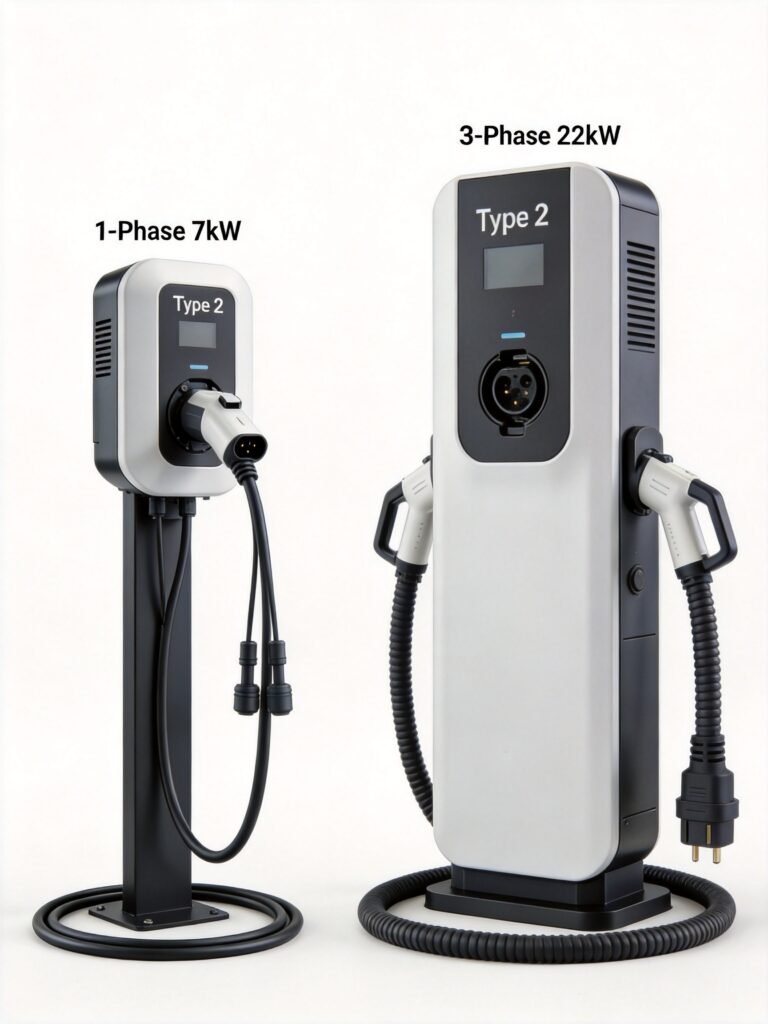
Key Takeaway for B2B Buyers
The real difference isn’t just power — it’s grid compatibility, thermal design, and component architecture. Single-phase chargers use simpler PCB topology; three-phase units need balanced load management and advanced thermal control.
Single-Phase vs Three-Phase Portable EV Chargers: A Technical Breakdown for B2B Buyers in 2026
Every B2B buyer sourcing portable EV charging equipment faces the same fundamental question: should your product lineup focus on single-phase or three-phase units — or both? The answer depends on electrical infrastructure, target vehicle fleets, and the regulatory environment in your market. This guide breaks down the technical differences, real-world performance, and procurement implications so you can make informed sourcing decisions for 2026 and beyond.
European Market Quick Update
With Europe’s public charging network surpassing 1.3 million points in mid-2026, the demand for complementary portable charging equipment is accelerating. Fleet operators, hotel chains, and aftermarket distributors are increasingly requesting both single-phase and three-phase portable EV chargers to cover diverse installation scenarios — from basic 230 V wall outlets to dedicated 400 V three-phase circuits in commercial parking facilities.
The Electrical Fundamentals: What Actually Differs
At the most basic level, the distinction between single-phase and three-phase portable EV chargers comes down to how alternating current is delivered from the grid to the vehicle’s onboard charger (OBC).
Single-phase AC charging uses one alternating voltage waveform. In Europe, this means a 230 V supply through a standard household or light-commercial socket. With a 16 A rating, maximum output is approximately 3.7 kW. At 32 A, it reaches 7.4 kW. The cable assembly carries three conductors: Live (L), Neutral (N), and Protective Earth (PE).
Three-phase AC charging distributes power across three alternating voltage waveforms offset by 120 degrees. In Europe, the line-to-line voltage is 400 V. At 16 A per phase, the theoretical output is approximately 11 kW. At 32 A per phase, it delivers up to 22 kW — nearly three times the single-phase maximum. The cable assembly carries five conductors: L1, L2, L3, Neutral (N), and Protective Earth (PE).
As explained in the technical reference on single-phase and three-phase AC charging, the number of phases directly affects available charging power, but it does not determine power alone — the vehicle’s onboard charger capacity, the cable rating, and the installation circuit all play critical roles.
Performance Comparison: Charging Time and Power Delivery
For B2B buyers, the practical question is: how much faster does three-phase charging actually deliver? The answer varies by vehicle, but the math is straightforward.
Consider a typical mid-size electric vehicle with a 60 kWh battery and an 11 kW three-phase onboard charger:
- Single-phase 7.4 kW (230 V / 32 A): Full charge from 10% to 100% takes approximately 8.5 hours. Ideal for overnight home charging or hotel guest parking where vehicles remain stationary for 8+ hours.
- Three-phase 11 kW (400 V / 16 A): The same charge completes in roughly 5.5 hours — a 35% time reduction.
- Three-phase 22 kW (400 V / 32 A): Full charge in about 3 hours, assuming the vehicle supports 22 kW OBC input. This represents a 65% time saving over single-phase.
However, not all vehicles can utilize three-phase power. Many plug-in hybrids and entry-level battery electric vehicles are equipped with single-phase onboard chargers only (typically 3.7 kW or 7.4 kW). When connected to a three-phase portable charger, these vehicles will only draw power from one phase — the charger does not “force” three-phase input. The actual charging speed is always limited by the weakest link in the chain: the supply circuit, the charger hardware, or the vehicle’s OBC. To learn more about this topic, see our article on RCD protection in EV chargers.
Cable Construction and Connector Standards
The physical differences between single-phase and three-phase portable EV chargers extend beyond electrical performance. These differences affect manufacturing cost, cable weight, logistics, and compliance requirements.
| Specification | Single-Phase Portable Charger | Three-Phase Portable Charger |
|---|---|---|
| Voltage | 230 V AC | 400 V AC (L-L) |
| Current Rating | 16 A or 32 A | 16 A or 32 A per phase |
| Max Power Output | 3.7 kW / 7.4 kW | 11 kW / 22 kW |
| Conductors | 3 (L, N, PE) | 5 (L1, L2, L3, N, PE) |
| Cable Cross-Section (32 A) | 3×4 mm² + 2×0.5 mm² | 5×6 mm² + 2×0.5 mm² |
| Typical Cable Weight (5 m) | ~2.0 kg | ~3.5 kg |
| Connector (Europe) | Type 2 (IEC 62196-2) | Type 2 (IEC 62196-2) |
| Charging Mode | Mode 2 (IC-CPD) | Mode 2 or Mode 3 |
Both single-phase and three-phase portable chargers sold in Europe must comply with IEC 61851-1 conductive charging system standards and IEC 62196-2 connector dimensional requirements. The Type 2 connector used across Europe supports both single-phase and three-phase configurations — the same physical connector, different internal pin assignments. For more details, explore our guide on EV charging connector standards.
For manufacturers offering OEM/ODM services, the key difference lies in the cable assembly and the internal control board. Three-phase units require heavier-gauge conductors, a more robust IC-CPD (In-Cable Control and Protection Device), and a control pilot circuit capable of managing phase balancing.
Market Demand: Where Each Type Sells
Understanding your end users’ electrical infrastructure is essential for product mix decisions.
Single-phase portable chargers (3.7–7.4 kW) dominate in these segments:
- Residential aftermarket — homeowners charging from standard 230 V garage or driveway sockets
- Hospitality sector — hotels and B&Bs offering overnight guest charging without dedicated EV infrastructure
- Fleet supplementary charging — depots where vehicles charge overnight on standard circuits
- Emergency/backup charging — portable units kept in vehicle trunks for top-up charging
Three-phase portable chargers (11–22 kW) are preferred for:
- Commercial parking facilities with 400 V three-phase supply already installed
- Corporate fleet operations requiring faster turnaround between shifts
- Workshop and dealership environments where vehicles need same-day charging
- Rental car and car-sharing operators who need vehicles ready within hours
In markets like Germany, the Netherlands, and Scandinavia, three-phase 400 V supply is standard in commercial buildings, making 11 kW and 22 kW portable chargers the natural choice for B2B procurement. In contrast, the UK predominantly uses single-phase 230 V supply even in many commercial settings (three-phase is available mainly in larger premises), which drives stronger demand for single-phase portable units.
Procurement Decision Framework: What to Stock
For distributors and retailers entering the European portable EV charger market, we recommend a mixed product strategy:
- SKU breadth: Offer at least 2–3 single-phase models (16 A and 32 A variants) alongside 2 three-phase models (16 A / 11 kW and 32 A / 22 kW). This covers the majority of buyer requirements without excessive inventory complexity.
- Adjustable amperage: Prioritize portable chargers with selectable current settings (e.g., 10 A / 13 A / 16 A / 20 A / 24 A / 32 A). This single SKU replaces multiple fixed-current units and reduces after-sales complications when end users change their circuit breakers.
- Cable length options: Stock 5 m as standard, with 7.5 m and 10 m variants available. Three-phase cables are heavier — ensure the cable management design includes strain relief and ergonomic handles.
- Certification coverage: Every portable charger must carry CE marking for EU markets, with IEC 62196-2 and IEC 61851-1 compliance documented in test reports. For the UK market, UKCA certification is required post-Brexit. RoHS and REACH compliance are non-negotiable for EU distribution.
- OEM branding: European buyers increasingly request private-label packaging and custom firmware (e.g., branded LCD displays, custom amperage presets). Work with a factory that supports OEM/ODM customization with low MOQ flexibility.
Why ChuangRui for Portable EV Charger Sourcing
At ChuangRui (创瑞), we manufacture both single-phase and three-phase portable EV charging equipment under one roof. Our product range spans 3.7 kW to 22 kW portable chargers with Type 2 connectors, all compliant with IEC 62196-2, IEC 61851-1, CE, UKCA, RoHS, and REACH standards. Our facility holds IATF 16949, ISO 9001, ISO 14001, and ISO 45001 certifications — ensuring consistent quality from raw material to finished goods.
We support full OEM/ODM customization, including private-label packaging, adjustable amperage firmware, custom cable lengths, and branded displays. With production capacity scaled to meet European demand and typical lead times of 7–15 days, we help distributors and fleet operators build a competitive portable EV charger lineup — fast.
Browse our full product catalog at our product pages, learn about our OEM/ODM services, review our certifications, or contact us directly for a quotation. Learn more about our company and manufacturing capabilities.
Chat on WhatsApp — +86 13757774567 — Quick questions? Our team replies within 2 hours.
Start a WhatsApp conversation →
Request our certification package
Get IEC test reports, CE declarations, and compliance documents →
Request a quote — 24h response
Send your specifications and receive a detailed quotation →
#EVCharger #PortableEVCharger #ThreePhase #SinglePhase #OEM #B2B #IEC62196 #ChuangRui
📚 References
Frequently Asked Questions
❓ What is the technical difference between single-phase and three-phase portable EV chargers?
Single-phase chargers process one AC waveform (230V) through a single relay and power circuit. Three-phase chargers handle three simultaneous waveforms (400V), requiring three relays, balanced load monitoring, and more complex PCB layouts with additional current sensors.
❓ Why do three-phase portable chargers cost more?
Three-phase units require 3× the power relays, 3× current sensors, larger contactors, balanced-phase PCB layout, and more sophisticated thermal management. The BOM cost is typically 35–50% higher than equivalent single-phase models.
❓ Do three-phase portable chargers need special installation?
No — portable three-phase chargers plug into a three-phase industrial socket (e.g., CEE 16A/32A blue or red connector). No fixed installation is needed, making them ideal for fleet operators and temporary charging scenarios.
❓ What is the charging speed difference in real-world use?
Single-phase 32A: ~7.4kW, adding ~30km range per hour. Three-phase 16A: ~11kW, adding ~45km/h. Three-phase 32A: ~22kW, adding ~90km/h. The exact speed depends on the vehicle’s onboard charger capacity.
❓ Should distributors prioritize single-phase or three-phase portable chargers?
For the European market, a 55:45 single-to-three-phase ratio is optimal. Single-phase covers the mass residential market; three-phase targets commercial, fleet, and premium residential segments with higher margins.

About the CREVCC Engineering Team
Our engineering team brings 12+ years of experience in EV charging system design, from PCB layout and power electronics to international certification compliance. We design and manufacture portable EV chargers, charging guns, and V2L discharge equipment for B2B partners across Europe, North America, and Southeast Asia.


