
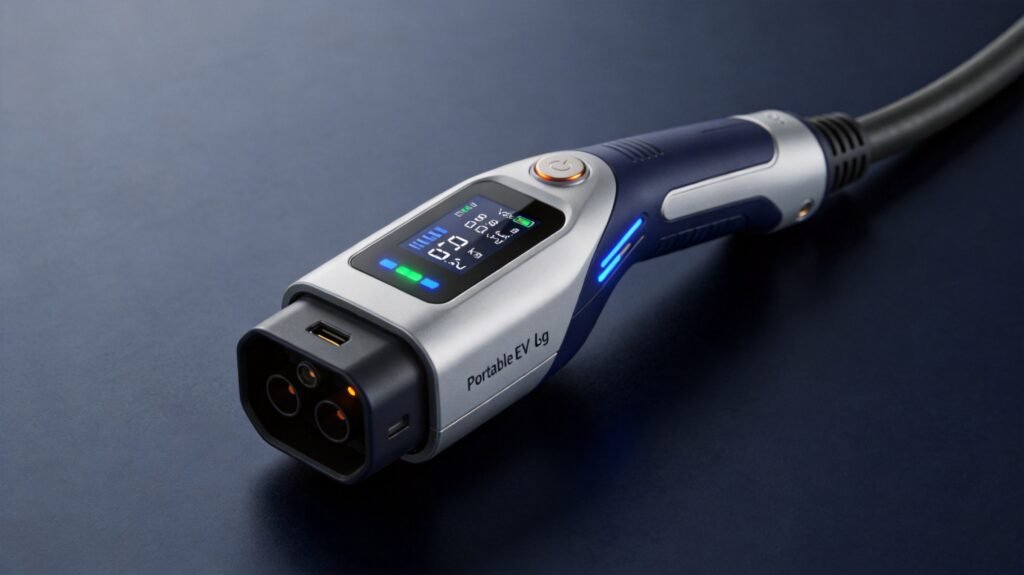
Inside the EV Charging Gun: 5 Core Technologies Every B2B Buyer Must Understand in 2026
Key Takeaway for B2B Buyers
The 5 core technologies inside a modern EV charging gun — power electronics, control circuitry, thermal management, connector interface, and communication protocol — determine product reliability, safety certification, and market compliance.
When a European distributor evaluates a portable EV charger for their catalog, the conversation usually starts with power ratings and connector types. But the real differentiators — the features that prevent returns, reduce warranty claims, and build long-term brand trust — live inside the charging gun itself. In 2026, as Europe’s EV parc surpasses 10 million vehicles and the EU’s Commission Delegated Regulation (EU) 2025/656 mandates ISO 15118 communication for all new public charging points, understanding what happens inside that plug has never been more critical for procurement teams.
European market update: As of August 2026, the EU has over 1.1 million public charging points, and the AFIR mandate requiring ISO 15118-2 support for all new public chargers — effective since January 8, 2026 — is reshaping product specifications across the supply chain. From January 1, 2027, ISO 15118-20 extends this requirement to private charging points as well, creating a hard compliance deadline for every AC charging gun sold in Europe.
1. NTC Temperature Sensors: The First Line of Thermal Defense
Temperature is the silent enemy of every EV charging connection. When current flows through the contact pins of a Type 2 or CCS2 connector, resistive heating occurs at the interface — and in portable chargers, where users may plug into ageing wall sockets with uncertain wiring, this risk multiplies. According to CharIN’s August 2026 position paper on AFIR implementation, thermal management remains one of the top safety concerns flagged by industry test bodies.
Modern charging guns integrate Negative Temperature Coefficient (NTC) thermistors directly at the pin contacts. These sensors measure temperature in real time and feed data back to the charger’s control unit. If the contact temperature exceeds a safe threshold — typically 85°C at the pin — the system automatically reduces current or pauses charging entirely. This is not a luxury feature; it is the mechanism that prevents melted connectors, scorched wall sockets, and the liability claims that follow.
For B2B buyers, the critical specification is where the sensor is placed. Budget units may place a single sensor on the PCB inside the control box, measuring ambient air rather than actual contact temperature. Quality units embed NTC sensors directly at the power pins and at the wall-plug end — the two hottest points in the chain. ChuangRui’s portable charging guns use dual NTC sensors at both interfaces for continuous thermal monitoring.
2. RCD Protection: Type B Is Now the European Benchmark
Residual Current Devices (RCDs) protect users from electric shock by detecting leakage current and cutting power within milliseconds. For EV charging equipment, the relevant standard is IEC 62752, which defines RCD protection requirements for Mode 2 portable chargers. But not all RCDs are equal, and the distinction matters enormously for both safety and market access.
Type AC RCDs detect only sinusoidal AC residual current — the cheapest and most basic option. Type A adds detection of pulsating DC residual current. Type B RCDs detect all forms: sinusoidal AC, pulsating DC, and smooth DC residual current up to 6 mA. This last capability is essential for EV charging because the vehicle’s onboard charger can generate smooth DC leakage that Type A and Type AC devices simply cannot detect.
European market practice and national wiring regulations in Germany (VDE 0100-722), the Netherlands, and increasingly across the EU require Type B RCD protection for dedicated EV charging circuits. For portable chargers — which are plugged into arbitrary household sockets where the building’s RCD type is unknown — integrating Type B protection within the charging gun or in-cable control box is not merely best practice; it is the only way to guarantee user safety regardless of the installation environment.
Procurement teams should request RCD test reports from suppliers, confirming that the unit carries genuine Type B DC leakage detection (6 mA threshold) rather than relying on the building’s upstream protection. This is one component where cost-cutting creates unacceptable risk exposure for both the brand and the end user.
3. Control Pilot Signal and PP Resistor Architecture
Every IEC 61851-compliant charging gun uses a Control Pilot (CP) circuit to communicate maximum available current to the vehicle. This PWM (Pulse Width Modulation) signal — operating at 1 kHz — tells the car whether it can draw 13A, 16A, 20A, or 32A. The Proximity Pilot (PP) resistor, meanwhile, tells the charger whether the connector is properly latched and detects cable capacity.
While PWM signaling has existed for over a decade, what changes in 2026 is the regulatory push toward digital communication. Under AFIR, all new public charging points must support ISO 15118 Power Line Communication (PLC), which overlays digital data on the same CP wire. This enables Plug & Charge — automatic vehicle authentication without RFID cards or apps — and, under ISO 15118-20, bidirectional power transfer for V2G applications.
For portable AC charger buyers, the practical question is whether the control box and gun assembly include the PLC modem hardware required for ISO 15118 communication. Units that support only analog PWM will remain functional for basic charging, but they will not support Plug & Charge and may face restricted relevance as the European fleet transitions to ISO 15118-equipped vehicles. ChuangRui’s product roadmap includes ISO 15118-ready control electronics across its OEM and ODM product lines, ensuring that distributor partners can offer future-proof inventory as the 2027 deadline approaches.
The PP resistor architecture also deserves attention during sourcing. The resistor value must precisely match the cable’s current-carrying capacity: 220 ohms for 13A cables, 680 ohms for 20A, 1.5k ohms for 32A. A mismatched PP resistor — a surprisingly common defect in low-cost units — can cause the vehicle to charge at an incorrect current, creating overheating risk. Buyers should request PP resistor tolerance documentation as part of their quality verification process.
4. LCD Display and User Feedback Systems
The display on a portable EV charger is far more than a marketing feature. It is the primary diagnostic interface that helps end users — and, crucially, customer support teams — identify and resolve charging faults without returning the unit. In 2026, a meaningful LCD or LED status system has become a baseline expectation in the European portable charger market.
At minimum, a quality display should show: real-time charging current and voltage, accumulated energy in kWh, charging duration, connector temperature, and fault codes. The most useful fault code systems align with IEC 61851 state definitions: CP signal errors, RCD trips, over-temperature cutoffs, and vehicle communication failures. When a customer calls support saying “the charger shows error E03,” a well-documented code system can resolve the issue in minutes rather than processing a return.
For distributors serving multiple European markets, multilingual display options — English, German, French, Spanish, Italian — add measurable value and reduce product return rates. Adjustable current settings (typically 6A/10A/13A/16A selectable via button or app) are also increasingly important, as they allow users to adapt to older electrical installations where a 16A circuit cannot safely sustain continuous load. This flexibility directly addresses the core use case for portable chargers: charging at locations with unknown or limited electrical infrastructure.
ChuangRui integrates full-function LCD panels across its portable charger range, with customizable display languages and adjustable current profiles available through OEM branding programs. This level of configurability is one of the key reasons European distributors choose factory-direct sourcing partners over off-the-shelf catalogue products.
5. IP Ratings, Cable Materials, and Mechanical Durability
A portable charging gun lives a hard life. It is dragged across driveways, left in car boots through winter, exposed to rain and UV radiation, and plugged and unplugged thousands of times. The Ingress Protection (IP) rating and cable jacket material determine whether it survives that life or fails prematurely.
For the connector head, IP55 is the practical minimum for outdoor use — protected against limited dust ingress and low-pressure water jets from any direction. IP66, which offers complete dust protection and resistance to heavy seas or powerful water jets, is increasingly specified by fleet operators and public charging providers. For the in-cable control box, IP54 is typical for portable units, while wall-mounted products should reach IP65.
Cable jacket material is equally important. Standard PVC jackets become stiff and brittle below 0°C, making the cable difficult to handle in Northern European winters. TPU (Thermoplastic Polyurethane) jackets maintain flexibility down to -40°C, resist abrasion and UV degradation, and are rated for over 10,000 flex cycles. For ChuangRui’s products, TPU is standard — not an upgrade — because the European climate demands it.
Mechanical durability also extends to the connector latch mechanism and contact pins. Silver-plated copper alloy contacts provide superior conductivity and corrosion resistance compared to tin-plated alternatives. The latch should survive a minimum of 10,000 mating cycles without degradation — roughly equivalent to daily use for 27 years. Buyers should request IEC 62196-1 mechanical endurance test reports to verify these claims rather than accepting marketing specifications at face value.
Full product certifications — including CE, UKCA, RoHS, and REACH compliance — are documented on ChuangRui’s certifications page, along with IATF 16949 quality management credentials that reflect automotive-grade manufacturing standards.
What This Means for Your Sourcing Strategy
As the ISO 15118 mandate approaches and European consumers become more discerning about charging safety, the gap between commodity chargers and quality-engineered products will widen. Distributors who compete on price alone will face rising return rates, warranty exposure, and potential regulatory action as enforcement of AFIR and EN IEC standards intensifies.
The five technologies covered in this article — NTC thermal sensing, Type B RCD protection, CP/PP communication architecture with PLC readiness, intelligent display systems, and robust IP-rated mechanical design — are not optional extras. They are the foundational elements of a portable EV charger that is safe, compliant, and reliable enough to carry your brand into 2027 and beyond.
When evaluating suppliers, ask for the test reports behind each claim. A credible factory will provide IEC 62752 RCD test certificates, IEC 62196 mechanical endurance data, thermal test logs, and ISO 15118 conformance documentation without hesitation. If a supplier cannot produce these documents, the product is not ready for the European market — regardless of how attractive the unit price appears.
ChuangRui manufactures a complete range of portable EV charging guns, discharge guns, and dual-head charging solutions from our certified production facility, with full OEM/ODM customization, 7-15 day lead times, and the documentation package required for European market access. Contact our team to discuss your product specifications and request a detailed quotation.
Talk to Us
Chat on WhatsApp — +86 13757774567 — Quick questions? Our team replies within 2 hours.
Request our certification package — Full CE, UKCA, UL, RoHS, REACH, IATF 16949 and ISO documentation for your procurement review.
Request a quote — 24h response with pricing, MOQ, lead times and OEM customization options.
#EVChargingGun #PortableEVCharger #ISO15118 #AFIR2026 #Type2Charger #EVChargerOEM #B2BEVCharging
📚 References & Further Reading
- IEC 62196 Standard — EV charging connector and coupler specifications
- SAE J1772 — Connector standard for North American market
- Charging Station – Wikipedia — EV charging infrastructure overview
- UL Certification — Safety certification for charging connectors
Frequently Asked Questions
❓ What are the core technologies inside an EV charging gun?
Five key subsystems: (1) Power electronics (AC-DC conversion, power factor correction), (2) Control circuitry (CP/PP signaling, MCU), (3) Thermal management (temperature monitoring, active cooling), (4) Connector interface (mechanical design, contact materials), (5) Communication protocol (OCPP, PLC, CAN bus).
❓ Why does the control circuitry (CP/PP) matter most for B2B buyers?
The Control Pilot (CP) and Proximity Pilot (PP) circuits manage the charging handshake between vehicle and charger. Poor CP/PP design causes charging failures, compatibility issues, and the #1 source of customer complaints in the portable charger segment.
❓ What thermal management features should a quality EV charging gun have?
NTC temperature sensors at contact points, automatic current derating when temperature exceeds 80°C, and in high-power models: active fan cooling. B2B buyers should request thermal test reports showing stable operation at rated current for 4+ hours.
❓ How do connector interface materials affect product lifespan?
Contact pin material (copper alloy with silver/tin plating) determines contact resistance and wear. Premium connectors use 50μm silver plating for <0.5mΩ contact resistance. Cheap alternatives use 3-5μm tin plating that degrades after 2000+ mating cycles.
❓ What communication protocols should an EV charging gun support in 2026?
For AC portable chargers: basic CP/PP signaling is minimum. For smart chargers: OCPP 1.6J (JSON over WebSocket) is the European standard. For DC fast charging: ISO 15118 (PLC) and DIN 70121 are required for plug-and-charge functionality.
class=”author-box” style=”display:flex; gap:16px; background:#fff; border:1px solid #e0e0e0; padding:20px; margin-top:24px; border-radius:8px; align-items:center;”>

Written by the CREVCC Engineering Team
Our engineering team brings 12+ years of experience in EV charging systems, PCB design, and international certification. We write to help B2B buyers make informed decisions based on real technical data.


