
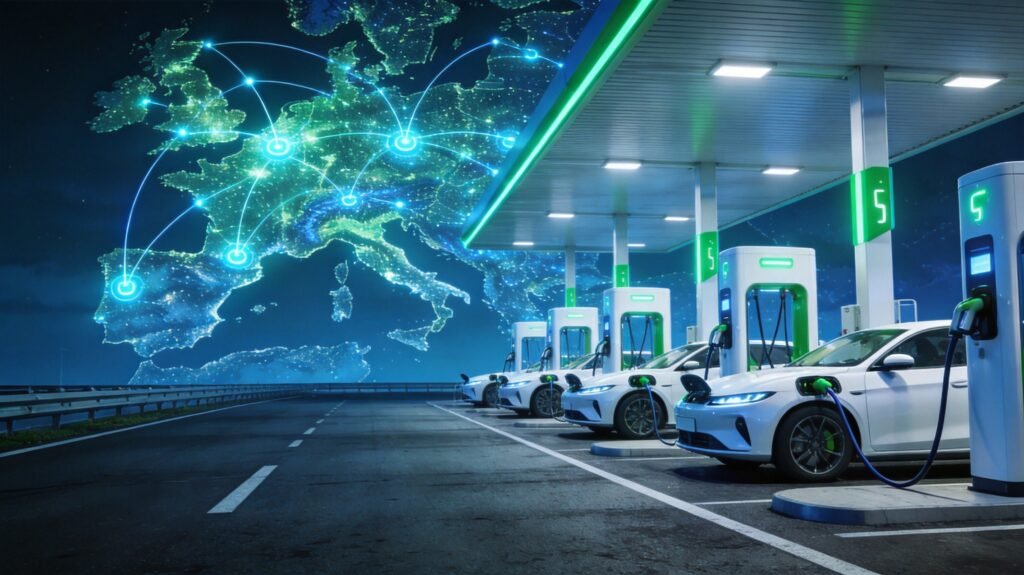
Key Takeaway for B2B Buyers
Europe hit 20% BEV share in 2026 with 1.5B EUR investment. The EU Grid Package cuts permit times from years to months.
In the first five months of 2026, the European Union recorded 950,521 new battery electric vehicle (BEV) registrations — 20% of all new car sales, up from just 15.3% a year earlier. Behind this surge lies a rapidly evolving charging infrastructure landscape: Europe crossed the symbolic threshold of one million publicly accessible charging points at the end of 2025, and the pace of deployment is accelerating faster than ever.
For B2B buyers — charging station distributors, fleet operators, retail chains, and energy service companies — this moment presents both opportunity and urgency. Here is what the latest data and policy developments mean for your procurement strategy.
Europe’s EV Market Hits Record Numbers
The numbers tell a clear story. According to the European Automobile Manufacturers’ Association (ACEA), total EU car registrations rose 4% year-over-year in January–May 2026, driven almost entirely by electrified vehicles. BEV growth was particularly strong in major markets: Italy (+75.7%), France (+55.4%), and Germany (+40.9%).
In June 2026 alone, approximately 530,000 electric vehicles were registered across Europe — a 31% increase compared to June 2025. Germany, the continent’s largest auto market, saw BEVs capture 28.4% of new car registrations for the first time, making battery electric the single largest powertrain type.
For charging infrastructure procurement, the implications are straightforward: more EVs on the road translate directly into demand for more charging points — at highways, in urban centres, at retail locations, and within fleet depots.
EU Grid Package: Cutting Red Tape for Charging Stations
One of the most significant barriers to charging station deployment has been slow and fragmented permitting processes. The European Parliament is moving to change that.
In late June 2026, the Parliament’s Industry, Research and Energy Committee (ITRE) backed a proposal under the broader EU Grid Package to dramatically speed up approvals for energy infrastructure projects, including EV charging stations. Key provisions include:
- Maximum three-month approval deadlines for charging stations up to 1 MW
- No administrative permits required for charging stations up to 1 MW on “artificial structures” (such as highway rest areas)
- Raised capacity thresholds for mandatory permitting: from 100 kW to 200 kW for small-scale installations
- “Tacit approval” mechanism: if authorities fail to respond within the deadline, projects are automatically approved
According to the European Parliament, electricity transmission grids currently take around 10 years to complete, with permitting accounting for more than half of that time. The proposed reforms could fundamentally change this landscape.
What this means for B2B buyers: Faster permitting translates to faster time-to-revenue on charging infrastructure investments. Companies planning to deploy charging networks can expect shorter lead times and less administrative overhead when these rules take effect.
EU Battery Booster Facility: €1.5 Billion for Domestic Production
The European Commission has formally established the Battery Booster Facility, mobilising up to €1.5 billion from EU Emissions Trading System (ETS) revenues through the Innovation Fund to support battery cell manufacturing in Europe.
For the first time, the Commission will provide direct support through interest-free loans rather than traditional grants. Eligible projects must have a minimum annual production capacity of 10 GWh and be located within the European Economic Area. Maximum loan size per project: €500 million.
The call for proposals opens in Q3 2026, with first projects expected to be selected and funded before year-end.
EU Climate Commissioner Wopke Hoekstra stated: “The Battery Booster Facility steps in at the most critical and capital-intensive phase of industrial scale-up… It is turning the cost of emissions into the fuel for innovation.”
Why this matters for charging equipment buyers: A stronger European battery supply chain means more EVs produced with European-sourced batteries — which in turn drives charging infrastructure demand. It also signals the EU’s commitment to building a complete electric mobility ecosystem, from battery production to end-user charging.
Market Consolidation: Major Players Scale Up Fast
The private sector is responding to these market signals with aggressive expansion:
- BYD announced plans to build 3,000 flash charging stations across Europe within the next 12 months, including at least 300 in the UK. Its first German flash charging station, featuring 1,500 kW units capable of 5-minute charging, became operational in May 2026.
- Vattenfall InCharge acquired Nima Energy’s Swedish ultra-fast charging business in July 2026, adding 178 operational and 254 planned high-power charging points. Vattenfall InCharge now operates approximately 48,500 charge points across Europe.
- The European Commission selected 70 projects to decarbonise transport, including over 500 new charging points for lorries along the TEN-T network, backed by €600 million in Connecting Europe Facility funding.
These moves signal a clear trend: the charging infrastructure market is consolidating around large-scale, network-level deployments. For B2B buyers, this means procurement cycles are getting larger and more strategic. Distributors need suppliers who can deliver consistently at scale; fleet operators need partners who understand both hardware quality and compliance requirements across multiple markets.
What This Means for Your EV Charging Equipment Procurement
Europe’s charging infrastructure is entering a period of unprecedented acceleration, driven by converging policy reforms, record vehicle adoption, and aggressive private investment. For B2B buyers, the question is no longer whether to enter this market — it is how to build a supply chain that can keep pace.
Key procurement considerations for 2026:
- Certification readiness: With multiple EU member states scaling up simultaneously, having products certified under CE, UKCA, and relevant IEC standards is non-negotiable. The upcoming EU Cyber Resilience Act adds another layer of compliance to prepare for.
- Supply chain flexibility: As deployment timelines compress, buyers need manufacturers who can deliver within weeks, not months. OEM and ODM capabilities allow buyers to customise products for specific market requirements without lengthy development cycles.
- Product range diversity: From portable charging guns for aftermarket distributors to dual-head connectors for fleet operations, having a comprehensive product portfolio simplifies multi-category procurement.
- Quality systems: IATF 16949 and ISO 9001 certifications in a manufacturer ensure consistent quality across bulk orders — critical when deploying hundreds or thousands of units across different markets.
Partner with ChuangRui for Europe’s Charging Expansion
As a factory-direct manufacturer of portable EV charging guns, discharge guns, and dual-head connectors, ChuangRui is positioned to support B2B buyers navigating Europe’s rapidly evolving charging landscape. Our product range holds full CE, UKCA, UL, and RoHS certifications, with production facilities certified under IATF 16949 and ISO 9001/14001/45001.
We offer:
- Full product line of portable EV charging solutions designed for European market requirements
- OEM/ODM services for branded customisation and market-specific adaptations
- Factory-direct pricing with 7-15 day delivery for bulk orders
- Dedicated certification support documentation for multi-market compliance
Chat on WhatsApp — +86 13757774567 — Quick questions? Our team replies within 2 hours. (Click to chat)
Request our certification package — Contact us for CE, UKCA, UL, and test reports
Request a quote — Get in touch for factory-direct pricing, 24h response
#EVCharging #EuropeEV #EVInfrastructure #OEM #B2B #ChargingEquipment #CleanEnergy #ElectricMobility
📚 References
Frequently Asked Questions
❓ What is the EU Grid Package?
Reforms permitting for EV charging stations, reducing approval from 3-7 years to 6-12 months.
❓ How much investment is flowing into EU EV infrastructure?
Over 1.5B EUR in 2026 including Battery Booster, CEF Transport, and national programs.
❓ What is Europe current BEV market share?
20% of new car registrations in 2026, approximately 2.4M BEVs annually.
❓ Which equipment benefits most?
DC fast chargers (fastest growth), smart AC chargers (steady growth), portable chargers (volume from adoption).
❓ How should buyers adjust strategy?
Accelerate certification, establish IATF 16949 supply relationships, diversify AC/DC/portable portfolios.

About the CREVCC Engineering Team
Our engineering team brings 12+ years of experience in EV charging system design, from PCB layout and power electronics to international certification compliance.


