
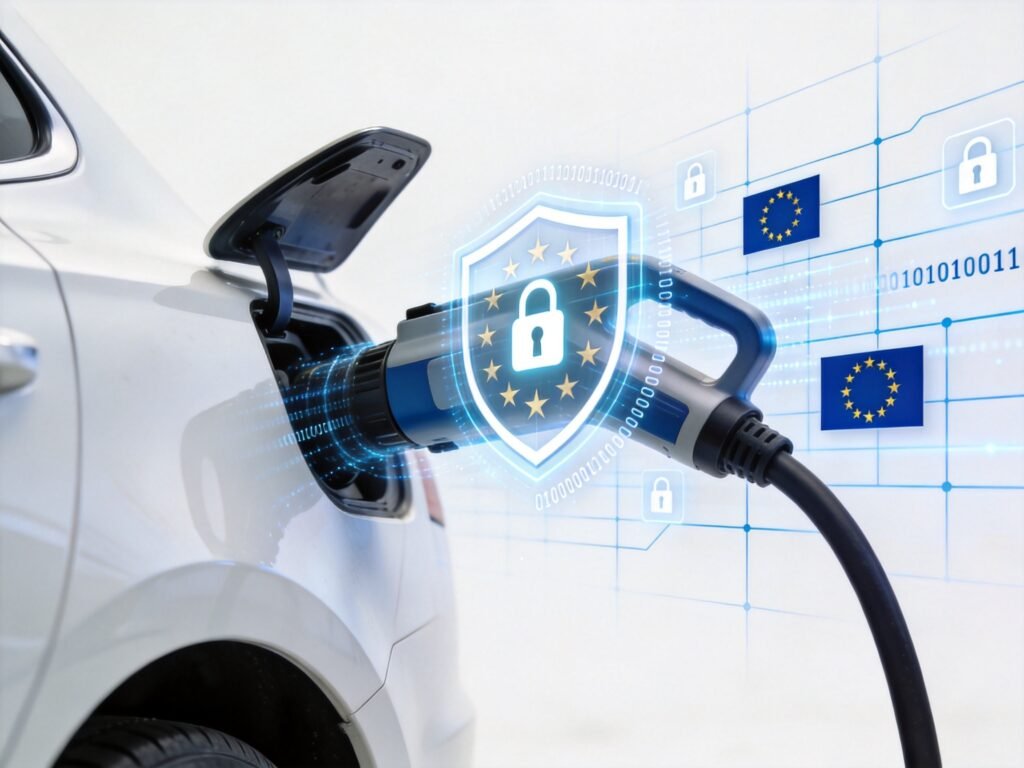
Key Takeaway for B2B Buyers
The CRA requires all connected EV chargers to meet cybersecurity requirements: secure defaults, vulnerability disclosure, software updates. Non-compliant products banned from EU.
EU Cyber Resilience Act for EV Charging Equipment: What B2B Buyers Must Know Before September 2026
The European Union is about to enforce one of the most significant cybersecurity regulations in industrial history — and it directly affects every EV charging device connected to a network. If you procure, distribute, or install electric vehicle charging equipment in Europe, the EU Cyber Resilience Act (CRA) will reshape your supply chain requirements starting this September.
This article breaks down what the CRA means for EV charging equipment buyers, the compliance timeline, and how to ensure your supplier meets the new cybersecurity obligations.
European Market Flash
On 11 September 2026, the EU Cyber Resilience Act’s mandatory vulnerability reporting obligations take effect. From that date, all manufacturers of connected products — including EV chargers — must report actively exploited vulnerabilities and serious security incidents within 24 hours to ENISA and national CSIRTs. Full compliance, including CE marking for cybersecurity, follows on 11 December 2027.
What Is the EU Cyber Resilience Act and Why Does It Matter for EV Chargers?
The Cyber Resilience Act (Regulation EU 2024/2847) is a horizontal EU regulation that establishes mandatory cybersecurity requirements for all “products with digital elements” sold in the European Union. Unlike sector-specific standards, the CRA applies horizontally across virtually every connected hardware and software product on the market.
For the EV charging industry, this is a game-changer. Modern portable EV chargers, smart charging guns, and connected charging stations are no longer purely electrical devices — they contain firmware, communication modules (Wi-Fi, Bluetooth, 4G/LTE), and network interfaces that manage charging protocols like OCPP and ISO 15118. Under the CRA, any EV charging equipment with a direct or indirect data connection to a device or network qualifies as a “product with digital elements” and must comply.
This means cybersecurity is no longer optional. It is now a precondition for market access in the EU — just like CE marking for electrical safety or EMC compliance.
Key CRA Requirements That Affect EV Charging Equipment Procurement
Here is what B2B buyers need to verify in their supplier’s compliance documentation:
1. Security by Design
Manufacturers must integrate cybersecurity considerations from the product design phase. This includes secure boot mechanisms, encrypted firmware updates, and protection against unauthorized access to the charger’s control systems.
2. Software Bill of Materials (SBOM)
Every connected EV charger must come with a machine-readable SBOM — a complete inventory of all software components, libraries, and frameworks used in the product. This allows buyers and regulators to quickly identify whether a known vulnerability exists in any component.
3. Vulnerability Management & Security Updates
Manufacturers must maintain a vulnerability handling process throughout the product’s expected lifecycle. Security patches must be provided promptly, and the manufacturer must actively monitor for new threats affecting their products.
4. Mandatory Incident Reporting (Effective 11 September 2026)
From September 2026, manufacturers must report:
- An early warning within 24 hours of becoming aware of an actively exploited vulnerability
- A full notification within 72 hours
- A final report within 14 days after a corrective measure is available
5. CE Marking Extension
By December 2027, the CE mark will also signify cybersecurity compliance — not just electrical safety and EMC conformity. Products without CRA-compliant CE marking cannot be legally sold in the EU.
How the CRA Interacts with Existing EV Charging Certifications
The CRA does not replace existing certifications like CE (LVD/EMC), UKCA, or IEC 61851 compliance. Instead, it adds a cybersecurity layer on top. Here is how the regulatory landscape now looks for EV charging equipment entering the European market:
| Requirement | What It Covers | Status |
|---|---|---|
| CE — LVD (2014/35/EU) | Electrical safety | Mandatory now |
| CE — EMC (2014/30/EU) | Electromagnetic compatibility | Mandatory now |
| CE — RED (2014/53/EU) | Radio equipment + basic cybersecurity (EN 303 645) | Mandatory now |
| IEC 61851 / IEC 62196 | Charging performance & connector standards | Mandatory now |
| CRA (2024/2847) | Cybersecurity by design, SBOM, vulnerability handling, incident reporting | Reporting: Sep 2026 / Full: Dec 2027 |
For B2B buyers, this means your supplier certification package must now include cybersecurity documentation alongside traditional test reports. When evaluating a manufacturer, ask specifically about their CRA compliance roadmap, SBOM availability, and security update commitment.
What This Means for European Charging Infrastructure Operators
The timing is significant. The EU’s Horizon Europe research programme is already funding projects specifically focused on cybersecure e-mobility ecosystems, requiring full CRA compliance for all connected charging infrastructure by November 2027.
For charging point operators (CPOs), fleet managers, and procurement directors, the practical implications are clear:
- Tender specifications must now include CRA compliance as a mandatory requirement, not just CE/IEC certification.
- Supplier audits should verify SBOM delivery, security update SLAs, and incident reporting procedures.
- Lifecycle cost models need to account for ongoing cybersecurity maintenance — not just hardware costs.
- Multi-standard compliance from a single supplier reduces administrative burden. A manufacturer already holding CE, UKCA, IEC, and ISO certifications with an established CRA compliance programme offers the shortest path to market.
The CRA also reinforces the trend toward OEM/ODM partnerships where manufacturers take full responsibility for the product’s cybersecurity lifecycle, rather than leaving it to the integrator or operator.
How ChuangRui Is Preparing for CRA Compliance
At ChuangRui, we have been tracking the CRA’s development since its proposal in September 2022. Our current preparation includes:
- Conducting cybersecurity risk assessments across our entire portable EV charger and charging gun product line
- Implementing secure firmware update mechanisms with encrypted OTA (over-the-air) capability
- Generating machine-readable SBOMs for all connected product variants
- Establishing a formal vulnerability disclosure and incident reporting workflow aligned with ENISA requirements
- Integrating CRA documentation into our existing quality management system (ISO 9001 / IATF 16949 / ISO 14001 / ISO 45001)
Our goal: when full CRA enforcement arrives in December 2027, every ChuangRui product entering the EU market will carry CE marking that covers electrical safety, EMC, radio equipment, and cybersecurity — all from a single, certified manufacturer.
Three Action Items for B2B Buyers Right Now
With the September 2026 reporting deadline less than two months away, we recommend every procurement team take these steps immediately:
- Audit your current supplier’s CRA readiness. Ask for their SBOM delivery timeline, security update policy, and incident reporting procedures. If they cannot answer these questions, you have a compliance gap.
- Update your tender specifications. Add CRA compliance as a mandatory requirement for all new procurement of connected EV charging equipment. Reference Regulation (EU) 2024/2847 explicitly.
- Request a CRA compliance roadmap from your manufacturer. A credible supplier should be able to show a documented plan with milestones leading to full compliance by December 2027.
Get in Touch
Chat on WhatsApp — +86 13757774567 — Quick questions? Our team replies within 2 hours.
Start WhatsApp Chat →
Request our certification package
Get CE, UKCA, IEC & CRA compliance documentation →
Request a quote — 24h response
Send your specifications →
#EVCertification #CyberResilienceAct #EVCharger #OEM #B2B #ChargingEquipment #EUMarketing #Compliance
📚 References
Frequently Asked Questions
❓ What is the CRA and when does it apply?
EU regulation requiring cybersecurity for all products with digital elements. Full effect September 2026. Smart EV chargers with WiFi/BT/4G/Ethernet are covered.
❓ What requirements apply to smart chargers?
Four mandatory: secure by default, vulnerability handling process, software updates for 5+ years, CE marking with cybersecurity assessment.
❓ How does CRA interact with CE marking?
Adds cybersecurity as new essential requirement alongside LVD, EMC, RED. Separate conformity assessment needed. Documentation retained 10 years.
❓ What are the penalties?
Fines up to 15M EUR or 2.5% global turnover. Authorities can order recalls and prohibit sales.
❓ How to verify CRA compliance?
Request: CRA Declaration of Conformity, cybersecurity documentation, software update policy, third-party audit report.

About the CREVCC Engineering Team
Our engineering team brings 12+ years of experience in EV charging system design, from PCB layout and power electronics to international certification compliance.


