Key Takeaway for B2B Buyers
The 10 must-verify quality points: IATF 16949, CE/UL reports, PCB ownership, IQC, hi-pot testing, thermal data, IP verification, aging burn-in, OQC sampling, warranty terms.
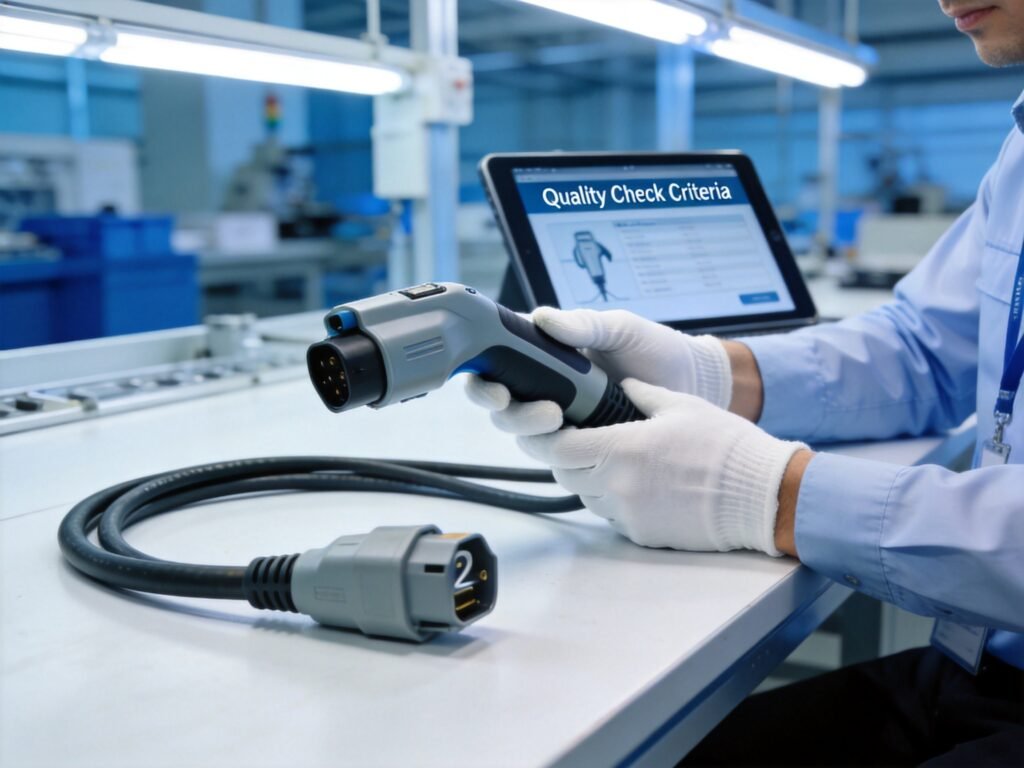
EV Charging Equipment Quality Checklist: 10 Must-Verify Points Before Placing a Bulk Order
The European EV charging market is accelerating at an unprecedented pace. According to the European Alternative Fuels Observatory (EAFO), publicly accessible recharging points across the EU reached 1,155,861 by May 2026 — a 19.1% year-on-year increase. With the Alternative Fuels Infrastructure Regulation (AFIR) mandating rapid infrastructure expansion, B2B buyers face growing pressure to source reliable equipment fast.
But speed should never come at the expense of quality. A single defective batch of charging guns or cables can trigger warranty claims, reputational damage, and regulatory penalties that far exceed the initial purchase price. This checklist gives procurement managers, distributors, and fleet operators 10 critical verification points to evaluate before signing a bulk purchase order for EV charging equipment.
European Market Flash
Battery-electric vehicles captured 20% of the EU new car market in the first five months of 2026, with 950,521 BEV registrations — up 35.7% year-on-year, according to ACEA. Italy (+75.7%), France (+55.4%), and Germany (+40.9%) led the surge, creating massive downstream demand for certified charging accessories.
1. CE and UKCA Certification Authenticity
CE marking is non-negotiable for the EU market; UKCA is required for Great Britain. However, not all certificates are equal. Request the original test reports — not just the certificate PDF — and verify them against the issuing body’s database. Authentic certifications are issued by accredited labs such as TÜV, SGS, or Intertek. Ask for the report number and cross-check it on the certifier’s website.
If a supplier cannot provide verifiable test reports within 48 hours, treat it as a red flag. For a detailed breakdown of what each certification covers, read our certifications guide.
2. Compliance with IEC 61851 and IEC 62196 Standards
The International Electrotechnical Commission (IEC) publishes the global standards that underpin EV charging safety. IEC 61851 covers the charging system’s electrical performance, while IEC 62196 defines connector dimensions and pin configurations. Your supplier must demonstrate full compliance with the latest editions — particularly IEC 61851-1:2019+A1:2024 for AC charging and IEC 61851-23 for DC applications.
Request the Declaration of Conformity and confirm it references the correct standard versions. Outdated references (e.g., IEC 61851-1:2010 without amendments) indicate the supplier has not kept up with regulatory changes.
3. Material Quality: Cable Gauge, Insulation, and Connector Pins
The physical build quality of charging cables and connectors directly determines product lifespan. Key parameters to verify:
- Conductor material: Pure copper (not copper-clad aluminum) with the correct cross-sectional area for the rated current.
- Insulation layer: Must use flame-retardant, UV-resistant materials rated for -30°C to +70°C operating temperatures.
- Connector pins: Copper alloy with silver plating thickness ≥ 3μm to ensure low contact resistance and long mating cycle life (minimum 10,000 cycles).
- Housing material: PC/ABS blend or PA66 with glass fiber reinforcement, meeting UL 94 V-0 flame rating.
Ask for material datasheets and third-party test reports for each component. Reputable product lines will include full material traceability documentation.
4. IP Rating and Environmental Testing
EV charging equipment operates in diverse weather conditions. For outdoor deployment across European climates, verify the following:
- IP54 minimum for charging guns and portable units (dust and splash protection).
- IP65 or higher for fixed installations in exposed locations.
- Operating temperature range: Confirm the rated range covers at least -25°C to +50°C for Northern and Southern European deployment.
- UV resistance testing: At minimum 1,000 hours of accelerated weathering per ISO 4892-2.
Request the actual test certificates from an accredited laboratory — not just the supplier’s self-declaration.
5. Electrical Safety Protection Features
A quality charging gun or portable charger must integrate multiple layers of electrical protection. Verify the product includes:
- Residual Current Device (RCD) protection — Type A minimum, Type B recommended for DC-capable units
- Over-current and short-circuit protection
- Over-voltage and under-voltage protection
- Over-temperature shutdown with NTC thermistor monitoring
- CP (Control Pilot) and PP (Proximity Pilot) signal verification per IEC 61851
These are not optional add-ons — they are baseline safety requirements for any product carrying CE certification. If the spec sheet omits any of these, walk away.
6. OEM/ODM Capability and Customization Flexibility
For B2B buyers building their own brand or integrating charging products into a larger product line, OEM/ODM flexibility is essential. Evaluate the supplier on:
- Custom cable length and color options (standard European colors: black, orange, green)
- Branding options: logo printing, custom packaging, private labeling
- Ability to modify connector types (Type 2, CCS2, GB/T) for different target markets
- Minimum order quantities (MOQs) that align with your procurement cycle
A supplier offering comprehensive OEM/ODM services with low MOQs and fast turnaround gives you competitive agility — especially when responding to time-sensitive tenders.
7. Quality Management System Certification
Beyond product-level certifications, the manufacturer’s overall quality management system must be independently audited. Look for:
- ISO 9001:2015 — Baseline quality management certification
- IATF 16949:2016 — Automotive-grade quality management; essential if your end customers are OEMs or Tier 1 suppliers
- ISO 14001 — Environmental management (increasingly required in EU public tenders)
- ISO 45001 — Occupational health and safety management
These certifications demonstrate the factory operates with systematic process controls, reducing the risk of batch-level quality failures.
8. Production Capacity and Delivery Lead Time
Europe’s charging infrastructure rollout timeline does not wait for slow suppliers. Verify the manufacturer’s:
- Monthly production capacity for the specific product category you are ordering
- Standard lead time from order confirmation to ex-factory delivery
- Surge capacity — ability to increase output by 30-50% for urgent orders
- Warehouse and logistics partnerships for European delivery (DDP or CIF terms)
A reliable factory-direct supplier should offer 7-15 day delivery for standard orders. Anything longer than 30 days for stock items signals potential production bottlenecks.
9. Sample Testing and Pre-Production Approval Process
Never place a bulk order without first testing production samples. A structured sampling process should include:
- Pre-production samples (3-5 units) for functional and dimensional verification
- Production sample from the first batch for golden sample comparison
- Independent third-party testing (TÜV, SGS, or Intertek) if your order exceeds €50,000
- Clear acceptance criteria documented in the purchase agreement
This step adds 1-2 weeks to the procurement cycle but prevents costly disputes and returns down the line.
10. After-Sales Support and Warranty Terms
Quality does not end at delivery. Verify the supplier’s after-sales framework:
- Standard warranty period (12 months minimum; 24 months preferred for premium products)
- Defective rate guarantee (should be below 0.5% for quality manufacturers)
- Replacement or credit policy for DOA (Dead on Arrival) units
- Technical documentation package: user manuals, installation guides, compliance declarations
- Responsive communication — the supplier should reply to technical queries within 24 hours
Build these terms into your purchase contract. Suppliers unwilling to commit to after-sales terms in writing are signaling low confidence in their own product quality.
Why ChuangRui Checks Every Box
At ChuangRui (创瑞), quality is not a marketing slogan — it is engineered into every product we manufacture. Our EV charging guns, discharge guns, and portable charging accessories carry CE, UKCA, UL, and RoHS certifications, backed by IATF 16949 and ISO 9001 quality management systems.
With factory-direct pricing, full OEM/ODM customization, and 7-15 day standard delivery, we help European distributors, automotive aftermarket buyers, and fleet operators source with confidence. Every unit undergoes 100% electrical testing before shipment, and our defective rate consistently stays below 0.3%.
Ready to evaluate our products against this checklist? Contact our team — we will send you the complete certification package, product datasheets, and a sample quotation within 24 hours.
Get in Touch
Chat on WhatsApp — +86 13757774567 — Quick questions? Our team replies within 2 hours.
https://wa.me/8613757774567
Request our certification package
/contact-us-4/
Request a quote — 24h response
/contact-us-4/
#EVCharging #QualityChecklist #B2B #OEM #EVCharger #ChargingGun #Type2Connector #Procurement
📚 References
Frequently Asked Questions
❓ What are the 10 quality verification points?
IATF 16949 cert, CE/UL reports, PCB design ownership, IQC process, 100% hi-pot, thermal data, IP verification, 24hr burn-in, AQL 2.5 OQC, 3-year warranty.
❓ How to verify IATF 16949?
Check IATF registrar database, request certificate with scope details, verify current status (3-year cycle with annual audits).
❓ What sampling standard to use?
AQL 2.5 per ISO 2859-1 (Level II). For 1000 units: sample 80, accept if 5 or fewer defects. Safety parameters: 100% inspection.
❓ What warranty terms to require?
Min 3-year comprehensive: response <48hrs, replacement shipping terms, field failure threshold >3% triggers batch replacement, firmware updates 5+ years.
❓ Should I request factory audit?
Yes for orders >$50K. Focus: SMT quality, testing calibration, IQC/OQC, warehouse, traceability. Third-party audits add objectivity.

About the CREVCC Engineering Team
Our engineering team brings 12+ years of experience in EV charging system design, from PCB layout and power electronics to international certification compliance.


