Key Takeaway for B2B Buyers
Three levels: V2L (power devices), V2H (power home), V2G (sell to grid). V2L discharge guns growing 200%+ YoY in Europe.
EV Discharge Gun Technology Explained: V2L, V2G & Bidirectional Charging for B2B Buyers
The EV charging industry is evolving beyond one-way energy delivery. As vehicle batteries grow larger and grid infrastructure faces mounting pressure, discharge gun technology has emerged as a critical product category — transforming electric vehicles from simple transportation into mobile power stations. For B2B buyers sourcing EV charging equipment, understanding discharge gun specifications, bidirectional charging standards, and real-world applications is now essential.
At ChuangRui, we manufacture portable charging guns, discharge guns, and dual-head charging guns with full CE, UKCA, and UL certifications — ready for the European and global markets.
European Market Brief
The EU’s Alternative Fuels Infrastructure Regulation (AFIR) continues to accelerate charging deployment across the TEN-T network, with CCS2 confirmed as the mandatory DC fast-charging standard. Meanwhile, the European Commission’s updated Battery Regulation introduces sustainability requirements that extend to bidirectional charging compatibility — opening new demand for certified discharge equipment.
What Is an EV Discharge Gun?
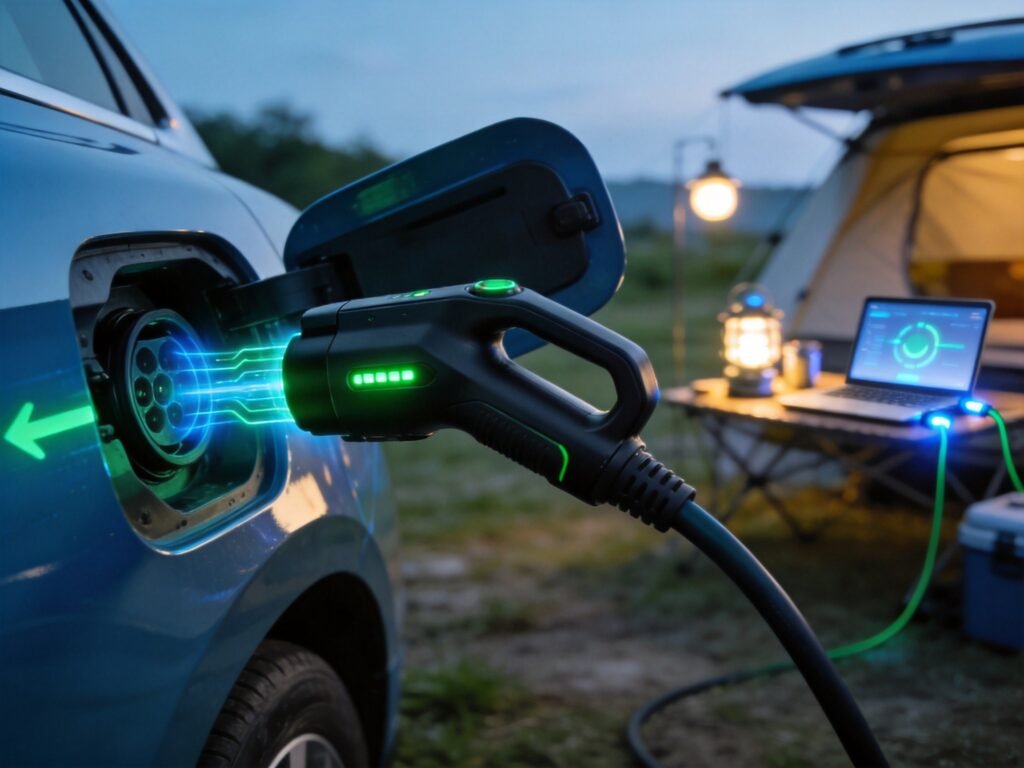
An EV discharge gun is a device that connects to an electric vehicle’s charging port (typically the CCS or Type 2 port) and enables the vehicle’s battery to supply power outward — rather than receiving it. Think of it as reversing the charging process: instead of grid-to-vehicle, energy flows from vehicle-to-load (V2L), vehicle-to-grid (V2G), or vehicle-to-home (V2H).
Technically, the discharge gun uses an internal inverter module to convert the vehicle’s high-voltage DC battery output into standard 220V/50Hz AC power with pure sine wave output. This means it can power household appliances, industrial tools, medical equipment, and even temporary event infrastructure — all sourced from the vehicle’s battery.
Key technical parameters that B2B buyers should evaluate include:
- Output power rating: Typically 3.3 kW to 60 kW, depending on application
- Connector compatibility: CCS2 (European standard), Type 2 AC, or GB/T for Asian markets
- Communication protocol: Must comply with IEC 61851-1 and vehicle BMS protocols for safe authorization
- Waveform quality: Pure sine wave output (THD < 3%) for sensitive electronics
- Safety certifications: CE, UKCA, UL listing for market access
V2L, V2G & V2H: Three Applications, One Technology Platform
Bidirectional charging encompasses several use cases, each with distinct B2B demand signals:
Vehicle-to-Load (V2L)
V2L is the most mature application. The discharge gun plugs into the vehicle’s CCS port and provides standard AC outlets for external devices. Use cases include:
- Emergency roadside assistance: Power diagnostic equipment, lights, and tools directly from a service vehicle’s battery
- Outdoor events and construction: Supply temporary power where grid access is unavailable
- Fleet operations: Logistics companies using EV vans as mobile power sources for last-mile delivery equipment
For distributors and fleet operators, V2L-capable discharge guns represent a high-margin accessory category with growing demand.
Vehicle-to-Grid (V2G)
V2G enables electric vehicles to feed energy back into the power grid during peak demand periods. This creates revenue opportunities for fleet operators who can sell stored energy at premium rates. The technology requires advanced communication protocols (ISO 15118-20) and grid-compatible inverters — and it is rapidly gaining regulatory support across Europe.
Several European countries have already launched V2G pilot programs, and the updated EU Battery Regulation explicitly encourages bidirectional charging compatibility. For charging equipment distributors, V2G-ready discharge guns will become a standard product requirement within the next 2-3 years.
Vehicle-to-Home (V2H)
V2H allows the vehicle to power an entire household during outages or peak tariff periods. While V2H requires integration with home energy management systems, the discharge gun is the physical interface that makes it possible. In markets like Germany, Italy, and the UK, V2H adoption is accelerating alongside residential solar installations.
Technical Standards and Safety Requirements
B2B buyers must ensure that any discharge gun they source meets the following standards:
| Standard | Coverage | Why It Matters |
|---|---|---|
| IEC 61851-1 | General EV charging system requirements | Defines communication protocols between vehicle and equipment |
| IEC 62196-2 / -3 | Connector specifications (Type 2, CCS2) | Ensures physical compatibility with European vehicles and infrastructure |
| IEC 61851-23-1:2026 | DC EV supply equipment with automated connection | New standard covering automated and bidirectional DC systems |
| EN 61000-6-3 / -4 | EMC requirements | Mandatory for CE marking in the EU |
| UL 2202 / UL 2594 | EV charging equipment safety (North America) | Required for market entry in the US and Canada |
ChuangRui’s discharge guns carry CE, UKCA, and UL certifications, manufactured under IATF 16949 quality management. Every unit undergoes full protocol validation against vehicle BMS systems before shipment — the complete certification package is available on request.
Why Discharge Guns Are a High-Growth Product Category for 2026-2028
Several converging trends make discharge guns a strategic product line for EV charging distributors and fleet operators:
- Regulatory push: The EU Battery Regulation and national V2G pilot programs are creating mandatory demand for bidirectional equipment.
- Fleet electrification: As commercial fleets transition to electric vans and trucks, the ability to use vehicles as mobile power sources becomes a competitive advantage.
- Emergency preparedness: Climate-related power outages are increasing across Europe, driving demand for vehicle-based backup power solutions.
- Consumer expectation: Modern EVs like the Hyundai Ioniq 5, Kia EV6, and Ford F-150 Lightning already ship with V2L capability — buyers expect compatible discharge accessories.
- Aftermarket revenue: Discharge guns are high-margin accessories with low return rates, ideal for distributors seeking to expand their product catalogs.
For OEM/ODM partners, ChuangRui offers customizable discharge gun solutions including branded housing, custom connector configurations, and firmware adaptation for specific vehicle BMS protocols. Our full product range covers portable charging guns, discharge guns, and dual-head charging guns — all with 7-15 day delivery.
What B2B Buyers Should Look for in a Discharge Gun Supplier
When evaluating discharge gun manufacturers, prioritize these criteria:
- Certification completeness: Ensure the supplier holds CE, UKCA, and UL certifications — not just product-level but factory-level (IATF 16949, ISO 9001)
- Protocol compatibility: The supplier must validate discharge gun communication against major European EV platforms (VW Group, Stellantis, BMW, Mercedes, Hyundai-Kia)
- OEM customization: Look for suppliers offering branded enclosures, custom cable lengths, and firmware adaptation
- Quality assurance: Request test reports for output waveform quality, thermal performance, and IP rating verification
- Delivery capability: For European distributors, factory lead times of 7-15 days are critical for maintaining stock levels
Get Certified Discharge Guns from ChuangRui
ChuangRui is a factory-direct manufacturer of portable EV charging guns, discharge guns, and dual-head charging guns with full international certifications. We support OEM/ODM customization and offer competitive pricing for volume orders.
Chat on WhatsApp — +86 13757774567 — Quick questions? Our team replies within 2 hours. Start a conversation
Request our certification package — CE, UKCA, UL, IATF 16949 documentation available. Contact us
Request a quote — 24h response guaranteed. Get pricing now
#EVDischargeGun #V2L #V2G #BidirectionalCharging #EVCharger #OEM #B2B #ChuangRui
📚 References
Frequently Asked Questions
❓ What is V2L?
Vehicle-to-Load: EV powers external devices through a discharge gun (230V, up to 3.6kW). For camping, tools, emergency backup.
❓ Difference between V2L, V2H, V2G?
V2L: power devices. V2H: power entire home via bidirectional wallbox. V2G: sell electricity to grid during peak demand.
❓ What products for this market?
V2L discharge guns (fastest growth), bidirectional wallbox (emerging), V2G DC chargers (future). Start with V2L guns.
❓ Are V2L guns compatible with all EVs?
No – vehicle must support bidirectional discharge (BYD, Hyundai/Kia, some VW). Discharge gun must match connector (CCS2 for Europe).
❓ What certifications needed?
CE (LVD+EMC+RoHS), IEC 61851-1 bidirectional compliance, thermal protection, vehicle-specific compatibility testing.

About the CREVCC Engineering Team
Our engineering team brings 12+ years of experience in EV charging system design, from PCB layout and power electronics to international certification compliance.


