Key Takeaway for B2B Buyers
ISO/IEC 14543 (June 2026) introduces new smart charging communication requirements for EVSE. Products compliant with this standard will have a competitive edge in EU tenders.
New ISO/IEC 14543 EVSE Smart Charging Standards: What B2B Buyers Must Know About the June 2026 Release
In June 2026, the International Organization for Standardization (ISO) and the International Electrotechnical Commission (IEC) published two landmark standards that redefine how EV charging equipment communicates with smart home energy systems. For B2B buyers sourcing portable charging guns, discharge guns, and dual-head connectors for the European market, these new protocols will shape procurement specifications for years to come.
This guide breaks down what ISO/IEC 14543-4-303:2026 and ISO/IEC 14543-4-304:2026 mean for your business — and why choosing a certification-compliant manufacturer like ChuangRui matters more than ever.
European Market Flash
The European EV market continues its rapid expansion: BEV registrations reached 950,521 units between January and May 2026, representing a 20% market share. As charging infrastructure scales across the continent, interoperability between EV supply equipment (EVSE) and home energy management systems is becoming a top priority for regulators, charge point operators, and procurement managers alike.
What Are ISO/IEC 14543-4-303 and 14543-4-304?
Published in June 2026 under the Home Electronic System (HES) architecture framework, these two new international standards define application-layer communication protocols for EV charging equipment:
ISO/IEC 14543-4-303:2026 establishes the application protocol for communication between EVSE chargers and their controllers. Built on the Network Enhanced Communications Device (NECD) protocol, it ensures that charging equipment from different manufacturers can interoperate seamlessly within residential and commercial smart energy ecosystems. The standard specifies message structures, command sequences, timeout management, and mandatory property sets for both chargers and controllers.
ISO/IEC 14543-4-304:2026 extends the framework to cover bidirectional EVSE equipment — devices capable of both charging and discharging (Vehicle-to-Home and Vehicle-to-Grid). Published on June 30, 2026, this standard introduces new NECD objects for dischargeable capacity, charge/discharge state management, and dual-operational status reporting. It is a foundational protocol for the V2G and V2H applications that European grid operators are actively piloting.
Both standards operate over UDP using IPv4 or IPv6 (TCP is optional), ensuring low-latency, high-reliability communication suitable for real-time energy management scenarios.
Why These Standards Matter for B2B Buyers
If you are a European distributor, fleet operator, or charge point operator procuring EV charging equipment, these standards have direct implications for your sourcing strategy:
1. Interoperability is becoming mandatory. As smart home and commercial energy management systems proliferate, charge point operators (CPOs) will increasingly require equipment that conforms to standardized communication protocols. Non-compliant products risk exclusion from tenders and procurement frameworks.
2. Bidirectional charging is moving from pilot to production. The EU Battery Regulation (2023/1542) explicitly supports bidirectional charging capabilities. ISO/IEC 14543-4-304 provides the protocol foundation that makes V2G/V2H deployments reliable and interoperable. Buyers should begin specifying bidirectional readiness in RFQs.
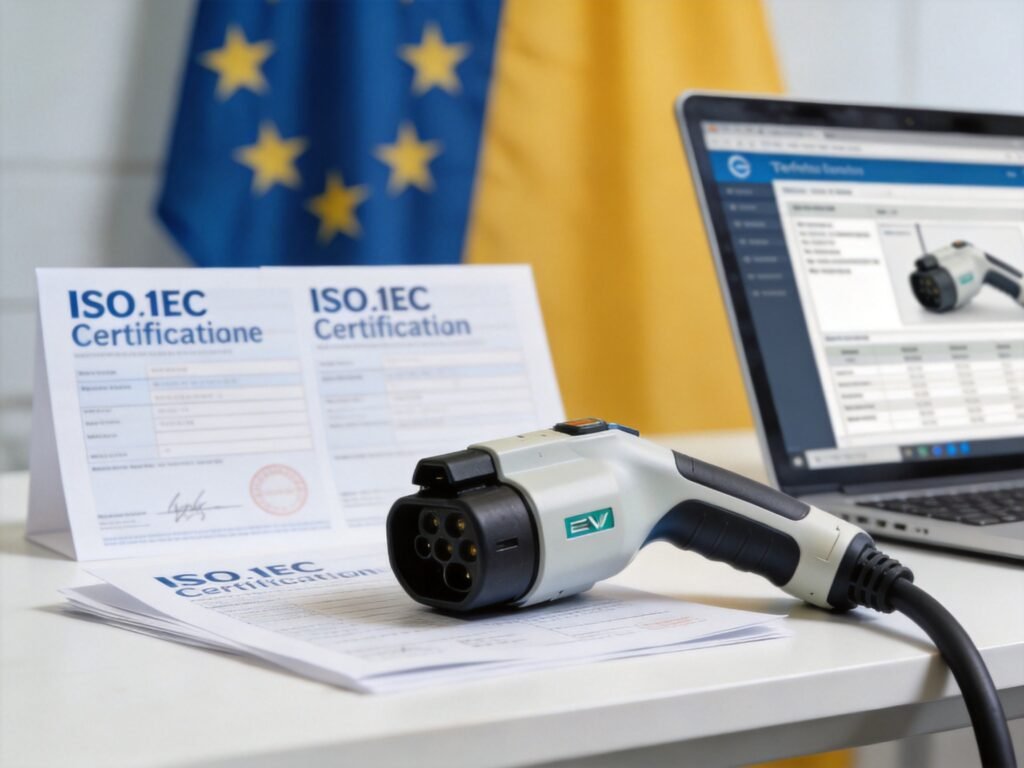
3. Certification stacking is the new baseline. European procurement now demands a comprehensive certification portfolio: CE marking, UKCA for the UK market, IEC 61851 and IEC 62196 for electrical safety, and increasingly, compliance with emerging communication standards like the ISO/IEC 14543 series. Manufacturers who invest early in multi-standard compliance gain a competitive edge.
4. Future-proofing reduces total cost of ownership. Equipment designed to align with these standards can be integrated into evolving smart grid and home automation ecosystems without costly retrofits. For large-scale deployments, this translates into significant long-term savings.
How ChuangRui Is Preparing for the New Smart Charging Standards
At ChuangRui, we track international standards developments closely to ensure our product portfolio stays ahead of regulatory requirements. Our current preparation includes:
Protocol-ready product design. Our portable charging guns and discharge guns are engineered with modular communication interfaces, enabling future firmware upgrades to support NECD-based protocols as adoption timelines crystallize across European markets.
Comprehensive certification stack. Every ChuangRui product carries CE, UKCA, UL, RoHS, and REACH certifications. Our manufacturing facility holds IATF 16949 and ISO 9001/14001/45001 certifications, ensuring that quality management processes meet the most rigorous international benchmarks. Explore our full certifications portfolio for details.
OEM/ODM flexibility. Through our OEM/ODM services, we can customize communication protocol implementations to match your specific integration requirements — whether you need OCPP compatibility, ISO 15118 Plug & Charge support, or upcoming NECD protocol alignment.
Browse our complete product range to see how ChuangRui’s Type 2 charging guns, CCS2 connectors, and bidirectional discharge guns are built for the next generation of European charging infrastructure.
Procurement Action Items: What to Do Now
For B2B buyers evaluating EV charging equipment suppliers, here are practical steps to take in light of these new standards:
Update your technical specifications. Add references to ISO/IEC 14543-4-303 and 14543-4-304 in upcoming RFQs, even if compliance is not yet mandatory. This signals to suppliers that interoperability is a priority and helps you identify forward-thinking manufacturing partners.
Audit your current supplier’s standards roadmap. Ask your existing suppliers about their plans for aligning with the new HES architecture protocols. Manufacturers who are unaware of these standards may struggle to support your long-term product requirements.
Prioritize bidirectional readiness. With the EU Battery Regulation and national V2G pilot programs accelerating across Europe, specifying discharge-capable equipment today positions your infrastructure for tomorrow’s energy market.
Verify the full certification portfolio. Smart communication protocols are only one layer. Ensure your supplier also meets CE/UKCA safety requirements, IEC 61851/62196 electrical standards, and maintains a certified quality management system (ISO 9001 or IATF 16949).
The Bottom Line
The June 2026 publication of ISO/IEC 14543-4-303 and 14543-4-304 marks a turning point for EV charging interoperability. These standards lay the groundwork for a future where charging equipment from any manufacturer communicates seamlessly with home energy systems, commercial building management platforms, and grid operator networks.
For B2B buyers, the message is clear: start specifying smart communication compliance today, partner with manufacturers who invest in standards readiness, and build infrastructure that can evolve with the rapidly changing European energy landscape.
ChuangRui is committed to staying at the forefront of these developments. Our team is ready to support your procurement needs with certified, future-ready EV charging solutions — backed by factory-direct pricing and 7-15 day delivery across Europe.
Get in Touch
Chat on WhatsApp — +86 13757774567 — Quick questions? Our team replies within 2 hours.
Start a WhatsApp conversation
Request our certification package
Contact us to receive CE, UKCA, UL, and IEC test reports
Request a quote — 24h response
Send your specifications and receive a detailed quotation
#EVCharger #EVSEStandards #ISO14543 #BidirectionalCharging #V2G #OEM #B2B #ChuangRui
📚 References
Frequently Asked Questions
❓ What is ISO/IEC 14543?
ISO/IEC 14543 is the international standard for communication between EVSE and energy management systems. The June 2026 release adds smart charging requirements including dynamic load management and grid response signals.
❓ How does ISO/IEC 14543 differ from OCPP?
OCPP manages charger-to-back-end communication. ISO/IEC 14543 focuses on charger-to-grid interaction – how the charger responds to grid signals and manages load dynamically.
❓ Is ISO/IEC 14543 mandatory in Europe?
Not yet mandatory, but increasingly referenced in EU-funded tenders. Compliant products will have preference in public procurement.
❓ What product modifications are needed?
Smart chargers need: standardized communication interface, dynamic power adjustment, energy metering accuracy class 1.0, and firmware upgradeability.
❓ Should buyers require compliance now?
Yes – specify it in RFQs as future-proofing. Suppliers who comply now will have shorter lead times when it becomes de facto required.

About the CREVCC Engineering Team
Our engineering team brings 12+ years of experience in EV charging system design, from PCB layout and power electronics to international certification compliance.


