Key Takeaway for B2B Buyers
For serious B2B brands: OEM (your design, our manufacturing) protects your IP and brand differentiation. ODM (our design, your brand) is faster and cheaper but creates product homogeneity. Most successful EV charger brands start with ODM and migrate to OEM.
OEM vs ODM EV Charging Equipment: A B2B Buyer’s Guide to Choosing the Right Manufacturing Model
With BYD officially surpassing Tesla in European EV sales in July 2026 and the EU-UK extending rules-of-origin deadlines for electric vehicles through year-end, the conversation among B2B buyers has shifted from “should we stock EV charging accessories?” to “how do we build a competitive, compliant product line?” Whether you are a European charging station distributor expanding into portable chargers, an automotive aftermarket company adding EV accessories, or a fleet operator evaluating bulk procurement, one decision will shape your entire supply chain strategy: OEM or ODM?
This guide breaks down both manufacturing models with a specific focus on EV charging equipment — portable charging guns, discharge guns, and dual-head connectors — so you can choose the path that fits your budget, timeline, and brand ambitions.
European Market Brief: Why the OEM vs ODM Question Matters Now
According to ACEA data, battery electric vehicles captured 20.7% of the European market in H1 2026, with combined electrified sales (BEV + PHEV) surpassing conventional fuel vehicles for the first time at 30.5%. Meanwhile, the EU’s new Zero Emission Vehicle framework and the proposed Industrial Accelerator Act are introducing stricter Union-origin requirements for publicly procured EV products. For B2B buyers, this means your choice of manufacturing partner directly affects not only product quality and cost — but also compliance eligibility.
OEM Explained: You Design, the Factory Builds
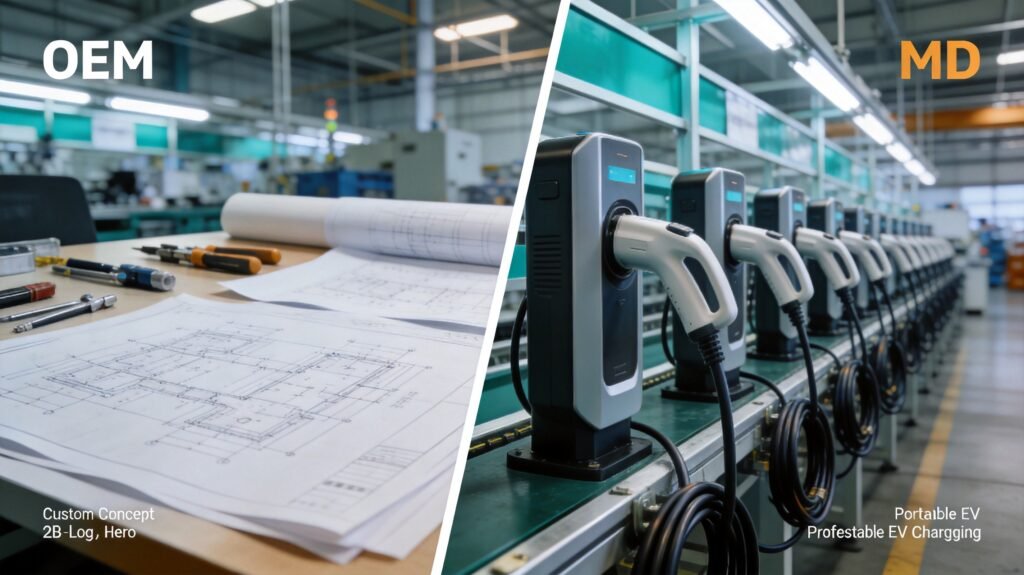
Original Equipment Manufacturing (OEM) means you provide the complete product design — blueprints, material specifications, tooling drawings, and quality standards — and the factory manufactures exactly to your blueprint. The finished product carries your brand, and you retain full ownership of the design intellectual property.
In the EV charging equipment context, an OEM arrangement might look like this:
- You design a proprietary 32A three-phase portable charging gun with a custom housing shape, proprietary PCB layout, and specific cable gauge requirements.
- You provide the mold files, BOM (Bill of Materials), and testing criteria to the factory.
- The factory produces units that meet your exact specifications, and only you can sell that design.
When OEM makes sense for EV charging equipment:
- You have an established engineering team with detailed product specifications.
- You need product differentiation — a unique form factor, proprietary smart features, or custom firmware for load management.
- You are targeting certifications (CE, UKCA, UL) under your own brand name and need full control over component selection.
- Your order volumes justify the upfront tooling investment, typically 1,000–5,000+ units per SKU.
Key considerations: OEM development timelines typically run 4–8 months from design finalization to first production batch. Upfront costs include custom molds ($5,000–$50,000+), certification testing fees, and iterative sampling rounds. However, per-unit costs decrease significantly at scale, and you maintain exclusive rights to the design.
ODM Explained: The Factory Designs, You Brand
Original Design Manufacturing (ODM) means the supplier already has proven product designs, molds, and production lines. You select from their existing catalog, customize branding elements (logo, color, packaging), and the factory handles both design and production.
For EV charging equipment, an ODM scenario might involve:
- You choose a factory’s existing 16A Type 2 portable charger design that already holds CE and RoHS certifications.
- You customize the housing color, add your logo via silk-screen or laser engraving, and design your retail packaging.
- The factory ships branded units ready for your distribution channels within weeks.
When ODM makes sense for EV charging equipment:
- You are entering the EV charging market and need speed-to-market over product uniqueness.
- Your business model focuses on distribution and branding rather than product engineering.
- You want to test market demand before committing to custom tooling investment.
- Your initial order quantities are in the 100–500 unit range per SKU.
Key considerations: ODM lead times are typically 1–3 months from selection to shipment. Upfront investment is minimal since molds and designs already exist. However, the same platform may be available to other buyers in your market unless you negotiate exclusivity — which often carries a premium.
Side-by-Side Comparison: OEM vs ODM for EV Charging Products
| Factor | OEM | ODM |
|---|---|---|
| Design Ownership | Buyer owns all design rights | Supplier owns design; buyer licenses |
| Upfront Investment | $5,000–$50,000+ (molds, tooling, sampling) | Minimal to zero |
| Development Timeline | 4–8 months | 1–3 months |
| Customization Level | Full control over every detail | Limited to available options (color, logo, packaging) |
| MOQ | Typically 1,000–5,000+ units | Often 100–500 units |
| IP Protection | Strong — buyer retains all IP | Moderate — design may be sold to multiple buyers |
| Certification Path | Buyer-driven; full control over component selection | Supplier provides baseline certifications; buyer adds branding-specific marks |
| Best For | Established brands with engineering capacity | Distributors, startups, market testers |
How to Decide: 5 Questions Every EV Charging Equipment Buyer Should Ask
1. Do you have in-house engineering capability for EV charging products?
If your team can produce detailed CAD files, PCB schematics, and a validated BOM for a charging gun or portable charger, OEM is viable. If not, ODM lets you leverage the factory’s R&D immediately.
2. What is your target timeline for market launch?
If you need product on shelves within one quarter, ODM is the practical choice. If you are planning a 6–12 month product development cycle, OEM gives you time to create something differentiated.
3. How important is product exclusivity in your market?
European distributors selling to utilities or fleet operators often need unique specifications to stand out. OEM delivers exclusivity. ODM works better when your competitive advantage comes from service, pricing, or brand reputation rather than product uniqueness.
4. What certifications do you need, and who holds them?
Under the EU’s Delegated Regulation (EU) 2025/656, all new or renovated charging points installed after January 2026 must comply with updated EN IEC 62196 connector standards. In an OEM model, you control which components are specified to meet these standards. In an ODM model, verify that your supplier’s existing certifications cover the specific standards your target markets require — CE for the EU, UKCA for the UK, UL for North America.
5. What are your volume projections for the first 12 months?
If you project under 1,000 units across all SKUs in year one, ODM minimizes financial risk. If you have confirmed purchase orders or framework agreements totaling several thousand units, the OEM investment pays for itself quickly through lower per-unit costs.
ChuangRui’s Approach: Full-Capability OEM and ODM Under One Roof
At ChuangRui, we support both OEM and ODM models for our complete range of EV charging equipment — portable charging guns (16A/32A, single/three-phase), V2L discharge guns, and dual-head connectors. Our IATF 16949-certified production lines, combined with CE, UKCA, UL, and RoHS compliance, mean you can start with ODM to validate your market and transition to OEM as volumes grow — without changing suppliers. For more details, explore our guide on dual-head EV charging gun. To learn more about this topic, see our article on dual-head EV charging gun.
Whether you need a fully custom 32A three-phase charging gun with your proprietary load-management firmware, or a proven 16A Type 2 portable charger with your brand and packaging, our team delivers within 7–15 days for standard configurations.
Explore our product range, learn about our OEM/ODM services, review our certifications, or contact our team to discuss your project. Visit our company page to understand our manufacturing capabilities.
Ready to Start Your EV Charging Equipment Project?
Chat on WhatsApp — +86 13757774567 — Quick questions? Our team replies within 2 hours.
https://wa.me/8613757774567
Request our certification package — CE, UKCA, UL, RoHS, REACH, IATF 16949 documentation for your compliance records.
Contact us to receive the package
Request a quote — 24h response, with detailed pricing for both OEM and ODM configurations.
Submit your RFQ here
#EVCharger #OEM #ODM #B2B #PortableEVCharger #EVChargingEquipment #ChargingGun #ElectricVehicle
📚 References
Frequently Asked Questions
❓ What is the difference between OEM and ODM for EV charging equipment?
OEM (Original Equipment Manufacturing): the buyer provides the design, and the factory manufactures to spec. ODM (Original Design Manufacturing): the factory provides the base design, and the buyer customizes branding/packaging/minor features.
❓ Which model is better for building a differentiated EV charger brand?
OEM is superior for brand differentiation — you control the product design, features, and IP. However, OEM requires higher upfront investment in design, prototyping, and tooling (typically $20,000–$80,000).
❓ What are the risks of ODM for EV charging equipment?
ODM products are widely available — multiple brands may sell identical hardware. This limits pricing power and makes your product vulnerable to direct price competition. Additionally, ODM factories may share your customizations with competitors.
❓ Can I start with ODM and transition to OEM later?
Yes, this is the most common path. Start with ODM to test the market, build distribution channels, and generate revenue. Then invest in OEM for your next-generation product line. The transition typically happens at 2,000–5,000 units/year volume.
❓ How do I protect my OEM design when working with a Chinese factory?
Sign a comprehensive NNN agreement (Non-Disclosure, Non-Use, Non-Circumvention) under Chinese law — not just an NDA under Western law. Register your IP with China’s State Intellectual Property Office. Use IATF 16949-certified factories with proven IP protection track records.

About the CREVCC Engineering Team
Our engineering team brings 12+ years of experience in EV charging system design, from PCB layout and power electronics to international certification compliance. We design and manufacture portable EV chargers, charging guns, and V2L discharge equipment for B2B partners across Europe, North America, and Southeast Asia.


